GEO vs AEO vs LLMO: The Three Terms, Defined
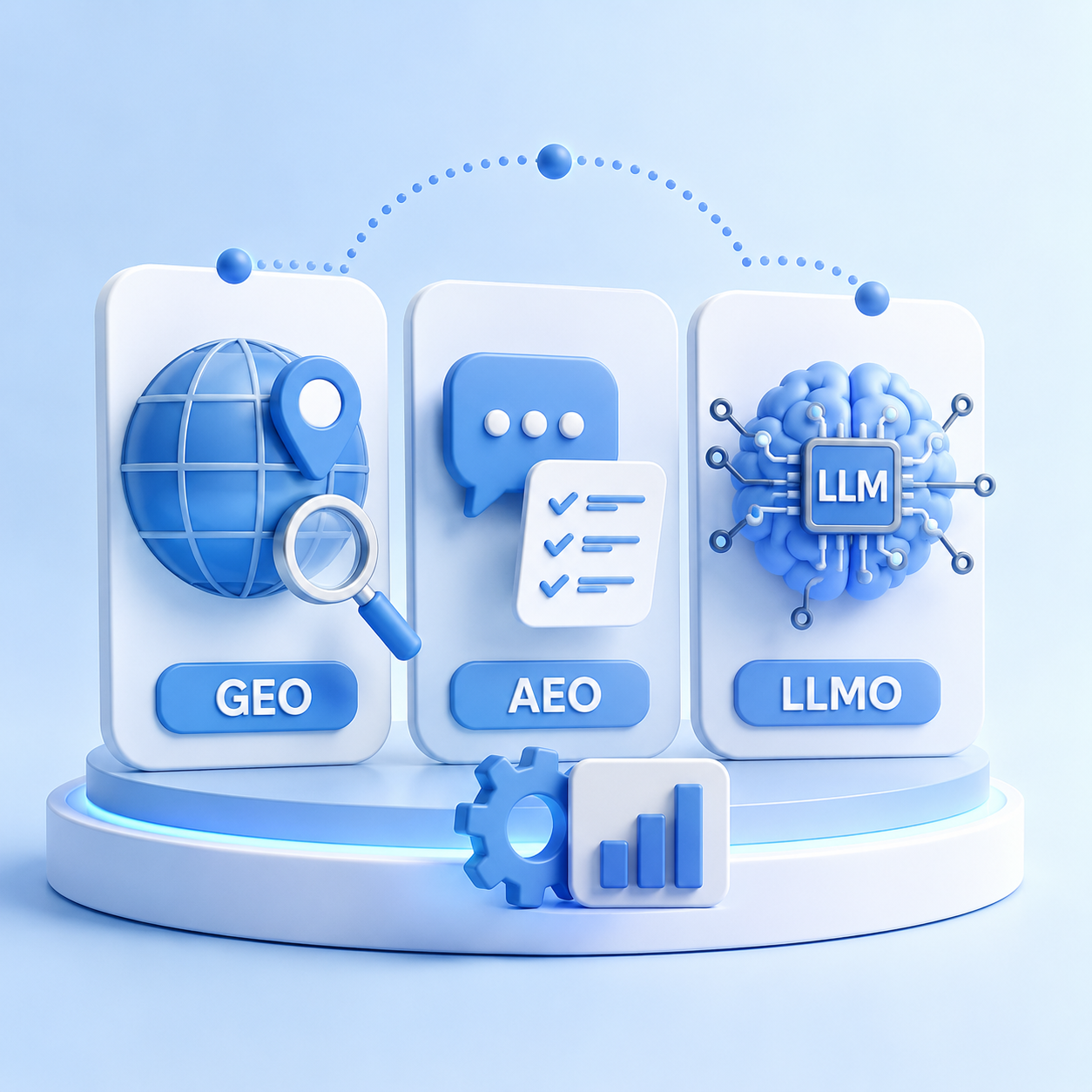
GEO, AEO, and LLMO are related but not the same. Each shapes a different part of how AI systems find, answer, and recommend information in 2026.
Why this matters more than most businesses realize
Search behavior has changed significantly
Buyers increasingly use AI tools during research and decision-making. Instead of clicking through multiple search results, they ask questions and receive synthesized recommendations. Understanding the differences between GEO, AEO, and LLMO helps marketing teams allocate resources more effectively and build future-ready search strategies.
Quick answer
Three terms, three different visibility problems
While these disciplines overlap, each addresses a distinct aspect of modern AI-driven visibility.
GEO
Optimizes for visibility inside AI-generated responses and recommendations.
AEO
Optimizes for becoming the preferred, directly extractable answer.
LLMO
Optimizes for how large language models understand and represent your brand over time.
Generative Engine Optimization
Defining GEO
Primary Objective: Increase the likelihood that content is cited, referenced, or recommended by generative AI systems.
Typical Use Case
A B2B software company may invest in GEO to ensure its product is referenced when users ask AI systems for CRM recommendations or marketing automation solutions.
Platforms Involved
- ChatGPT
- Gemini
- Perplexity
- Claude
- Google AI Overviews
Key Optimization Techniques
- Building topical authority
- Creating highly citable content
- Publishing original insights
- Strengthening entity recognition
- Improving content structure
Success Metrics
Answer Engine Optimization
Defining AEO
Primary Objective: Provide direct, accurate answers that can be extracted and displayed to users.
Typical Use Case
A healthcare provider may optimize content around questions such as "What are the symptoms of dehydration?" to improve visibility in answer-driven search experiences.
Common Environments
- Featured snippets
- Voice assistants
- Google AI Overviews
- Search engine answer boxes
- Conversational search interfaces
Key Optimization Techniques
- FAQ development
- Question-based content
- Direct-answer formatting
- Schema markup
- Structured content organization
Success Metrics
Large Language Model Optimization
Defining LLMO
Primary Objective: Improve how large language models interpret, retrieve, and reference information about entities, topics, and brands.
Typical Use Case
An enterprise software company may use LLMO techniques to ensure AI systems consistently understand its products, services, expertise, and competitive positioning.
Core Areas
- Entity optimization
- Knowledge representation
- Content retrievability
- Brand discoverability
- AI understanding
How LLMO Differs
- Traditional optimization focuses on rankings or answer visibility
- LLMO focuses on how AI systems learn, understand, and retrieve information over time
Success Metrics
Side-by-side comparison
GEO vs AEO vs LLMO at a glance
| Category | GEO | AEO | LLMO |
|---|---|---|---|
| Primary Goal | Visibility in AI-generated responses | Become the preferred answer | Improve AI understanding and retrieval |
| Target Platforms | ChatGPT, Gemini, Perplexity, Claude, AI Overviews | Search engines, answer engines, voice assistants | Large language models and AI ecosystems |
| Search Experience | AI-generated recommendations | Direct answers | Knowledge representation |
| User Intent | Research and discovery | Immediate information needs | Long-term discoverability |
| Content Strategy | Authority-driven content | Question-answer content | Entity-rich information |
| Optimization Focus | AI citations and mentions | Answer selection | AI comprehension |
| Structured Data Usage | Supports context and authority | Supports answer extraction | Supports entity clarity |
| AI Citation Potential | Very high | Moderate to high | Indirect but influential |
| Entity Importance | High | Medium | Extremely high |
| Measurement Methods | AI citations and visibility | Snippets and answer appearances | Brand understanding and consistency |
| Success Metrics | Mentions, citations, recommendations | Answer ownership | Accurate AI representation |
| Typical Content Formats | Research, guides, comparisons | FAQs, definitions, how-to content | Knowledge assets and authoritative content |
| Technology Dependency | Generative AI systems | Answer engines and search systems | Large language models |
| Time to Results | Medium term | Short to medium term | Long term |
| Business Impact | AI recommendation visibility | Direct-answer visibility | Sustainable AI discoverability |
Where they overlap
Shared foundations across all three
These shared foundations explain why organizations often implement GEO, AEO, and LLMO together rather than treating them as separate initiatives.
High-Quality Content
All three depend on useful, accurate, and trustworthy information.
Topical Authority
Consistent expertise improves visibility across search and AI systems.
E-E-A-T
Experience, Expertise, Authoritativeness, and Trustworthiness remain important signals.
Entity Consistency
Clear and consistent brand information improves AI interpretation.
Structured Information
Well-organized content is easier for both search engines and AI systems to process.
User-Focused Content
Content must solve real problems and answer genuine questions.
Practical audit
Which strategy should you prioritize?
Prioritize AEO When
- Featured snippets are a major opportunity
- Voice search visibility matters
- Customers frequently ask informational questions
- FAQ-driven content performs well
Industries such as healthcare, education, and financial services often benefit significantly from AEO.
Prioritize GEO When
- You operate in B2B markets
- AI-generated recommendations influence buyers
- Research-heavy purchasing journeys are common
- Brand visibility in AI systems is a strategic goal
SaaS companies, consulting firms, and enterprise technology providers often see strong GEO opportunities.
Prioritize LLMO When
- Brand visibility inside AI systems is a long-term objective
- Knowledge graph development is important
- Entity authority needs improvement
- AI ecosystems are becoming key discovery channels
Organizations investing in long-term AI discoverability should pay particular attention to LLMO principles.
A unified framework
Build one AI search visibility system
Rather than choosing one approach, organizations should build a unified strategy that supports GEO, AEO, and LLMO objectives simultaneously.
Build Strong SEO Foundations
Ensure technical performance, content quality, and search visibility are established.
Structure Content for Answers
Create direct-answer sections, FAQs, definitions, and extractable content blocks.
Strengthen Entity Authority
Improve consistency across websites, profiles, publications, and external mentions.
Optimize for AI Citations
Develop authoritative content that AI systems can confidently reference.
Monitor AI Visibility Across Platforms
Track citations, mentions, recommendations, and answer appearances across major AI platforms.
Common misconceptions
What people get wrong about GEO, AEO, and LLMO
GEO and AEO Are Identical
They overlap but focus on different visibility outcomes.
LLMO Replaces SEO
LLMO complements SEO rather than replacing it.
AI Optimization Only Matters for Large Brands
Smaller organizations can succeed through expertise and authority.
Structured Data Alone Is Enough
Schema helps, but content quality and authority remain essential.
AI Search Will Replace Traditional Search Completely
Search is evolving into a hybrid ecosystem rather than replacing existing channels.
Frequently asked questions
Common questions about GEO, AEO, and LLMO
What is GEO?
GEO stands for Generative Engine Optimization. It focuses on improving visibility within AI-generated answers, recommendations, and citations across generative AI platforms.
What is AEO?
AEO stands for Answer Engine Optimization. It focuses on helping content become the preferred answer selected by search engines, answer engines, and voice assistants.
What is LLMO?
LLMO stands for Large Language Model Optimization. It focuses on improving how AI models understand, retrieve, and represent information about brands, entities, products, and topics.
What is the difference between GEO and AEO?
GEO focuses on visibility inside AI-generated responses, while AEO focuses on becoming the direct answer selected by search and answer systems.
Is LLMO Replacing SEO?
No. LLMO addresses AI understanding and discoverability, while SEO continues to support traditional search visibility and traffic acquisition.
Which Strategy Should Businesses Focus on First?
Most organizations should establish strong SEO foundations first, then expand into AEO, GEO, and LLMO initiatives based on business goals and audience behavior.
Conclusion
GEO, AEO, and LLMO represent different approaches to solving visibility challenges in an AI-driven world
AEO focuses on direct answers. GEO focuses on AI-generated recommendations and citations. LLMO focuses on how AI systems understand and represent information. Together, they create a broader framework for modern digital visibility.
As AI-powered discovery continues to grow, organizations that understand these distinctions will be better positioned to reach customers wherever research, discovery, and decision-making occur.
The future of search is not about choosing one approach. It is about building a balanced strategy that supports visibility across search engines, answer engines, and generative AI platforms.
Let's build your AI visibility strategy
As AI-powered discovery continues to evolve, organizations need strategies that improve visibility across search engines, answer engines, and generative AI platforms.
Kambaa helps businesses strengthen AI visibility through GEO, AI search optimization, content strategy, and broader digital transformation initiatives. A structured approach can help organizations build authority across the rapidly changing landscape of AI-driven discovery.