Multi-Tenant SaaS Architecture Services
Design scalable, secure, and cost-efficient SaaS platforms with modern multi-tenant architecture.
Building a successful SaaS product requires more than developing features. Long-term growth depends on architectural decisions that influence scalability, security, performance, operational efficiency, and customer experience.
Multi-Tenant SaaS Architecture enables organizations to serve multiple customers from a shared platform while maintaining tenant isolation, operational control, and infrastructure efficiency.
Kambaa helps SaaS companies, technology providers, startups, and enterprises design and implement modern multi-tenant platforms that support rapid growth, predictable operations, and enterprise-grade security.
Whether you are launching a new SaaS product, modernizing an existing platform, or migrating from a single-tenant architecture, our SaaS architects and engineering teams help create scalable foundations for long-term success.
Why SaaS Companies Choose Multi Tenant Architecture
Modern SaaS companies increasingly adopt multi-tenant architectures because they provide significant technical and business advantages.
Lower Infrastructure Costs
Shared infrastructure reduces the need to maintain separate environments for every customer.
Benefits include:
- Reduced cloud spending
- Improved resource utilization
- Lower operational costs
- Greater infrastructure efficiency
This creates a more sustainable business model as customer growth increases.
Easier Maintenance
Managing a single platform is significantly easier than maintaining hundreds or thousands of isolated deployments.
Benefits include:
- Simplified operations
- Reduced maintenance overhead
- Faster issue resolution
- Centralized management
- Improved engineering productivity
Faster Deployments
Updates can be deployed once and made available across the platform.
Benefits include:
- Rapid feature releases
- Consistent user experiences
- Reduced deployment complexity
- Shorter release cycles
Centralized Updates
Software enhancements, security improvements, and bug fixes can be delivered efficiently across all tenants.
Benefits include:
- Improved platform consistency
- Reduced support effort
- Enhanced security posture
- Faster innovation cycles
Better Scalability
Multi-tenancy supports growth without requiring infrastructure duplication.
Benefits include:
- Efficient scaling
- Improved elasticity
- Predictable operations
- Support for rapid expansion
Multi Tenant Architecture Models
Different SaaS products require different multi-tenancy models. The right architecture depends on security requirements, compliance needs, scalability goals, and operational complexity.
Shared Database Shared Schema
All tenants share the same database and schema. Tenant data is differentiated through tenant identifiers.
Pros
- •Lowest infrastructure cost
- •Simple management
- •High operational efficiency
- •Easy deployment
- •Efficient scaling
Cons
- •Stronger isolation controls required
- •Potential compliance limitations
- •More complex data segregation logic
- •Greater impact from design mistakes
Best Use Cases
Shared Database Separate Schemas
All tenants share the same database while maintaining separate schemas.
Pros
- •Improved tenant separation
- •Flexible customization
- •Simplified compliance management
- •Balanced operational efficiency
Cons
- •Increased database complexity
- •More administrative overhead
- •Schema management challenges
- •Higher operational costs
Best Use Cases
Separate Database Per Tenant
Each tenant receives an independent database.
Pros
- •Maximum isolation
- •Strong compliance support
- •Improved security boundaries
- •Independent scaling flexibility
- •Tenant-specific customization
Cons
- •Higher infrastructure costs
- •More operational complexity
- •Database management overhead
- •Complex migrations
Best Use Cases
Architecture Trade-Offs
Selecting a multi-tenant architecture requires balancing multiple business and technical considerations.
Security
Stronger isolation generally improves security but increases complexity and cost. Organizations must align architecture choices with risk tolerance and compliance requirements.
Performance
Shared environments require careful resource management to prevent one tenant from impacting another. Performance planning is critical for long-term scalability.
Compliance
Industries such as healthcare, finance, and government often require stricter data separation controls. Architecture decisions should align with regulatory obligations.
Customization
Some customers require platform customization. The architecture must support flexibility without creating operational challenges.
Operational Complexity
More isolation typically increases infrastructure and management overhead. Organizations must balance operational efficiency with customer requirements.
Cost
Infrastructure decisions directly influence profitability. Architectural choices should support sustainable business growth.
Scalability
Scalability should be designed from the beginning rather than addressed later. Well-designed architectures support rapid growth without major redesign efforts.
Kambaa's Multi Tenant SaaS Development Approach
Kambaa applies a structured engineering framework that balances scalability, security, operational efficiency, and customer experience.
Tenant Onboarding
We design automated onboarding workflows that simplify customer provisioning. Capabilities include tenant creation, environment configuration, user provisioning, subscription setup, and automated activation.
Identity Management
Identity systems support secure authentication across multiple tenants. Capabilities include SSO, federated identity, role management, access governance, and user lifecycle management.
Authorization
Authorization frameworks ensure users access only permitted resources. Capabilities include RBAC, policy-driven permissions, tenant-level security boundaries, and fine-grained access management.
Data Isolation
Tenant isolation is implemented across application, service, and database layers. Approaches include tenant-aware services, data partitioning, schema isolation, database isolation, and encryption controls.
API Architecture
Modern SaaS platforms depend heavily on APIs. Our architecture includes API gateways, version management, rate limiting, security controls, service integrations, and scalable communication patterns.
Scalability Planning
We design platforms capable of supporting future growth. Areas include application scaling, database scaling, caching strategies, container orchestration, and infrastructure automation.
Monitoring
Observability is built into the architecture. Capabilities include application monitoring, performance monitoring, tenant analytics, infrastructure monitoring, alerting systems, and operational dashboards.
Security
Security is integrated throughout the architecture lifecycle. Areas include encryption, identity protection, network security, data protection, audit logging, and compliance controls.
Reference Architecture Example
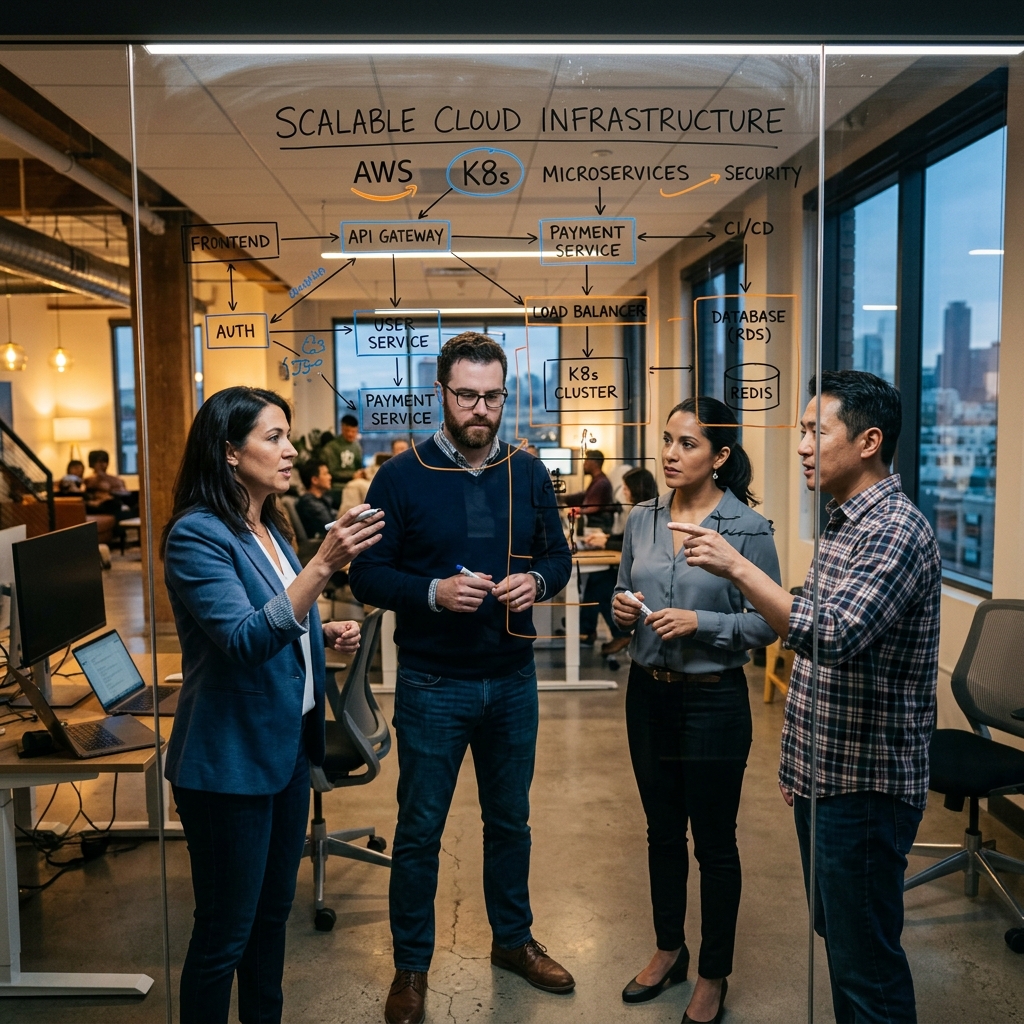
Below is an example of a modern multi-tenant SaaS architecture supporting scalability and observability.
Common Challenges in Multi Tenancy SaaS
Multi-tenancy introduces architectural challenges that must be addressed proactively.
Tenant Isolation
Poor isolation can create security risks. Kambaa designs robust tenant boundaries that protect customer data.
Noisy Neighbor Problems
One tenant consuming excessive resources can impact others. We implement resource controls, workload isolation, performance monitoring, and capacity planning.
Scaling
Growth often introduces bottlenecks. We design architectures that support horizontal scaling and elastic infrastructure.
Data Migration
Migration between tenancy models can be complex. We create migration frameworks that minimize disruption.
Compliance
Regulated industries require stronger controls. We align architecture decisions with compliance requirements.
Performance
Performance must remain consistent as tenant counts increase. We optimize caching, database performance, infrastructure efficiency, and application responsiveness.
Security
Security remains critical at every layer. We implement enterprise-grade controls that protect both tenants and platform operations.
SaaS Multi Tenant Development Services
Architecture Consulting
Architecture assessments, platform planning, and technical strategy development.
SaaS Platform Development
End-to-end SaaS engineering from concept to deployment.
Cloud Infrastructure Design
Cloud-native infrastructure designed for scalability and reliability.
Tenant Migration
Migration from single-tenant to multi-tenant architectures.
Security Engineering
Identity management, authorization, compliance controls, and platform security.
Performance Optimization
Application tuning, infrastructure optimization, and scalability improvements.
Ongoing Support
Continuous platform improvement, monitoring, and engineering support.
Our Development Framework
Phase 1: Discovery
- • Business requirements analysis
- • Technical assessment
- • Growth planning
- • Architecture evaluation
Phase 2: Architecture Design
- • Tenant strategy selection
- • Data architecture design
- • Security planning
- • Infrastructure planning
Phase 3: Development
- • Platform engineering
- • API development
- • Infrastructure implementation
- • Security integration
Phase 4: Testing
- • Functional testing
- • Security testing
- • Performance testing
- • Scalability validation
Phase 5: Deployment
- • Production rollout
- • Infrastructure provisioning
- • Monitoring implementation
- • Operational readiness
Phase 6: Optimization
- • Performance improvements
- • Scalability enhancements
- • Security updates
- • Continuous platform evolution
Business Outcomes
Organizations implementing modern multi-tenant architectures achieve measurable benefits.
Reduced Infrastructure Costs
Improve resource utilization and lower operational spending.
Faster Scaling
Support customer growth without infrastructure duplication.
Improved Security
Implement stronger isolation and governance controls.
Better Operational Efficiency
Simplify maintenance, monitoring, and platform management.
Faster Product Growth
Accelerate feature delivery and innovation cycles.
Improved Customer Experience
Deliver reliable, secure, and high-performance SaaS experiences.

Why Choose Kambaa?
Kambaa combines SaaS engineering expertise, cloud architecture capabilities, enterprise consulting experience, and digital transformation knowledge to help organizations build scalable software platforms.
We help organizations design platforms that support both current requirements and future growth.
Our Strengths
- Enterprise architecture experience
- Cloud expertise
- SaaS engineering expertise
- Digital transformation experience
- Scalable platform development
- Modern cloud-native architectures
- Security-first engineering practices
- Long-term technology partnership approach
Frequently Asked Questions
Build a Scalable Multi Tenant SaaS Platform
Create a SaaS foundation designed for scalability, security, performance, and long-term growth.
Partner with Kambaa to design and develop a modern multi-tenant architecture that supports customer growth, operational efficiency, and future innovation.
Talk to a SaaS Architecture Expert