
AEO vs SEO: How Answer Engine Optimization Differs From Traditional SEO
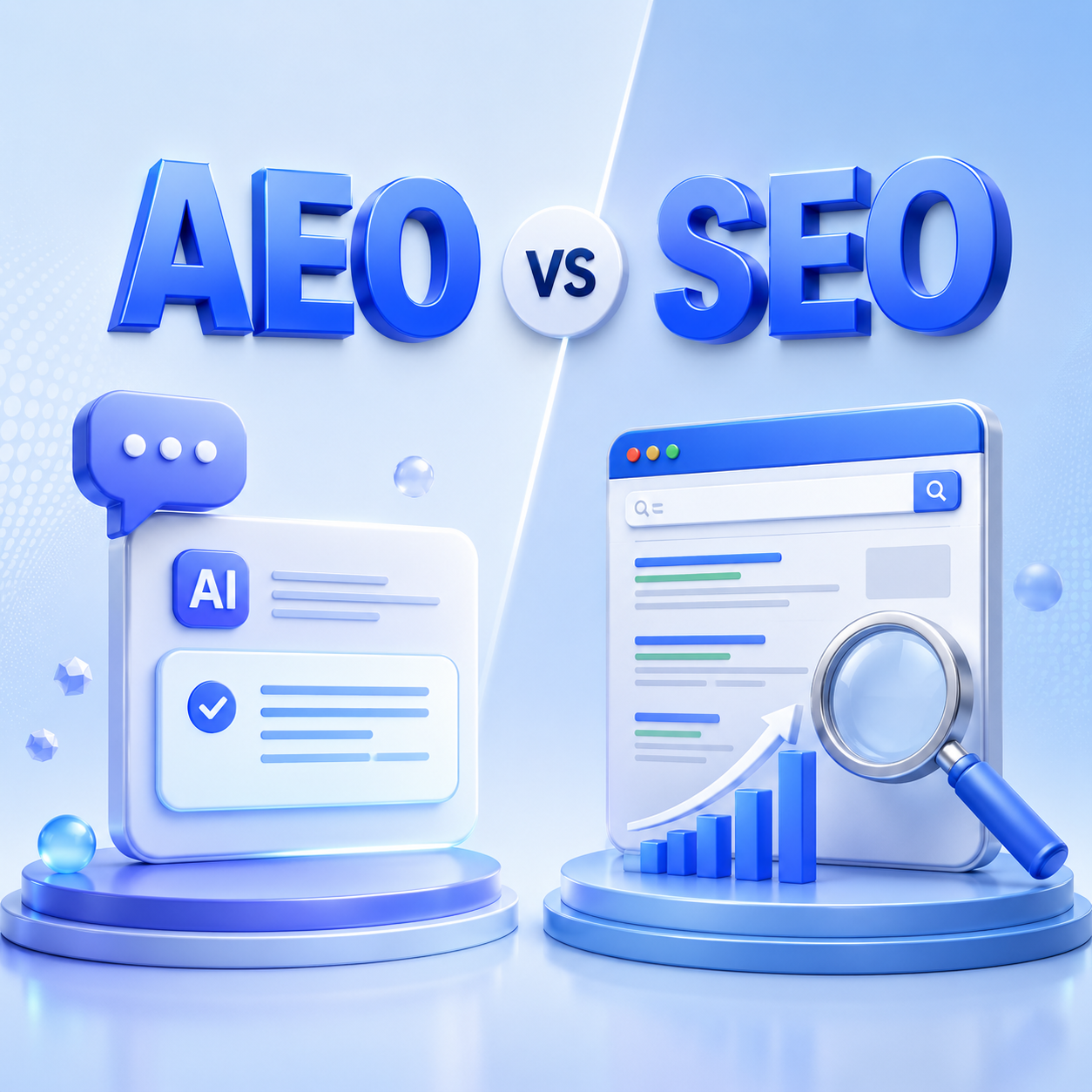
Search is moving from a rankings-first model to an answer-first model. AEO helps brands become the direct source that answer engines, AI assistants, and voice search tools choose to surface.
Why This Comparison Matters in 2026
Search is no longer limited to traditional search engine results pages. Several shifts are changing how buyers discover information:
- AI-generated answers are becoming more common.
- Voice search continues to influence information retrieval.
- Featured snippets provide immediate answers without requiring clicks.
- Zero-click searches are increasing across many informational queries.
- Buyers often use AI tools during research and evaluation stages.
For businesses, this means visibility can no longer be measured only by rankings and traffic. Brands that become trusted answer sources gain influence even when users never visit a website.
Organizations that understand both SEO and AEO are better positioned to capture attention throughout the modern customer journey.
Quick answer
AEO vs SEO: What's the difference?
SEO (Search Engine Optimization) focuses on improving visibility within traditional search engine results pages by optimizing content, keywords, backlinks, technical performance, and relevance signals. The goal is to increase rankings and attract clicks from search engines.
AEO (Answer Engine Optimization) focuses on helping content become the preferred answer selected by search engines, AI assistants, voice search platforms, featured snippets, and answer engines. Rather than competing only for rankings, AEO aims to increase the likelihood that content is extracted, cited, or delivered directly as an answer.
SEO drives discoverability. AEO drives answer visibility. Modern search strategies increasingly require both.
Side-by-side comparison
AEO vs SEO: Side-by-side comparison
| Category | SEO | AEO |
|---|---|---|
| Primary Goal | Improve rankings in search engine results | Become the preferred answer selected by answer engines |
| Target Platforms | Google, Bing, Yahoo | Google AI Overviews, ChatGPT, Gemini, Perplexity, Claude, voice assistants |
| Search Experience | Users choose from ranked results | Users receive direct answers |
| User Intent | Keyword-driven discovery | Question-driven information seeking |
| Content Format | Landing pages, blogs, category pages | Direct answers, FAQs, structured responses |
| Optimization Focus | Rankings and organic traffic | Answer extraction and answer visibility |
| Ranking Factors | Keywords, backlinks, relevance, technical SEO | Clarity, authority, structure, answer quality |
| Success Metrics | Rankings, clicks, conversions | Featured snippets, AI citations, answer visibility |
| Featured Snippets | Opportunity within SEO | Core AEO objective |
| Voice Search | Secondary consideration | Major optimization target |
| Structured Data Usage | Improves search understanding | Helps answer engines interpret content |
| Content Structure | Comprehensive topic coverage | Extractable question-answer formats |
| User Journey Stage | Discovery and exploration | Information gathering and evaluation |
| Time to Results | Weeks to months | Months depending on authority and content quality |
| Measurement Methods | Organic traffic, rankings, CTR | Answer appearances, citations, snippet ownership |
How Traditional SEO Works
SEO is designed to help search engines discover, understand, and rank content
Search engine process
Crawling: Search engines scan websites to discover pages through links, sitemaps, and site architecture.
Indexing: Content is analyzed and stored in search engine databases.
Ranking: Algorithms evaluate thousands of signals to determine which pages should appear for specific searches.
Key SEO components
- Keyword research
- Technical SEO
- Backlink acquisition
- Search intent alignment
- Content optimization
- Internal linking
- User experience improvements
How AEO Works
AEO focuses on how answer engines identify and select information
Answer engines evaluate content that directly addresses specific questions.
Featured snippets extract concise answers from well-structured content.
AI-generated responses synthesize information from multiple trusted sources.
Voice assistants prioritize content that can be delivered quickly and clearly.
Conversational search uses natural language questions instead of keywords.
Structured content extraction makes it easier for answer engines to interpret and reuse information.
Direct answer selection favors clear, concise, and trustworthy responses.
Key content differences between AEO and SEO
How content structure changes for answer visibility
SEO often emphasizes comprehensive topic coverage, while AEO prioritizes answer accessibility.
SEO content may begin with context before answering the main question, while AEO content often starts with the direct answer.
AEO content commonly includes FAQ sections, question-based headings, concise definitions, step-by-step explanations, and conversational language.
Both strategies work best when combined: direct answers within comprehensive resources.
Where AEO and SEO overlap
Shared foundations of modern visibility
High-quality content helps users solve problems.
Subject matter expertise improves trust and visibility.
Recognized authority strengthens both rankings and answer selection.
Accurate, reliable information is essential for both strategies.
Fast, accessible websites support SEO and AEO alike.
Clear architecture improves discoverability and interpretation across both models.
When SEO should be the priority
Use SEO first when rankings and traffic still matter most
Ecommerce Stores
Product searches often generate high purchase intent and significant traffic opportunities.
Local Businesses
Local SEO drives visibility for location-specific searches.
Transactional Search Terms
Users searching for products, pricing, or services frequently rely on traditional search results.
Traditional Lead Generation
Many organizations still depend heavily on website visits, landing pages, and conversion funnels.
When AEO becomes essential
Industries where answer visibility matters most
B2B Service Companies
Potential buyers frequently ask detailed research questions before contacting vendors.
SaaS Platforms
AI assistants increasingly influence software evaluation and comparison processes.
Consulting Firms
Answer visibility reinforces expertise and credibility.
Healthcare Providers
Patients often seek direct answers to informational questions.
Financial Services
Trustworthy answers help establish authority in complex decision-making environments.
Educational Organizations
Structured information is highly suitable for answer engines.
AEO + SEO framework for modern search visibility
A balanced path for modern discovery
Build SEO Foundations
Strengthen technical SEO, site performance, content quality, and keyword targeting.
Identify High-Intent Questions
Research the questions customers ask throughout their buying journey.
Structure Content for Answer Extraction
Use direct answers, FAQs, concise definitions, and clear headings.
Implement Schema Markup
Add structured data to improve content understanding.
Monitor Answer Engine Visibility
Track featured snippets, AI citations, voice search visibility, and answer engine performance.
Common misconceptions about AEO
What AEO does — and does not — mean
AEO Replaces SEO
AEO complements SEO rather than replacing it.
AEO Only Matters for Voice Search
Voice search is one use case, but AI assistants, featured snippets, and answer engines are equally important.
Only Large Brands Can Succeed
Smaller organizations can win through expertise, clarity, and content quality.
Featured Snippets Are the Same as AEO
Featured snippets are one outcome of AEO, not the entire strategy.
AI Search Eliminates Traditional Search
Traditional search remains a major channel for discovery and conversion.
Frequently asked questions
AEO questions answered
What is AEO?
Answer Engine Optimization is the process of improving content so it can be selected and delivered as a direct answer by search engines, AI assistants, voice platforms, and answer engines.
What is the difference between AEO and SEO?
SEO focuses on rankings and traffic from search engines, while AEO focuses on becoming the answer selected by answer engines and AI-powered search experiences.
Does AEO replace SEO?
No. SEO and AEO address different visibility objectives. Most organizations benefit from implementing both strategies together.
Is AEO important for B2B companies?
Yes. B2B buyers increasingly use AI assistants and answer engines during research and vendor evaluation processes.
Does schema markup improve AEO?
Schema markup helps answer engines understand content structure and context, which can improve answer extraction opportunities.
How do answer engines choose content?
Answer engines evaluate relevance, clarity, authority, trustworthiness, structure, and the ability to provide a direct answer to a user's question.
Conclusion
AEO and SEO together create stronger search visibility
SEO helps organizations become discoverable through traditional search results, while AEO helps them become visible within direct-answer experiences powered by search engines, AI systems, and voice assistants.
Search behavior is evolving toward faster, more conversational interactions. Businesses that optimize only for rankings risk missing opportunities to influence buyers who increasingly rely on direct answers.
The strongest search strategies combine SEO and AEO to maximize visibility across both discovery-driven and answer-driven experiences.
CTA
Need help making search and answer visibility work together?
Modern search success depends on visibility in both traditional results and answer-driven experiences. If your content is optimized for clicks but not for answer engine selection, you may be missing a growing portion of search-driven demand.
Kambaa helps brands create content that ranks, answers, and converts across search, AI, and voice surfaces.