
GEO vs SEO: Complete Comparison Guide 2026
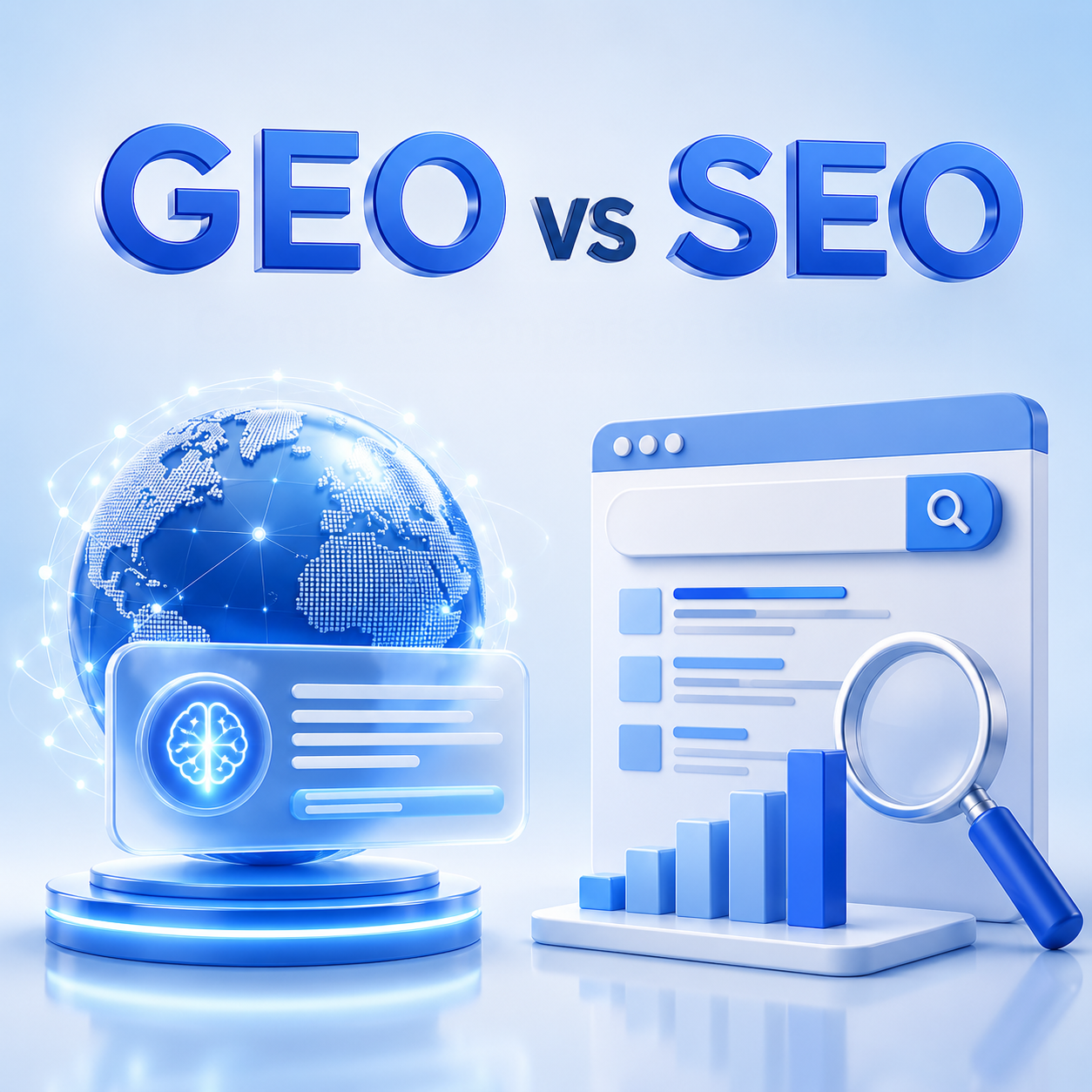
Search is no longer only about rankings. In 2026, visibility increasingly depends on whether AI systems choose your brand as the source of the answer.
Why This Comparison Matters in 2026
Search has entered a hybrid era. Users still perform traditional searches, but many now begin research conversations with AI assistants. Instead of clicking through multiple results, they ask questions and receive synthesized answers generated from multiple sources.
- Growth of conversational search experiences
- Increased use of AI assistants during research
- Reduced dependence on traditional blue links
- More complex buyer journeys
- Greater demand for immediate answers
For brands, the challenge is clear: visibility opportunities are expanding, but competition for attention is becoming more fragmented.
Quick answer
GEO vs SEO: What's the difference?
SEO (Search Engine Optimization) focuses on improving visibility within traditional search engine results pages by helping websites rank for relevant keywords. GEO (Generative Engine Optimization) focuses on increasing the likelihood that a brand, website, or content is cited, referenced, or recommended in AI-generated answers from platforms such as ChatGPT, Gemini, Perplexity, Claude, and Google AI Overviews.
While SEO aims to earn clicks from search results, GEO aims to influence the answers users receive from AI systems. Together, they help organizations maintain visibility across modern search and discovery experiences.
Side-by-side comparison
GEO vs SEO: Side-by-side comparison
| Category | SEO | GEO |
|---|---|---|
| Primary Goal | Improve rankings in search results | Increase citations in AI-generated answers |
| Target Platforms | Google, Bing, Yahoo | ChatGPT, Gemini, Perplexity, Claude, Google AI Overviews |
| Success Metrics | Rankings, traffic, conversions | AI citations, mentions, visibility in generated answers |
| Search Experience | User clicks search results | User receives synthesized answer |
| Content Format | Landing pages, blogs, category pages | Extractable, answer-focused content |
| User Intent | Keyword-driven searches | Conversational and contextual queries |
| Ranking Factors | Keywords, backlinks, relevance | Authority, entities, trustworthiness, extractability |
| Authority Signals | Backlinks and domain authority | Brand authority, entity recognition, citations |
| Optimization Focus | SERP visibility | AI answer visibility |
| Content Structure | Search-friendly formatting | AI-friendly formatting and answer blocks |
| Role of Schema | Improves search understanding | Supports entity recognition and content interpretation |
| Measurement | Organic traffic and rankings | AI mentions and citation frequency |
| Time to Results | Weeks to months | Months of authority and content development |
| Link Importance | Highly influential | Helpful but not always primary |
| AI Citation Potential | Indirect | Direct objective |
How SEO and GEO work
How SEO works, and how GEO works
How SEO works
Crawling: Search engines discover content through links, sitemaps, and website architecture.
Indexing: The content is analyzed and stored within search engine databases.
Ranking: Algorithms evaluate relevance and authority before determining position for queries.
Effective SEO relies on:
- Keyword research
- Content optimization
- Technical SEO
- Internal linking
- Backlink acquisition
- User experience improvements
How GEO works
AI retrieval systems identify relevant sources that best answer questions.
Entity recognition evaluates organizations, products, people, and concepts as connected entities.
AI citations favor clear, trustworthy, and well-structured content.
Structured content such as direct answers, definitions, and FAQs improves extractability.
Topical authority shows consistent expertise and strengthens credibility.
Knowledge graph relationships help AI systems understand context.
Source trustworthiness is shaped by authority, reputation, consistency, and credibility.
SEO helps you rank. GEO helps you get cited.
Traditional SEO focuses on earning visibility in ranked results. GEO focuses on becoming a trusted source in AI-generated answers, summaries, and recommendations.
Core comparison points
Visibility model
SEO focuses on ranking in traditional search results, while GEO focuses on being cited inside AI-generated answers and summaries.
User behavior
SEO is driven by keyword intent and click-through rates. GEO is driven by answer quality, trust, and machine readability.
Content format
SEO benefits from strong on-page structure and keyword relevance. GEO benefits from concise summaries, direct answers, and evidence-backed content.
Measurement
SEO is often measured by rankings and clicks. GEO is measured by citations, inclusion, assistant recommendations, and share of answer surfaces.
How AI platforms evaluate content
What AI systems prioritize when picking a source
ChatGPT
Uses context, clarity, and trustworthy language to decide whether a brand should be surfaced in recommendations.
Perplexity
Values strong sourcing, transparency, and concise explanation when presenting answers.
Gemini
Looks for structured information, entity clarity, and topical consistency across pages.
Google AI Overviews
Favors content that is directly useful, well-organized, and semantically rich.
What to focus on
A modern strategy needs both SEO and GEO
SEO remains important
SEO still drives discoverability, rankings, and transactional traffic from traditional search.
GEO is the new layer of visibility
GEO helps your brand become the answer AI systems select, summarize, and recommend.
Where GEO and SEO overlap
How GEO and SEO work together
Although GEO and SEO have different objectives, they share many foundational principles. Strong search optimization often creates a foundation for successful AI citation opportunities.
High-quality content remains essential.
Authority building is a major factor for both search engines and AI systems.
E-E-A-T influences traditional search and AI citations alike.
Structured websites improve discoverability and interpretation.
Helpful user experiences solve real problems.
Topical expertise strengthens visibility across both channels.
When SEO is the better priority
When SEO should come first
SEO remains the primary investment for many businesses that depend on rankings, traffic, and direct purchase intent from search queries.
Local Businesses
A dental clinic targeting local searches benefits more from local SEO than AI citations.
Ecommerce Brands
Product-focused searches often generate direct purchasing intent through traditional search.
Transactional Keywords
Queries such as "CRM software pricing" still drive substantial traffic through search engines.
Traditional Lead Generation
Organizations that depend heavily on website visits and form submissions continue to benefit significantly from SEO.
When GEO becomes critical
When GEO matters most
B2B Technology Companies
Buyers frequently use AI assistants to compare vendors and evaluate solutions.
Consulting Firms
Expertise-driven businesses can gain authority through AI citations.
AI Companies
Potential customers often ask AI systems for recommendations.
Enterprise Software Providers
Complex buying decisions involve extensive research across multiple channels.
Long Buying Cycles
AI platforms increasingly influence early-stage education.
Research-Heavy Purchases
Industries requiring extensive evaluation often see greater AI engagement.
The future of visibility
GEO and SEO are not competitors
One of the biggest misconceptions is that organizations must choose between GEO and SEO. SEO creates discoverability through search engines while GEO creates visibility within AI-generated responses.
Combined visibility increases trust, awareness, and influence across the modern search ecosystem.
SEO helps users find you through search results.
GEO helps users discover you through AI-generated recommendations.
Together they support discovery, education, trust building, and buyer influence.
GEO + SEO integration framework
A balanced path for modern visibility
Build SEO Foundations
Ensure technical SEO, content quality, and website performance are strong.
Strengthen Entity Authority
Develop consistent brand signals across websites, publications, and digital platforms.
Create AI-Friendly Content
Publish direct answers, FAQs, comparisons, frameworks, and educational resources.
Earn Third-Party Mentions
Increase credibility through authoritative references and industry recognition.
Measure AI Citations
Track brand visibility across AI platforms alongside traditional SEO metrics.
Common misconceptions
What GEO and SEO do — and do not — mean
GEO Replaces SEO
False. GEO complements SEO rather than replacing it.
AI Will Eliminate Google
False. Traditional search remains a major discovery channel.
Only Large Brands Can Win GEO
False. Smaller organizations can earn citations through expertise and content quality.
GEO Is Only About AI Tools
False. GEO includes content strategy, authority building, entity optimization, and digital trust signals.
SEO Is Becoming Irrelevant
False. SEO remains one of the most effective channels for acquiring qualified traffic.
Frequently asked questions
AI visibility questions answered
What is GEO?
Generative Engine Optimization is the practice of improving the likelihood that content, brands, or websites are cited within AI-generated answers.
What is the difference between GEO and SEO?
SEO focuses on traditional search rankings, while GEO focuses on visibility within AI-generated responses and recommendations.
Is GEO replacing SEO?
No. GEO extends search visibility into AI-powered environments but does not replace traditional search optimization.
Should businesses invest in both?
Most organizations benefit from a combined strategy because buyers use both search engines and AI assistants throughout the research process.
Can small businesses benefit from GEO?
Yes. Expertise, trustworthiness, and content quality often matter more than company size.
How do AI platforms choose sources?
AI systems evaluate relevance, authority, content quality, structure, trustworthiness, and entity relationships when selecting sources.
Conclusion
GEO and SEO are better together
GEO and SEO address different visibility challenges within the modern search ecosystem. SEO helps organizations rank within traditional search engines, while GEO helps them become visible within AI-generated answers.
Neither strategy replaces the other. Instead, they work together to support discovery, education, trust building, and buyer influence.
As search behavior continues to evolve, organizations that combine strong SEO foundations with proactive GEO initiatives will be better positioned to capture visibility wherever buyers seek information.
CTA
Need help making both search and AI discovery work together?
As AI-powered search continues to reshape how buyers discover information, organizations need strategies that improve visibility across both traditional search engines and AI-generated answers.
Kambaa helps businesses strengthen search visibility through GEO, SEO, AI citation optimization, and broader digital growth initiatives. A balanced approach can help organizations build authority across the evolving landscape of search and AI-powered discovery.