ServiceNow–Freshdesk Integration: Bridge Customer Support with Enterprise ITSM
How Kambaa engineered a bi-directional integration connecting Freshdesk customer support with ServiceNow IT Service Management—slashing MTTR by 45%, automating ITIL incident routing, and keeping support and IT teams in sync.
The Highlights
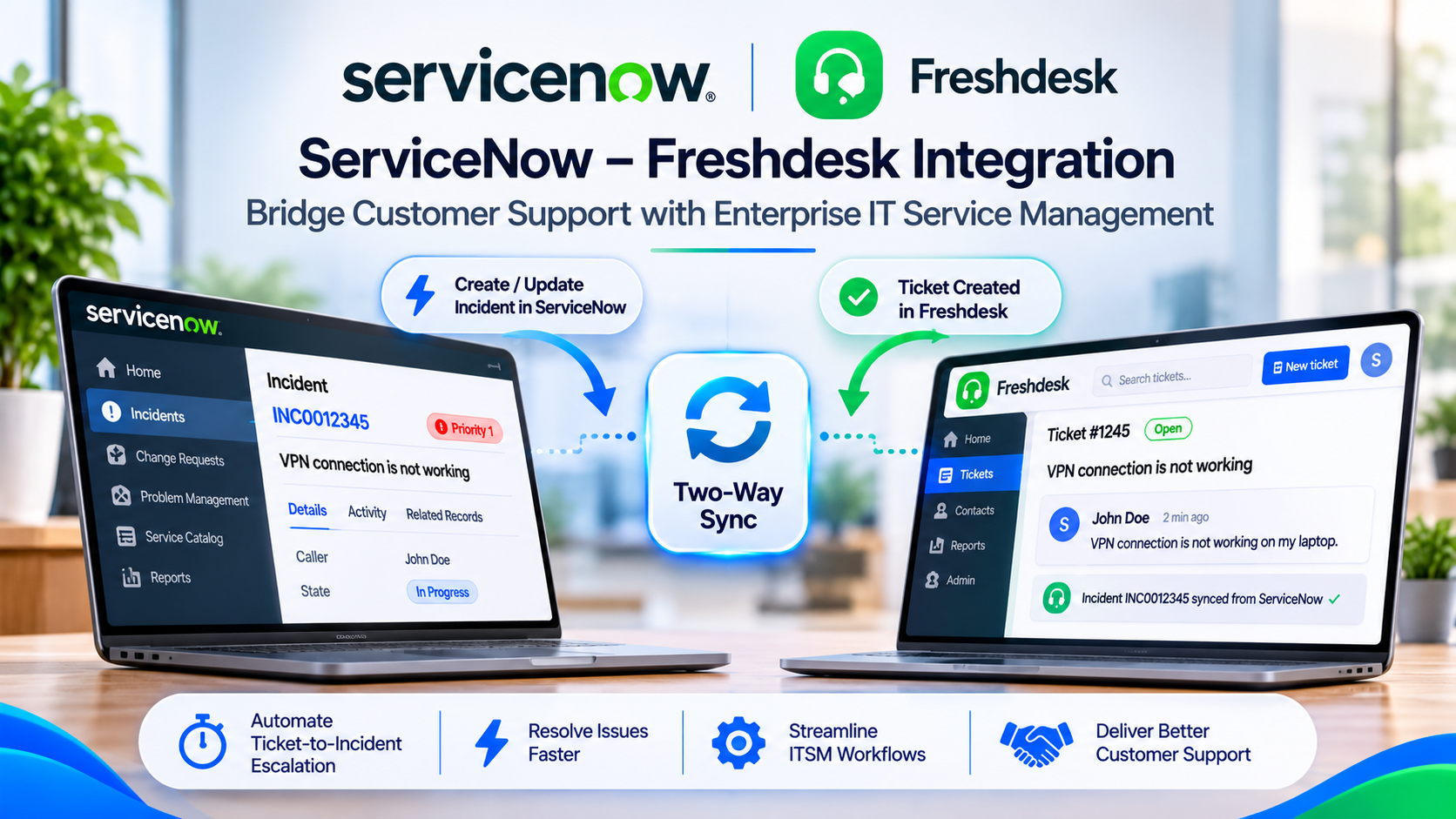
Directly connects Freshdesk customer support tickets with ServiceNow ITSM incidents with bi-directional synchronization.
Eliminates duplicate data entry and manual cross-platform copy-pasting of error messages, system configs, and diagnostic logs.
Accelerates technical incident triage and escalation time by 50% with automated assignment group routing and priority mapping.
Provides support agents with real-time visibility into ServiceNow ITIL incident states, work notes, and root-cause progress without leaving Freshdesk.
Client & Project Overview
Connecting Enterprise Frontline Support with ITIL Service Operations
The client is an enterprise cloud and managed infrastructure provider delivering mission-critical cloud hosting, managed security, and networking services to over 1,200 enterprise organizations globally. Their customer support team handles omnichannel client inquiries in Freshdesk, while ITIL-certified infrastructure administrators, DevOps squads, and network reliability engineers manage enterprise incidents, change controls, and CMDB Configuration Items inside ServiceNow ITSM.
- Client Confidentiality
- Withheld under NDA (Global Cloud & Managed IT Services Provider)
- Sector & Industry
- Enterprise IT Services, Telecommunications & Cloud Infrastructure
- Operating Region
- North America, EMEA & APAC Tier-1 Support Centers
- Core Platforms
- Freshdesk Omnichannel Support & ServiceNow ITSM Enterprise (Utah/Washington/Xanadu)
- Integration Architecture
- Bi-Directional Event-Driven REST API Middleware & Asynchronous Webhook Bus
- Implementation Timeline
- 7 Weeks (Scoping, CMDB CI & Field Mapping, Staging QA, Security Review & Production)
- Scale in Scope
- 85+ Support Agents, 260+ Enterprise IT & DevOps Engineers, 25,000+ Monthly Tickets
Customer Support
Frontline agents log inquiries, preserve customer sentiment, and maintain live communication channels without leaving Freshdesk.
Enterprise ITSM
IT teams triage incidents, manage infrastructure dependencies, and coordinate change management inside ServiceNow.
Connected Lifecycle
Automated synchronization ensures both teams share identical context from initial incident report through verified production resolution.
Business Context & Operational Landscape
Bridging the Operational Chasm Between ITIL Governance and Customer Success
In large-scale enterprise environments, customer support desks and IT operations serve two entirely distinct yet tightly interdependent operational missions. Customer support teams in Freshdesk prioritize rapid first response times, customer relationship management, and omnichannel ticket intake. Conversely, IT operations teams inside ServiceNow govern production availability, infrastructure health, root-cause investigations, and strict ITIL compliance.
When a customer experiences a service degradation or cloud infrastructure anomaly, the frontline support desk cannot resolve the issue alone. The ticket requires escalation to specialized IT squads—such as network engineering, database administrators, or security operations. Operating these two platforms in silos forces support engineers to act as manual human routers: copying and pasting stack traces, error messages, and customer tenant IDs between applications.
This swivel-chair integration model introduces critical operational latency, fragments audit trails, and blinds support agents to real-time engineering progress. Customers waiting for critical outage fixes are left in the dark, leading to SLA breaches, elevated frustration, and repetitive status inquiries that overwhelm support queues.
Kambaa's Engineering Approach
Kambaa engineered an event-driven, bi-directional integration layer connecting Freshdesk with ServiceNow ITSM. The system automates incident escalation, executes CMDB Configuration Item resolution, maps multi-tier ITIL state machines, and synchronizes work notes in real time—delivering full operational visibility without forcing either team to leave their native platform.
Four Core Business Challenges
Friction Caused by Disconnected Support Desks and ITIL Service Desks
Disconnected Support Desks & ITIL Operations Silos
Frontline customer support operated inside Freshdesk while enterprise IT, infrastructure engineering, and SecOps managed incident lifecycles inside ServiceNow. These isolated platforms created severe communication silos, forcing support agents to ping IT staff manually over Slack and email to track outages.
Swivel-Chair Duplicate Data Entry & Context Loss
When customers reported critical service interruptions, support engineers manually retyped customer descriptions, tenant IDs, server environments, and error logs into ServiceNow incidents. This manual overhead wasted hours and frequently omitted crucial diagnostic context needed for root-cause analysis.
Blind Spots in IT Incident Lifecycles & Change Tracking
Support teams had zero real-time visibility into whether an escalated incident was in initial triage, actively being investigated by network engineers, awaiting vendor hardware replacement, or tied to a scheduled Change Request. Agents were unable to provide accurate ETAs to impacted customers.
Delayed Customer Communications & At-Risk Outage SLAs
When IT resolved underlying server outages and deployed fixes in ServiceNow, there was no automated mechanism to update the linked Freshdesk tickets. Customer notifications were frequently delayed by hours, leading to unnecessary escalations, SLA breaches, and degraded CSAT scores.
Why Custom Integration Was Required
Limitations of Off-the-Shelf Marketplace Apps in Enterprise ITSM Workflows
Multi-Assignment Group & CMDB Configuration Item (CI) Routing
The client maintains over 30 specialized ServiceNow assignment groups (e.g., Cloud Networking, Database DBA, Core Platform, Identity & Access). Off-the-shelf apps only support routing to a single default queue. Kambaa's middleware intelligently inspects Freshdesk category tags, customer SLA tiers, and infrastructure assets to route incidents to the exact IT squad and link the affected Configuration Item (CI) in the ServiceNow CMDB automatically.
Filtered Bi-Directional Work Notes & Strict Privacy Partitioning
IT engineers routinely log internal server topologies, confidential IP addresses, and diagnostic code snippets within ServiceNow Work Notes. Kambaa implemented role-based comment classification: internal IT work notes sync to Freshdesk strictly as Private Internal Notes, while customer-safe replies sync to ServiceNow Additional Comments, eliminating data leakage risks.
Complex ITIL State-Machine Translation
ServiceNow's ITIL lifecycle (New ➔ In Progress ➔ On Hold [Reason: Awaiting Caller / Vendor / Change] ➔ Resolved ➔ Closed) does not align 1:1 with Freshdesk's ticket statuses (Open ➔ Pending ➔ Resolved ➔ Closed). Custom business logic translates multi-tier ITIL state transitions into clear, customer-facing support triggers with automated status messages.
High-Volume Diagnostic Log & Attachment Streaming
Enterprise technical troubleshooting requires transmitting HAR network captures, system core dumps, and high-resolution server screenshots up to 50MB. Kambaa streams attachments directly through ServiceNow's sys_attachment REST API with chunked encoding, bypassing standard marketplace payload size limits.
Enterprise Resilience, Rate-Limit Buffering & Idempotency
During major infrastructure outages, hundreds of customer tickets escalate simultaneously, triggering API rate throttling on enterprise instances. Kambaa introduced an asynchronous queue middleware with exponential backoff and idempotency keys to guarantee zero event loss or duplicate incident creation.
Solution Architecture & Technical Components
Four High-Throughput Components Powering the Real-Time Integration Layer
Freshdesk Webhook & Trigger Dispatcher
Monitors ticket escalation tags, customer SLA priorities, and agent commands via secure webhooks, dispatching structured JSON event payloads in milliseconds.
Kambaa Orchestration & Transformation Middleware
Validates payloads, enforces OAuth 2.0 token security, queries CMDB Configuration Items, and maps Freshdesk data schemas to ServiceNow Table API models.
ServiceNow Table & Attachment REST API Connector
Creates and updates incident and change_request records in ServiceNow, maps sys_id references, links epics, and streams diagnostic logs.
Bi-Directional State & Work Note Sync Listener
Listens to ServiceNow business rule events, capturing ITIL state changes, resolution codes, and engineer work notes to update linked Freshdesk tickets in real time.
Data Mapping Specifications
Precise Field-Level Synchronization Rules Between Freshdesk Tickets and ServiceNow Incidents
| Freshdesk Field | Direction | ServiceNow Field | Sync Rules & Transformations |
|---|---|---|---|
| Ticket ID & Subject | ⇄ (Bi-Directional) | Incident Number & Short Description | Maps Freshdesk ticket ID into ServiceNow correlation_id; displays ServiceNow incident number in Freshdesk sidebar. |
| Description & Diagnostics | ➔ (One-Way Initial) | Incident Description | Transforms customer issue description, reproduction steps, and system logs into structured Markdown inside ServiceNow. |
| Priority & Urgency (1-4) | ⇄ (Bi-Directional Matrix) | Urgency + Impact Matrix (Priority 1-5) | Calculates ServiceNow priority dynamically using client's ITIL Urgency and Impact matrix rules. |
| Product Module & Service Tier | ➔ (CMDB Lookup Engine) | Configuration Item (cmdb_ci) & Service | Automated CMDB lookup maps affected customer services to active configuration items and business services. |
| Support Escalation Tag | ➔ (Intelligent Routing) | Assignment Group & Assigned To | Dynamically routes incidents to specialized IT groups (e.g., Cloud Ops, Network Admin, SecOps) based on tags. |
| Agent Private Notes | ⇄ (Filtered Bi-Directional) | ServiceNow Work Notes (Internal) | Internal technical discussions sync exclusively as private notes, keeping sensitive IT diagnostics invisible to end customers. |
| Public Customer Replies | ⇄ (Filtered Bi-Directional) | ServiceNow Additional Comments (Public) | Customer replies sync to ServiceNow Additional Comments; IT public updates post as customer-visible replies. |
| Ticket Attachments & HAR Logs | ➔ (Streaming Chunked) | Incident Attachments (sys_attachment) | Streams screenshots, core dumps, and HAR logs directly to the ServiceNow incident record without file truncation. |
| Ticket Status Lifecycle | ⇄ (State Machine) | Incident State (New / In Progress / On Hold / Resolved) | State-machine translation maps ITIL lifecycle stages into clear customer-facing support statuses. |
| Ticket Resolution & CSAT | ⇄ (Bi-Directional) | Resolution Code & Resolution Notes | Resolving incident in ServiceNow triggers ticket resolution in Freshdesk, appending verified IT release notes. |
7-Step Integration Workflow
Lifecycle from Initial Outage Report to Verified Production Resolution
Customer Reports Technical Outage
A customer or enterprise tenant reports a service interruption, cloud infrastructure anomaly, or system defect via Freshdesk.
Support Engineer Triage & Tagging
A frontline support engineer validates the report, checks reproduction details, and applies the escalation tag for IT intervention.
Automated ServiceNow Incident & CI Linking
Kambaa middleware intercepts the event, performs CMDB CI resolution, and creates a linked Incident in the correct ServiceNow assignment group.
IT Engineering Squad Investigation
IT engineers and system administrators investigate the linked incident in ServiceNow with direct access to logs, screenshots, and context.
Real-Time Bi-Directional Status Sync
As IT updates work notes or transitions states (e.g., 'Work in Progress', 'On Hold - Awaiting Vendor'), notes reflect live in Freshdesk.
Support Agent Follow-Up with Accurate ETAs
With real-time visibility into IT investigation milestones, support agents communicate accurate resolution schedules directly to customers.
Verified ITIL Resolution & Ticket Closure
When IT marks the ServiceNow incident 'Resolved' with cause codes, the Freshdesk ticket is updated, customer confirmed, and closed.
Enterprise Reliability, Security & Controls
Rigorous Architectural Safeguards Ensuring Continuous Uptime and ITIL Compliance
Duplicate Prevention & Idempotency
Unique idempotency hashing prevents creating duplicate ServiceNow incidents, even if agents click escalate repeatedly or network retries trigger duplicate webhooks.
Automated Retry Handling & Exponential Backoff
An asynchronous event buffer manages temporary ServiceNow instance maintenance windows or API rate limits, retrying delivery with exponential backoff.
Comprehensive Audit Logging & ITIL Observability
Every sync transaction records complete request payloads, response codes, sys_ids, and timestamps in an audit log for full ITIL compliance and traceability.
Required Field & Schema Validation
Validates mandatory ServiceNow dictionary attributes (such as Assignment Group, Configuration Item, and Urgency) before API dispatch to prevent rejection errors.
Enterprise OAuth 2.0 & Field-Level Encryption
Restricted-scope API tokens and OAuth 2.0 credentials are encrypted in transit and at rest, adhering to strict enterprise security and SOC 2 Type II standards.
Bi-Directional Permalinks & Cross-Referencing
Generates clickable permalinks in both platforms, enabling one-click transitions between the Freshdesk ticket view and the ServiceNow incident view.
Six Core Capabilities Delivered
Core Enterprise Features Engineered into the Integration Layer
Automated Ticket-to-Incident Linking
Enables instant incident creation in ServiceNow directly from Freshdesk with one-click agent action or automated trigger tags.
Intelligent Multi-Assignment Group Routing
Dynamically parses issue tags, affected services, and contract tiers to route incidents to the correct IT assignment group without manual triage.
Real-Time Bi-Directional State Synchronization
Keeps Freshdesk ticket statuses synchronized with ServiceNow ITIL incident lifecycles, ensuring support agents have live operational insight.
Filtered Work Notes & Privacy Partitioning
Protects confidential infrastructure logs and internal IT discussions by syncing ServiceNow Work Notes strictly to Freshdesk private notes.
High-Volume Diagnostic Attachment Streaming
Streams screenshots, crash reports, core dumps, and HAR logs up to 50MB directly into ServiceNow incident attachments without truncation.
Enterprise Resilient Queue & Rate-Limit Shield
Buffers high-volume ticket surges during major outages, protecting ServiceNow APIs from rate limiting while guaranteeing zero dropped events.
Business Impact & Operational Benefits
Transforming Cross-Functional Velocity Across Support and IT Engineering
Accelerated Incident Triage & Faster MTTR
Automating incident handoff and CMDB linking slashes average time-to-escalate from 35 minutes to under 2 minutes, driving a 45% reduction in MTTR.
Eliminated Swivel-Chair Duplicate Data Entry
Support agents no longer spend hours copy-pasting customer details, screenshots, and logs between platforms, eliminating administrative fatigue.
Unified Operational Visibility Across Support & IT
Eliminates cross-team friction and ad-hoc Slack interruptions by establishing a synchronized single source of truth for all technical incidents.
Preserved Diagnostic & Customer Context
All reproduction logs, error stack traces, and customer communications remain permanently linked to both tickets and incident records.
Confident, Proactive Outage Communication
Support agents can provide timely, accurate progress reports and deployment schedules to customers without chasing IT specialists.
Protected Customer SLAs Across All Service Tiers
Aligning frontline response commitments with backend IT resolution timelines prevents critical customer-facing SLA breaches during major incidents.
Higher Customer Satisfaction & Agent Morale
Faster fixes and transparent communication directly improve customer CSAT to 96% while dramatically enhancing agent productivity.
Scalable Enterprise IT Infrastructure
Establishes a repeatable, enterprise-grade integration architecture that effortlessly scales as customer ticket volume and IT infrastructure expand.
Verified KPI Results & Performance Metrics
Quantified Improvements Measured Over Six Months in Production
Faster Incident Triage & Escalation
Reduction in elapsed time from customer report validation to active ServiceNow ITIL incident creation.
Less Manual Coordination Time
Reduction in agent hours spent chasing IT engineers via Slack, internal emails, and status meetings.
Faster Mean Time to Resolution (MTTR)
Accelerated technical handoff and instant diagnostic context slashes resolution times across high-priority outages.
ITIL Traceability & Linked Audit Trail
Complete end-to-end linked audit trail across 100% of escalated technical tickets and ServiceNow incidents.
Support & IT Productivity Gain
Personnel handle higher ticket volumes by focusing on resolution rather than manual cross-platform data transfer.
Customer Satisfaction (CSAT)
Record customer satisfaction achieved through timely, transparent updates during critical service outages.
Measurement Methodology
How Performance Metrics Were Tracked, Benchmarked, and Validated
Phase 1: Pre-Integration Baseline Establishment
Conducted a 90-day pre-integration operational audit tracking 12,000 escalated support tickets. Benchmarked average triage times, manual Slack handoffs, and customer wait times during technical service outages.
Phase 2: API Telemetry & Automated Timestamps
Instrumented automated server-side timestamps recording Freshdesk ticket creation, webhook dispatch, middleware processing latency, and ServiceNow incident creation timestamps to measure triage velocity with sub-second precision.
Phase 3: MTTR & Outage SLA Lifecycle Tracking
Monitored Mean Time to Resolution (MTTR) across 25,000 incident lifecycles post-launch, comparing elapsed time from initial report validation to verified ServiceNow incident closure against historical averages.
Phase 4: ITIL Compliance & Audit Verification
Validated cross-platform audit compliance across 100% of escalated tickets, verifying that correlation IDs, CMDB Configuration Items, work notes, and resolution codes aligned perfectly across platforms.
Client Perspective & Executive Feedback
“Before Kambaa deployed this custom integration, our support agents spent hours every day manually copying incident logs into ServiceNow and chasing IT specialists across Slack. Now, escalations take seconds, CMDB Configuration Items link automatically, and work notes sync bi-directionally with rock-solid privacy. Our MTTR dropped by 45% and our customer trust has never been higher.”
Why Kambaa for Enterprise Integrations
Specialized Engineering Expertise in Freshdesk and ServiceNow Architectures
Certified Integration Architects
Decades of combined engineering experience designing enterprise integrations between Freshworks platforms and enterprise ITSM systems.
Enterprise-Grade Middleware
Custom middleware architectures with asynchronous queue buffering, automatic retries, and SOC 2 Type II compliant encryption.
Custom ITIL Workflow Tailoring
We do not believe in one-size-fits-all connectors. We customize routing matrices, CMDB CI models, and ITIL state lifecycles to your exact operational requirements.
24/7 Monitoring & SLA Backing
Comprehensive post-deployment observability, monitoring dashboards, and guaranteed SLA backing for mission-critical enterprise workloads.
Frequently Asked Questions
Everything You Need to Know About the ServiceNow–Freshdesk Integration
Connect Customer Support with Enterprise ITIL Operations Today
Book a technical architecture discovery call with Kambaa's enterprise integration specialists. We will evaluate your Freshdesk queues and ServiceNow ITSM instances to design a tailored bi-directional integration roadmap.
Schedule a Discovery CallExplore Other Enterprise Integrations by Kambaa
Freshdesk–Jira Integration
Connecting frontline customer support tickets with Jira engineering sprint tasks with bi-directional syncing.
YouTube Comments ➔ Freshdesk
Automating community comment ingestion into Freshdesk tickets with direct bi-directional video reply capabilities.
HubSpot + WhatsApp CRM
Automating enterprise WhatsApp marketing workflows, lead triggers, and template approvals inside HubSpot CRM.