
What Is an AI Agent? The 2026 Definitive Guide
AI is rapidly evolving beyond answering questions. Here's what AI agents are, how they work, and where they create real business value.
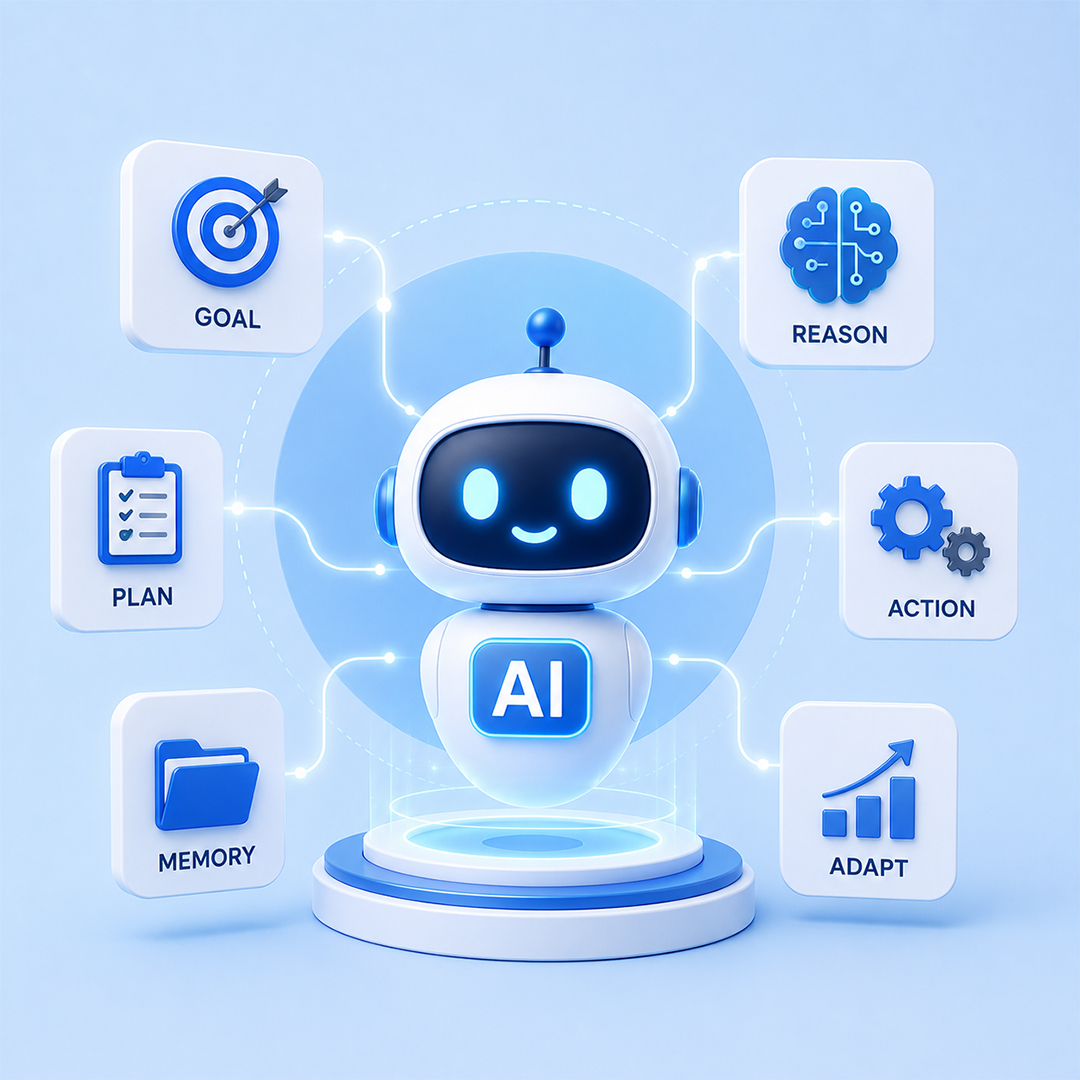
Introduction
Most people have experienced artificial intelligence through tools like ChatGPT. They ask a question, receive an answer, and continue the conversation. But AI is rapidly evolving beyond answering questions.
Organizations are now deploying AI systems that can complete tasks, make decisions, access business data, use software tools, execute workflows, and help employees accomplish work with minimal human intervention. This new category of technology is known as an AI agent.
This guide explains what AI agents are, how they work, where they create value, and how organizations can begin adopting them effectively.
What is an AI agent?
Intelligence, decision-making, and action-taking combined
An AI agent is an intelligent software system that can understand goals, make decisions, take actions, and interact with tools, data, software, or digital environments to complete tasks with varying levels of autonomy.
Unlike traditional software, which follows predefined rules and instructions, AI agents can reason through problems, plan actions, adapt to changing situations, and execute multi-step workflows to achieve a desired outcome.
In simple terms, an AI agent combines intelligence, decision-making, and action-taking capabilities into a system designed to perform work rather than simply provide answers.
AI agent: quick explanation
Think of ChatGPT as a knowledgeable consultant who answers your questions. Think of an AI agent as a knowledgeable employee who answers questions and then performs the work.
A chatbot explains how to schedule a meeting.
An AI agent schedules the meeting for you.
A chatbot explains how to generate a report.
An AI agent gathers the data and creates the report.
A chatbot identifies customer support issues.
An AI agent categorizes tickets, assigns priorities, and routes them to the correct teams.
The key difference is action. AI agents move beyond conversation and into execution.
Why AI agents matter in 2026
Several trends are driving rapid adoption
Enterprise Automation
Organizations are looking for ways to automate repetitive processes without extensive manual intervention.
Productivity Improvements
AI agents can assist employees by handling time-consuming operational tasks.
Operational Efficiency
Businesses can reduce bottlenecks by automating routine workflows.
Better Customer Experiences
AI agents can provide faster responses and more consistent service delivery.
Scalable Expertise
Organizations can extend specialized knowledge across teams without increasing headcount proportionally.
As AI technology matures, AI agents are becoming a practical business tool rather than an experimental innovation.
How AI agents work
Most AI agents follow a similar workflow
This ability to reason, plan, and execute distinguishes AI agents from traditional automation tools.
Goal Receives Input
A user or system provides a goal. Example: "Schedule customer onboarding meetings for all new clients."
Understands Context
The agent gathers relevant information. It reviews customer records, calendars, availability, and onboarding requirements.
Creates a Plan
The agent determines the steps needed to accomplish the objective.
Uses Tools and Data
The agent accesses CRM systems, calendars, email platforms, and internal databases.
Executes Actions
Meetings are scheduled, invitations are sent, and onboarding workflows begin.
Learns and Improves
Performance data helps improve future decisions and outcomes.
Core components of an AI agent
Six systems working together
1. Reasoning Engine
The reasoning engine acts as the agent's brain. It interprets goals, evaluates information, and determines the best course of action. Without reasoning capabilities, an agent would simply follow predefined instructions rather than adapt to changing situations.
2. Memory System
Memory allows the agent to retain context across interactions. This may include previous conversations, customer information, preferences, workflow history, or operational data. Memory helps agents provide more relevant and personalized responses.
3. Planning Layer
The planning layer breaks large objectives into manageable tasks. Rather than attempting to solve a problem all at once, the agent creates structured workflows that guide execution from start to finish.
4. Tool Integration Layer
Most business tasks require access to software systems. The tool integration layer allows agents to interact with CRMs, databases, ERP platforms, communication tools, document repositories, and external applications.
5. Decision-Making Logic
Agents must evaluate options and select appropriate actions. Decision-making logic helps prioritize tasks, assess outcomes, and choose among multiple possible paths based on available information.
6. Execution Layer
The execution layer performs the actual work. This may include sending emails, updating records, processing documents, creating reports, scheduling meetings, or triggering workflows across business systems.
AI agents vs traditional chatbots
Eight capabilities compared
Types of AI agents
Six categories, six areas of business value
Customer Service Agents
Handle inquiries, resolve issues, route tickets, and support customers across multiple channels.
Business value
Faster response times and improved customer satisfaction.
Sales Agents
Qualify leads, schedule meetings, enrich prospect data, and support sales teams throughout the pipeline.
Business value
Increased sales productivity and lead conversion efficiency.
Operations Agents
Automate internal processes such as approvals, reporting, compliance monitoring, and workflow management.
Business value
Reduced operational overhead.
Knowledge Agents
Retrieve and organize information from internal systems.
Business value
Faster access to organizational knowledge.
Research Agents
Gather information, summarize findings, monitor trends, and support decision-making.
Business value
Reduced research time and improved insights.
Software Development Agents
Assist with coding, testing, documentation, debugging, and deployment tasks.
Business value
Increased engineering productivity.
Real-world AI agent examples
Practical use cases organizations are deploying today
These use cases focus on improving operational efficiency rather than replacing human expertise.
AI agents vs AI assistants vs copilots
These terms are often confused
AI Assistant
An AI assistant primarily answers questions and provides information. Examples include conversational AI tools used for support and productivity.
Assistant → Helps
AI Copilot
A copilot works alongside a human user. It provides recommendations, drafts content, suggests actions, and assists decision-making while the human remains in control.
Copilot → Collaborates
AI Agent
An AI agent can independently execute tasks and workflows. It moves beyond assistance and actively performs work using tools, systems, and business processes.
Agent → Acts
Benefits of AI agents
Where the measurable value shows up
The most successful implementations focus on measurable business outcomes rather than technology adoption alone.
Common misconceptions about AI agents
Setting realistic expectations
AI Agents Are Fully Autonomous
Most enterprise agents operate within defined boundaries and human oversight.
AI Agents Replace Employees
In practice, agents typically augment employees rather than replace them.
AI Agents Require Large Budgets
Many organizations begin with focused pilot projects and expand gradually.
AI Agents Are Only for Enterprises
Small and mid-sized businesses increasingly deploy AI agents as costs decrease.
AI Agents Are the Same as Chatbots
Chatbots primarily communicate. Agents communicate and execute actions.
How businesses can get started with AI agents
A phased approach that reduces risk
Phase 1: Identify Repetitive Workflows
Look for processes that consume significant time and follow predictable patterns.
Phase 2: Select High-Impact Use Cases
Prioritize areas where automation can deliver measurable business value.
Phase 3: Pilot an AI Agent
Start with a controlled implementation and clearly defined objectives.
Phase 4: Measure Outcomes
Track productivity, efficiency, cost savings, and user adoption.
Phase 5: Scale Successful Implementations
Expand to additional workflows and departments based on results.
A phased approach reduces risk and improves adoption success.
What to expect in 2026 and beyond
A standard layer within modern digital infrastructure
Agentic AI
AI systems will increasingly operate with greater autonomy and goal-oriented behavior.
Multi-Agent Systems
Multiple agents will collaborate to solve complex business problems.
Enterprise Adoption
Organizations will integrate agents across operations, sales, support, and knowledge management.
Autonomous Workflows
Entire business processes will become increasingly automated.
AI-Powered Operations
AI agents will become a standard layer within modern digital infrastructure.
The future is not about replacing people. It is about enabling people to focus on higher-value work.
Frequently asked questions
Common questions about AI agents
What is an AI agent?
An AI agent is software that can understand goals, make decisions, use tools, and execute tasks to achieve specific outcomes with varying levels of autonomy.
How does an AI agent work?
AI agents receive goals, analyze context, create plans, access tools and data, execute actions, and continuously adapt based on available information.
What is the difference between an AI agent and a chatbot?
A chatbot primarily provides information through conversation. An AI agent can also take actions, interact with systems, and complete tasks.
Are AI agents autonomous?
Some agents operate with limited autonomy while others can execute workflows independently within predefined rules and safeguards.
What are examples of AI agents?
Examples include customer service agents, sales automation agents, research agents, IT support agents, scheduling agents, and knowledge management agents.
Can small businesses use AI agents?
Yes. Many AI agent solutions are now accessible to small and medium-sized businesses, making adoption increasingly practical.
How much does AI agent development cost?
Costs vary based on complexity, integrations, data requirements, and workflow scope. Pilot projects are often significantly less expensive than enterprise-scale implementations.
What industries benefit most from AI agents?
Technology, healthcare, finance, manufacturing, professional services, retail, logistics, and customer support functions are among the sectors seeing significant benefits.
Conclusion
AI agents represent the next major evolution in enterprise AI.
Unlike traditional chatbots or conversational tools, AI agents combine intelligence, reasoning, planning, and execution to accomplish meaningful work. They can automate workflows, improve productivity, enhance customer experiences, and help organizations scale expertise more effectively. Organizations that understand their capabilities and begin exploring high-value use cases today will be better positioned for the future of intelligent automation.
Ready to explore AI agents for your business?
Kambaa helps businesses design, develop, and deploy AI agents tailored to customer service, operations, sales, knowledge management, and enterprise workflows.