
What Is Agentic AI? And Why It's the Biggest Shift Since GenAI
Generative AI writes an email. Agentic AI sends it, schedules the meeting, updates the CRM, and follows up automatically. Here's what that shift really means.
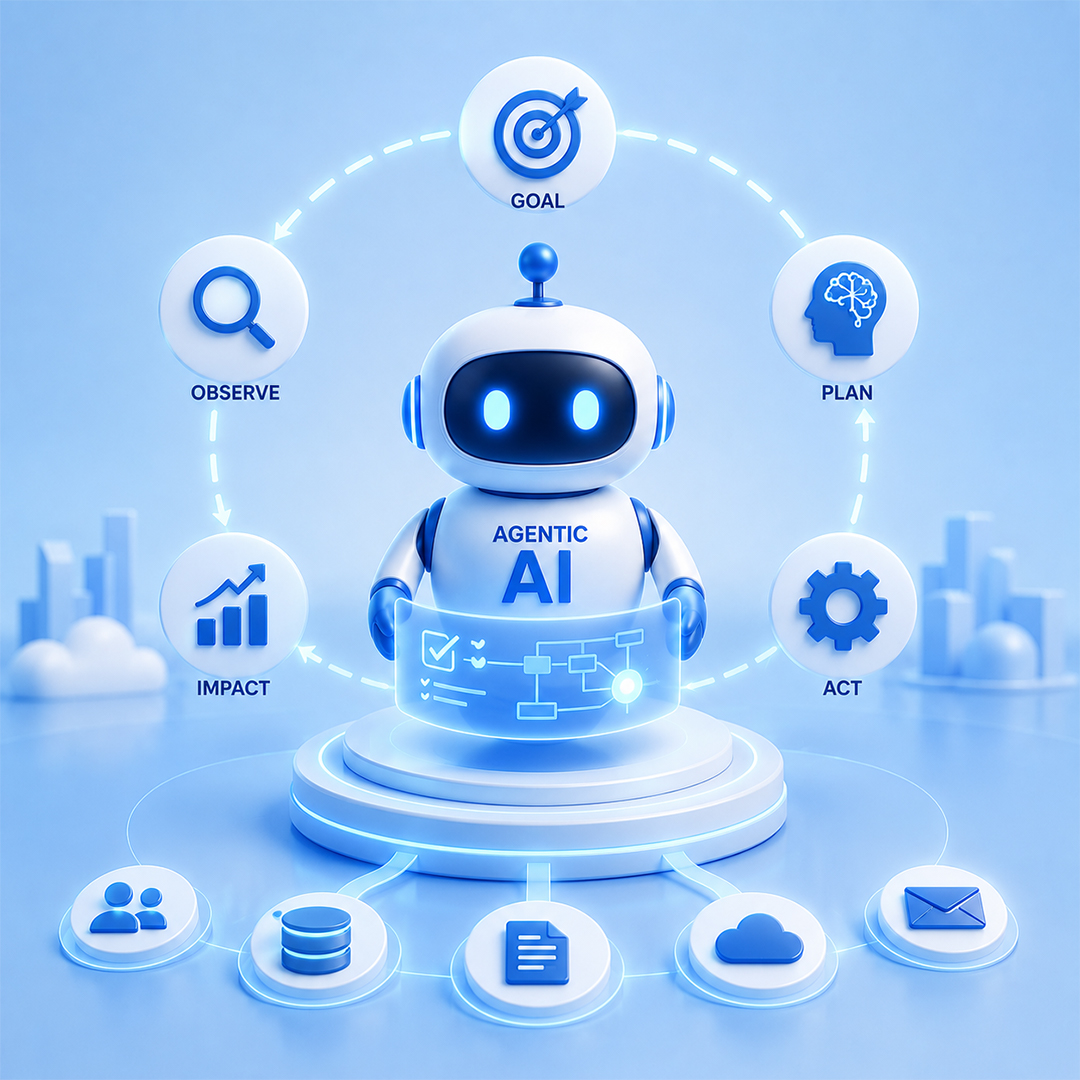
Introduction
The first wave of modern artificial intelligence focused on generating content, answering questions, summarizing information, and assisting users with knowledge-based tasks. Tools like ChatGPT demonstrated how AI could help people write emails, create reports, analyze data, and generate ideas in seconds.
But a new wave of AI is emerging. Instead of simply generating outputs, AI systems are increasingly capable of taking action. This shift from assistance to execution is why many experts consider Agentic AI the next major evolution beyond Generative AI.
Generative AI writes an email.
Agentic AI sends the email, schedules the meeting, updates the CRM, and follows up automatically.
Generative AI explains how to process an invoice.
Agentic AI processes the invoice and updates accounting systems.
What is Agentic AI?
From producing information to producing outcomes
Agentic AI refers to artificial intelligence systems that can independently pursue goals, make decisions, create plans, use tools, interact with software systems, and execute multi-step workflows with limited human intervention.
Unlike traditional AI systems that primarily generate outputs in response to prompts, Agentic AI systems are designed to take action and achieve objectives. An agentic system can understand a goal, gather information, determine the best course of action, interact with applications, execute tasks, evaluate outcomes, and adjust its behavior when circumstances change.
In simple terms, Generative AI focuses on producing information, while Agentic AI focuses on producing outcomes. The defining characteristic of Agentic AI is its ability to move beyond answering questions and actively perform work.
Agentic AI in one simple example
A useful way to understand Agentic AI is through a workplace analogy.
Think of Generative AI as a consultant.
The consultant provides recommendations, explains options, and helps you make decisions.
Think of Agentic AI as a team member.
The team member receives a goal and performs the work required to achieve it.
The difference is execution
Three examples across sales, service, and operations
Sales
Generative AI
Generative AI writes a follow-up email.
Agentic AI
Agentic AI sends the email, updates the CRM, schedules a meeting, and tracks responses.
Customer Service
Generative AI
Generative AI suggests a solution.
Agentic AI
Agentic AI verifies account details, processes the request, and closes the ticket.
Operations
Generative AI
Generative AI outlines a workflow.
Agentic AI
Agentic AI executes the workflow across multiple systems.
Why Agentic AI is the biggest shift since Generative AI
A fundamental shift in how organizations use AI
Moving From Assistance to Execution
Generative AI helps people perform work. Agentic AI performs portions of the work itself.
Moving From Responses to Outcomes
Instead of generating answers, agentic systems focus on achieving goals.
Moving From Single Tasks to Workflows
Agentic systems can coordinate multiple actions across various tools and applications.
Moving From User-Driven Interactions to Goal-Driven Systems
Users increasingly define objectives rather than individual instructions.
For businesses, this transition has the potential to significantly improve productivity, scalability, and operational efficiency.
Agentic AI vs Generative AI
Ten capabilities compared
How Agentic AI works
A similar process across most agentic systems
This ability to reason, plan, act, and adapt is what differentiates Agentic AI from traditional AI systems.
Receives a Goal
Example: "Onboard a new customer."
Understands Context
The system gathers information from CRM platforms, documents, and customer records.
Creates a Plan
Tasks are organized into a logical sequence.
Selects Tools
The system determines which applications and resources are needed.
Executes Actions
Meetings are scheduled, documents are generated, and workflows are initiated.
Evaluates Outcomes
Results are monitored and validated.
Adjusts Behavior
If obstacles occur, the system adapts and selects alternative approaches.
Completes the Objective
The onboarding process is completed and stakeholders are notified.
Core components of Agentic AI
Six building blocks that make agentic systems work
1. Goal Management
Defines what the system is trying to achieve. Rather than responding to individual prompts, the AI works toward broader objectives.
Business relevance
Aligns AI activity with organizational outcomes.
2. Planning Engine
Breaks objectives into smaller tasks and determines execution order.
Business relevance
Enables structured workflow automation.
3. Memory System
Stores relevant context, previous actions, and historical information.
Business relevance
Improves consistency and personalization.
4. Decision Layer
Evaluates options and determines appropriate actions.
Business relevance
Supports intelligent automation and operational flexibility.
5. Tool Integration Layer
Connects the AI system to applications, databases, APIs, and business software.
Business relevance
Enables real-world action across systems.
6. Execution Framework
Performs tasks and manages workflow completion.
Business relevance
Converts plans into measurable business outcomes.
Real-world Agentic AI use cases
Six functions, six outcomes
Customer Service
Problem solved: High support volume and repetitive requests.
How Agentic AI helps: Processes refunds, updates accounts, routes tickets, and resolves issues automatically.
Business value: Faster resolutions and lower operational costs.
Sales Operations
Problem solved: Manual lead qualification and follow-up.
How Agentic AI helps: Qualifies leads, schedules meetings, updates CRM records, and manages outreach workflows.
Business value: Higher productivity and improved sales efficiency.
Marketing Automation
Problem solved: Complex campaign management processes.
How Agentic AI helps: Coordinates campaign execution, reporting, optimization, and lead nurturing.
Business value: Scalable marketing operations.
IT Operations
Problem solved: Routine service requests and incident management.
How Agentic AI helps: Diagnoses issues, resets credentials, creates tickets, and performs remediation actions.
Business value: Reduced support workload and faster response times.
HR & Employee Support
Problem solved: Administrative workload and onboarding complexity.
How Agentic AI helps: Manages onboarding, employee requests, documentation, and workflow coordination.
Business value: Improved employee experience and operational efficiency.
Supply Chain & Operations
Problem solved: Operational complexity and coordination challenges.
How Agentic AI helps: Monitors inventory, coordinates suppliers, and manages workflow execution.
Business value: Greater efficiency and operational visibility.
Agentic AI vs AI Agents: what's the difference?
The concept vs the implementation
These terms are closely related but not identical.
For example, a customer service AI agent is a practical implementation of Agentic AI principles within a support environment.
In short, all AI agents are examples of Agentic AI, but Agentic AI encompasses a broader category of autonomous and goal-oriented systems.
Agentic AI is the concept.
It describes AI systems that can pursue goals, make decisions, and take actions.
AI agents are the actual systems that apply the concept.
AI Agents are specific implementations of Agentic AI.
Benefits of Agentic AI
Where the value shows up
The most significant value often comes from automating routine processes while allowing employees to focus on higher-value work.
Common misconceptions about Agentic AI
Setting realistic expectations
Agentic AI Is Fully Autonomous
Most systems operate within predefined boundaries and human oversight.
Agentic AI Replaces Humans
The primary goal is augmentation rather than replacement.
Agentic AI Requires Enterprise-Scale Budgets
Organizations can start with focused pilot projects and scale gradually.
Agentic AI Is Just Another Chatbot
Chatbots primarily communicate. Agentic systems execute actions and workflows.
Agentic AI Eliminates the Need for Oversight
Governance and monitoring remain essential.
Challenges and considerations
Successful adoption requires thoughtful planning
Governance
Clear rules and accountability are necessary.
Security
Systems must protect sensitive business information.
Data Quality
Poor data leads to poor outcomes.
Human Oversight
Critical decisions often require human review.
Workflow Design
Automation should align with business objectives.
Change Management
Employees need support as workflows evolve.
Organizations that address these considerations early tend to achieve better outcomes.
How businesses can get started with Agentic AI
A phased approach that reduces risk
Phase 1: Identify Repetitive Workflows
Look for high-volume processes with clear rules.
Phase 2: Define Business Goals
Focus on measurable outcomes such as efficiency or cost reduction.
Phase 3: Pilot an Agentic System
Start small and validate results.
Phase 4: Measure Outcomes
Track productivity, adoption, and operational improvements.
Phase 5: Scale Strategically
Expand successful implementations across departments.
This phased approach reduces risk while building organizational confidence.
What to expect in 2026 and beyond
From providing information to executing work
Multi-Agent Systems
Groups of AI agents will collaborate to accomplish complex objectives.
Autonomous Business Operations
Increasing portions of routine workflows will become automated.
AI Workforce Augmentation
Employees will work alongside specialized AI systems.
Agent Ecosystems
Organizations will deploy networks of interconnected agents.
Enterprise Adoption Trends
Agentic capabilities will become increasingly integrated into standard business software.
The long-term trend is clear: AI is evolving from a tool that provides information to a system that helps execute work.
Frequently asked questions
Common questions about Agentic AI
What is Agentic AI?
Agentic AI refers to artificial intelligence systems capable of pursuing goals, making decisions, using tools, and executing actions to achieve outcomes.
How is Agentic AI different from Generative AI?
Generative AI primarily creates content and responses. Agentic AI focuses on completing tasks and executing workflows.
What is the difference between Agentic AI and AI Agents?
Agentic AI is the broader concept of goal-oriented AI systems, while AI agents are specific implementations of that concept.
Is Agentic AI autonomous?
Agentic systems can operate with varying levels of autonomy, but most enterprise implementations include human oversight and governance controls.
What industries benefit most from Agentic AI?
Technology, healthcare, finance, manufacturing, retail, professional services, and logistics organizations can all benefit from agentic automation.
Can small businesses use Agentic AI?
Yes. Many solutions are becoming increasingly accessible, allowing smaller organizations to automate high-value workflows.
What are examples of Agentic AI?
Examples include customer support agents, sales automation systems, IT service agents, HR onboarding assistants, and workflow orchestration platforms.
How do businesses get started?
Most organizations begin by identifying repetitive processes, selecting a pilot use case, and measuring business outcomes before scaling.
Conclusion
Agentic AI represents the next major evolution in artificial intelligence.
While Generative AI transformed how people create content and access information, Agentic AI is transforming how work gets done. By combining reasoning, planning, decision-making, and execution, agentic systems can help organizations automate complex workflows and achieve measurable business outcomes. As adoption accelerates, businesses that understand and responsibly implement Agentic AI will be better positioned to improve efficiency, scale operations, and unlock new opportunities for growth.
Ready to move from AI experimentation to real outcomes?
Kambaa helps businesses design, develop, and deploy AI agents and agentic systems tailored to customer service, operations, sales, knowledge management, and enterprise automation.