
Top 20 Enterprise AI Use Cases with Measurable ROI
Most enterprises are no longer asking whether they should adopt artificial intelligence. The more important question is where AI can create the greatest business impact.
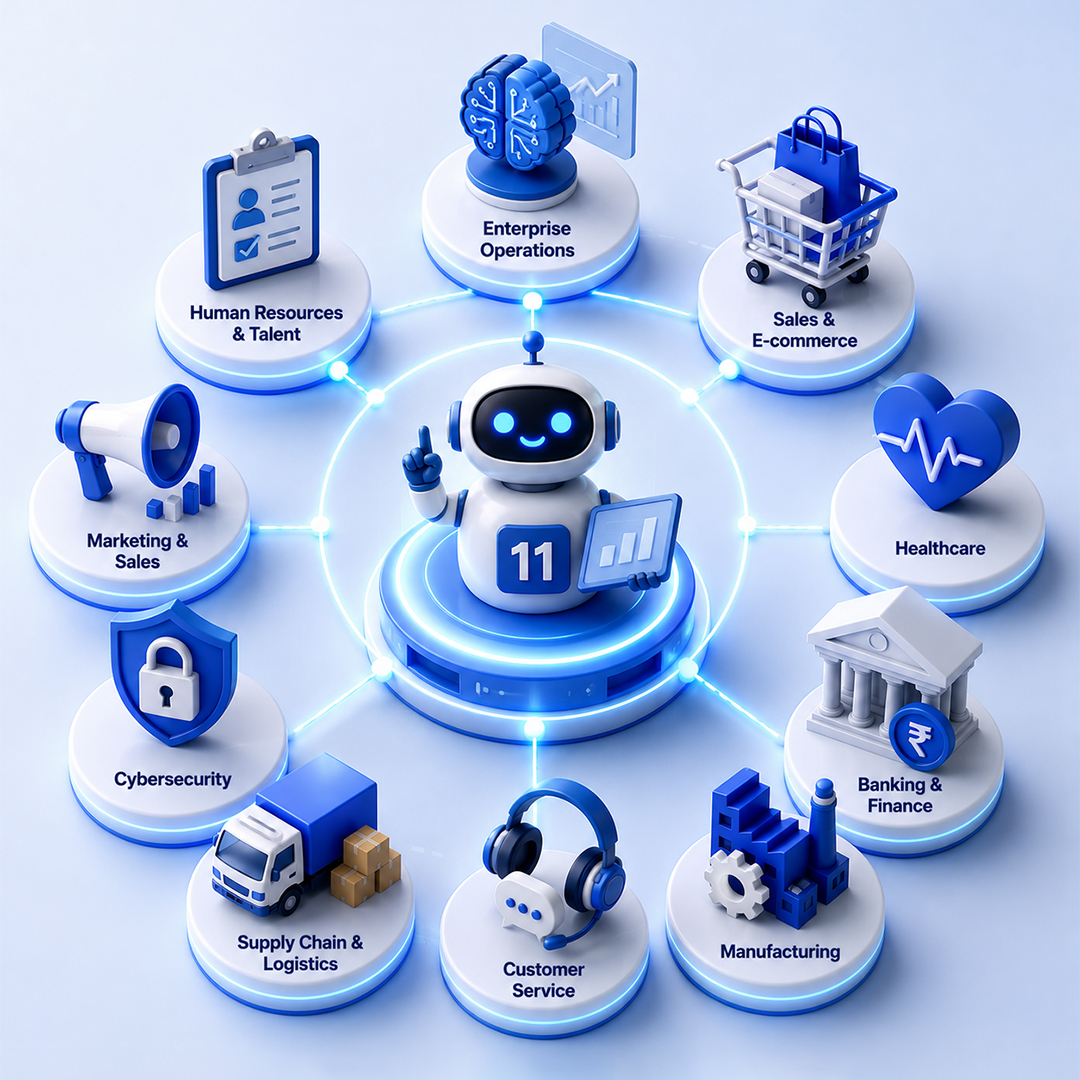
Introduction
Most enterprises are no longer asking whether they should adopt artificial intelligence. The more important question is where AI can create the greatest business impact.
Organizations face constant pressure to improve productivity, reduce operational costs, accelerate decision-making, and create competitive advantages. As a result, enterprise leaders are increasingly evaluating AI use cases in enterprise environments that can deliver measurable outcomes rather than experimental results.
The most successful AI initiatives are not driven by technology alone. They are driven by clear business objectives, strong implementation strategies, and measurable ROI. This guide explores 20 practical enterprise AI use cases that are already creating value across industries and business functions.
What are enterprise AI use cases?
Practical applications that solve business problems
Enterprise AI use cases are practical business applications where artificial intelligence helps organizations improve decision-making, automate processes, reduce costs, increase productivity, enhance customer experiences, or generate new revenue opportunities. These applications span departments including customer service, sales, marketing, finance, operations, supply chain, HR, compliance, and IT.
Rather than focusing on AI technology itself, enterprise AI use cases focus on solving business problems and delivering measurable outcomes. The most valuable use cases align AI capabilities with strategic objectives and operational priorities.
What makes an AI use case valuable?
Five criteria to evaluate before investing
Business Impact
Potential effect on revenue, costs, productivity, or customer experience.
Implementation Feasibility
Ease of deployment and organizational readiness.
Data Availability
Access to quality data needed for AI systems.
Scalability
Ability to expand across departments and workflows.
ROI Potential
Expected business value relative to investment.
The strongest AI projects typically score well across all five areas.
The top 20 enterprise AI use cases with measurable ROI
Practical applications already creating value across industries
1. Customer Service Automation
AI handles common inquiries, support requests, and customer interactions. ROI comes from reduced ticket volumes, faster response times, and improved service availability. Common in retail, SaaS, telecommunications, and financial services.
2. AI-Powered Knowledge Management
AI helps employees quickly find information across documents, policies, and internal systems. Benefits include reduced search time, improved productivity, and faster onboarding.
3. Sales Lead Qualification
AI evaluates leads based on behavior, demographics, and engagement signals. Sales teams spend more time on qualified opportunities and less time on manual screening.
4. Predictive Sales Forecasting
AI analyzes historical sales data and market trends to improve forecasting accuracy. Organizations benefit from better planning and resource allocation.
5. Marketing Content Generation
AI assists with blogs, emails, social content, and campaign assets. ROI is driven by increased content production efficiency and reduced content creation costs.
6. Personalized Customer Experiences
AI tailors recommendations, communications, and digital experiences based on customer behavior. Improved engagement and conversion rates are common outcomes.
7. HR Recruiting Assistance
AI helps screen resumes, identify qualified candidates, and support recruiting workflows. Benefits include reduced hiring time and improved recruiter productivity.
8. Employee Onboarding Automation
AI assists new employees by providing information, answering questions, and guiding onboarding processes. This improves employee experiences and reduces administrative effort.
9. IT Help Desk Automation
AI resolves common IT issues, answers support questions, and assists with troubleshooting. Benefits include faster issue resolution and lower support costs.
10. Document Processing & Extraction
AI extracts information from contracts, forms, invoices, and business documents. Organizations reduce manual processing time and improve accuracy.
11. Invoice Processing
AI automates invoice classification, validation, and routing. Finance teams benefit from faster processing cycles and fewer manual errors.
12. Financial Forecasting
AI supports budgeting, forecasting, and financial planning. Improved visibility and forecasting accuracy help leadership make better decisions.
13. Fraud Detection
AI identifies unusual patterns and potential fraudulent activities in real time. Financial institutions, insurers, and ecommerce companies frequently use this capability.
14. Supply Chain Optimization
AI helps optimize inventory, logistics, supplier performance, and operational planning. Benefits include cost reduction and improved service levels.
15. Demand Forecasting
AI predicts customer demand using historical and market data. Organizations improve inventory management and reduce stock-related issues.
16. Procurement Intelligence
AI analyzes spending patterns, vendor performance, and purchasing opportunities. Benefits include cost savings and improved procurement decisions.
17. Predictive Maintenance
AI predicts equipment failures before they occur. Manufacturing, energy, and industrial organizations often achieve significant reductions in downtime.
18. Compliance Monitoring
AI continuously reviews activities, documents, and transactions for compliance risks. Benefits include risk reduction and improved regulatory readiness.
19. Business Intelligence & Reporting
AI accelerates reporting, identifies trends, and generates insights from large datasets. Leaders gain faster access to decision-support information.
20. AI Agents for Workflow Automation
AI agents execute multi-step workflows across systems and departments. Common benefits include reduced manual effort, faster execution, and improved operational efficiency.
Which AI use cases deliver ROI fastest?
Three categories based on implementation timeline
Quick-Win AI Projects
These projects often deliver value quickly because implementation complexity is relatively low:
- Customer service automation
- Knowledge management
- Document processing
Medium-Term ROI Projects
These initiatives require more planning but often produce meaningful business outcomes:
- Sales lead qualification
- Marketing optimization
- HR automation
Strategic Transformation Projects
These initiatives create long-term competitive advantages:
- Supply chain optimization
- Enterprise AI agents
- Cross-functional automation programs
The 5 characteristics of successful enterprise AI programs
What high-performing AI programs share
1. Clear Business Objectives
Successful organizations start with measurable business outcomes rather than technology experiments.
2. High-Quality Data
Reliable data improves AI performance and reduces implementation risk.
3. Executive Sponsorship
Leadership support accelerates adoption and resource allocation.
4. Cross-Functional Collaboration
Business, technology, and operations teams must work together.
5. Continuous Optimization
AI initiatives require ongoing monitoring, improvement, and governance.
Common AI adoption mistakes
Challenges organizations frequently encounter
- Starting with technology instead of business goals
- Trying to automate everything simultaneously
- Ignoring change management
- Working with poor-quality data
- Lacking governance structures
- Expecting immediate transformation
The most successful programs start small, measure results, and scale gradually.
How to prioritize AI opportunities in your organization
A five-step process
Step 1: Identify Repetitive Processes
Look for tasks that consume significant employee time.
Step 2: Quantify Business Impact
Estimate cost savings, productivity improvements, or revenue potential.
Step 3: Assess Data Readiness
Determine whether sufficient data exists to support the initiative.
Step 4: Evaluate Implementation Complexity
Consider integrations, workflows, compliance requirements, and organizational readiness.
Step 5: Prioritize and Pilot
Launch small-scale pilots before broader deployment.
Enterprise AI ROI framework
Five core dimensions to evaluate AI success
Cost Reduction
Lower operational expenses through automation and efficiency gains.
Productivity Gains
Enable employees to accomplish more with fewer manual tasks.
Revenue Growth
Improve customer acquisition, retention, and sales effectiveness.
Risk Reduction
Strengthen compliance, fraud prevention, and operational resilience.
Customer Experience Improvements
Deliver faster, more personalized, and more consistent interactions.
The strongest AI business cases typically combine several of these benefits.
What to expect in 2026 and beyond
Several trends shaping the future of enterprise AI
Growth of Agentic AI
More organizations deploy systems capable of independent, multi-step task execution.
Enterprise AI platforms
Vendors offer more mature, enterprise-ready AI infrastructure.
AI copilots embedded across workflows
AI assistance becomes a standard part of everyday business tools.
Increased workflow automation
More business processes become candidates for intelligent automation.
More autonomous business operations
Systems take on greater responsibility across enterprise workflows.
Organizations that build strong AI foundations today will be better positioned to capitalize on future opportunities.
Frequently asked questions
Common questions about enterprise AI use cases
What are the best AI use cases in enterprise?
Customer service automation, knowledge management, sales optimization, document processing, and workflow automation are among the most widely adopted and impactful use cases.
Which AI projects deliver ROI fastest?
Customer support, document processing, and internal knowledge management projects often provide relatively fast returns due to lower implementation complexity.
What departments benefit most from AI?
Customer service, operations, finance, HR, marketing, sales, IT, and supply chain functions can all benefit from AI initiatives.
How do enterprises measure AI ROI?
Organizations typically measure cost savings, productivity gains, revenue impact, risk reduction, and customer experience improvements.
What is the most common enterprise AI use case?
Customer service automation remains one of the most common and widely implemented enterprise AI applications.
How should organizations prioritize AI projects?
Prioritize initiatives based on business impact, data readiness, implementation complexity, scalability, and expected ROI.
What industries benefit most from enterprise AI?
Financial services, healthcare, manufacturing, retail, logistics, technology, and professional services all benefit significantly from AI adoption.
How do businesses get started?
Begin with a high-value business problem, assess data readiness, launch a pilot project, measure outcomes, and scale successful initiatives.
Conclusion
Enterprise AI is already delivering measurable value across customer service, finance, operations, HR, supply chain, and business intelligence functions.
The greatest results come from selecting use cases that align with business priorities and measurable outcomes. Organizations that focus on high-impact opportunities, establish strong foundations, and scale strategically are far more likely to realize sustainable ROI from AI investments.
Success is not determined by how much AI is deployed, but by how effectively it solves real business challenges.
Ready to prioritize your enterprise AI roadmap?
As organizations move from AI experimentation to measurable business outcomes, selecting the right use cases becomes one of the most important decisions. Kambaa helps businesses identify, prioritize, implement, and scale AI initiatives across customer service, operations, finance, knowledge management, automation, and enterprise transformation programs.