
SaaS MVP Development: How to Build and Launch in 12 Weeks
Many founders spend months building products before confirming whether customers actually need them. The purpose of SaaS MVP development is not to create a complete platform—it is to validate assumptions, gather feedback, and reduce risk as quickly as possible.
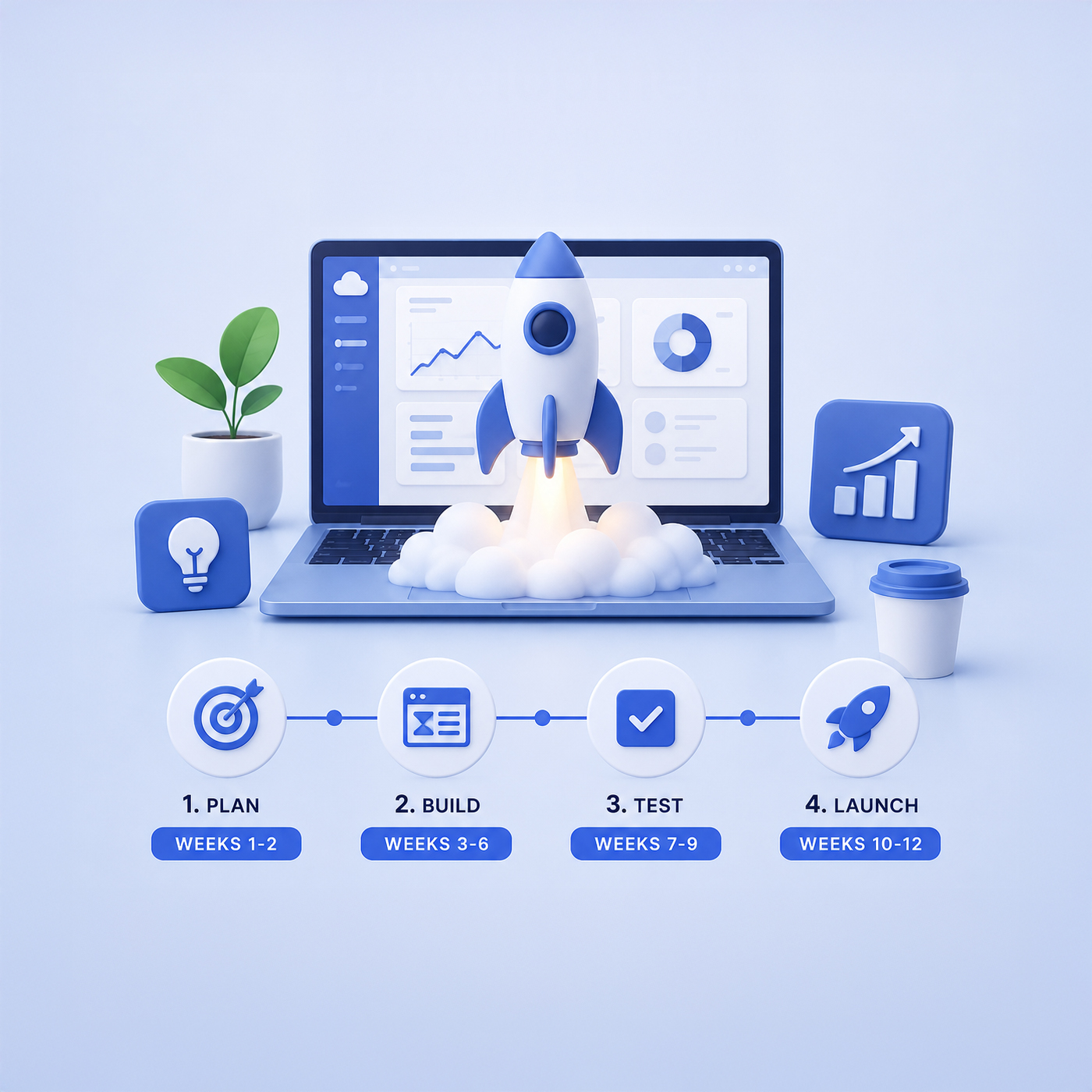
A focused MVP helps startups learn faster, avoid wasted development costs, and move toward product-market fit with real customer insights.
What Is SaaS MVP Development?
SaaS MVP development is the process of building the simplest version of a Software-as-a-Service product that delivers core value to users with minimal time, cost, and effort. Its purpose is to test market demand, validate business assumptions, collect customer feedback, and reduce product risk before investing in a full-scale solution.
Rather than building every planned feature, an MVP focuses on solving one important customer problem. The goal is learning and validation, not feature completeness.
Why Most SaaS MVPs Fail
Most MVP failures stem from losing focus on validation. Common mistakes include:
Successful founders launch early, learn from users, and iterate quickly.
MVP vs Full SaaS Product
| Area | SaaS MVP | Full SaaS Product |
|---|---|---|
| Objective | Validate assumptions | Scale business growth |
| Feature Scope | Core features only | Comprehensive functionality |
| Timeline | Weeks to months | Months to years |
| Budget | Lower investment | Larger investment |
| Risk | Reduced risk | Higher commitment |
| User Feedback | Early validation | Ongoing optimization |
| Scalability | Basic scalability | Enterprise readiness |
| Development Complexity | Limited scope | Advanced architecture |
| Market Validation | Primary focus | Already validated |
| Growth Readiness | Early stage | Mature stage |
The 12-Week SaaS MVP Development Roadmap
Problem Validation
Objective: Confirm the problem exists.
Activities: Customer interviews.
Deliverable: Problem statement.
Mistake: Assuming demand.
Customer Discovery
Objective: Understand users.
Activities: Research and segmentation.
Deliverable: Customer personas.
Mistake: Targeting everyone.
Market Research
Objective: Analyze competitors.
Activities: Market review.
Deliverable: Positioning strategy.
Mistake: Copying competitors.
MVP Scope Definition
Objective: Define essential features.
Activities: Prioritization.
Deliverable: MVP feature list.
Mistake: Including future features.
Product Wireframes
Objective: Map workflows.
Activities: Wireframing.
Deliverable: User journeys.
Mistake: Designing everything.
UX/UI Design
Objective: Create usable screens.
Activities: Interface design.
Deliverable: MVP-ready designs.
Mistake: Prioritizing visuals over usability.
Backend Development
Objective: Build core logic.
Activities: Database and API development.
Deliverable: Functional backend.
Mistake: Overengineering.
Frontend Development
Objective: Build user-facing screens.
Activities: UI implementation.
Deliverable: Working frontend.
Mistake: Excessive customization.
Core Feature Completion
Objective: Connect workflows.
Activities: Integration and refinement.
Deliverable: End-to-end functionality.
Mistake: Adding new requirements.
Testing & QA
Objective: Ensure stability.
Activities: Functional testing.
Deliverable: Tested MVP.
Mistake: Ignoring critical bugs.
Beta Launch
Objective: Release to early users.
Activities: Controlled rollout.
Deliverable: Initial feedback.
Mistake: Launching too broadly.
Feedback & Iteration Planning
Objective: Review results.
Activities: Analyze metrics and feedback.
Deliverable: Improvement roadmap.
Mistake: Ignoring user insights.
What Features Should Be Included in an MVP?
Focus only on features required to validate demand.
Must-Have Features
- Core workflow
- User authentication
- Essential data management
- Basic onboarding
Nice-to-Have Features
- Integrations
- Advanced analytics
- Automation
Future Features
- AI capabilities
- Enterprise permissions
- Advanced reporting
How to Prioritize SaaS MVP Features
Define the Core Problem
Identify the primary customer pain point.
Identify the Core Workflow
Map the shortest path to solving it.
Remove Non-Essential Functionality
Cut anything that does not support validation.
Validate With Customers
Confirm priorities through interviews.
Build Only What Supports Validation
Invest development effort where learning occurs.
SaaS MVP Architecture Basics
Frontend
The interface users interact with.
Backend
Handles business logic and workflows.
Database
Stores application and user data.
Authentication
Manages login and access control.
Cloud Infrastructure
Hosts the application and supports growth.
Founders should keep architecture simple but scalable enough for future expansion.
Real SaaS MVP Example
Example: Project Management SaaS MVP
Problem: Small teams struggle to track projects efficiently.
Included Features:
- User accounts
- Task management
- Project boards
- Team collaboration
Excluded Features:
- AI recommendations
- Time tracking
- Advanced analytics
- Third-party integrations
Timeline: 12 weeks
Validation Goals: Measure activation, retention, and workflow adoption.
Expected Outcome: Determine whether teams consistently use the platform before expanding functionality.
Typical SaaS MVP Costs
No-Code MVP: Typically $5,000–$20,000 for rapid validation.
Startup MVP: Typically $20,000–$75,000 for most early-stage SaaS products.
Custom SaaS MVP: Typically $75,000–$200,000+ for complex workflows and custom functionality.
Common SaaS MVP Development Mistakes
Avoid:
- Building before validation
- Overengineering architecture
- Chasing competitor feature parity
- Ignoring customer interviews
- Launching too late
- Tracking vanity metrics
Remember: the goal is learning, not feature accumulation.
The 8 Metrics Founders Should Track After Launch
What Happens After the MVP?
Iterate: Improve based on user feedback.
Improve: Refine workflows and usability.
Expand: Add validated features.
Scale: Invest in infrastructure and growth.
The MVP is the starting point, not the final product.
SaaS MVP Planning Worksheet
- Problem Statement: What problem are you solving?
- Target Audience: Who has this problem?
- Core Workflow: What is the primary user journey?
- Must-Have Features: What is essential for validation?
- Validation Goals: What assumptions must be proven?
- Launch Criteria: What defines readiness?
- Success Metrics: How will success be measured?
What to Expect in 2026 and Beyond
SaaS MVP development will continue to accelerate through:
Founders who learn quickly and iterate consistently will maintain an advantage.
Frequently Asked Questions
Conclusion
A SaaS MVP reduces risk by helping founders validate ideas before making major investments. The most successful startups focus on solving one problem, launching quickly, and learning from real users.
In SaaS, rapid validation and continuous iteration consistently outperform long development cycles.
Ready to Build Your SaaS MVP?
As founders move from ideas to execution, a structured MVP strategy can significantly improve the chances of building a successful SaaS product.
Kambaa helps startups and enterprises validate ideas, define MVP scope, build SaaS products, integrate AI capabilities, and scale platforms through outcome-focused product development.