
AI in Retail:RPA vs AI Automation: Key Differences Explained
Understand the differences between Robotic Process Automation and AI Automation, including capabilities, use cases, implementation complexity, scalability, and business value.
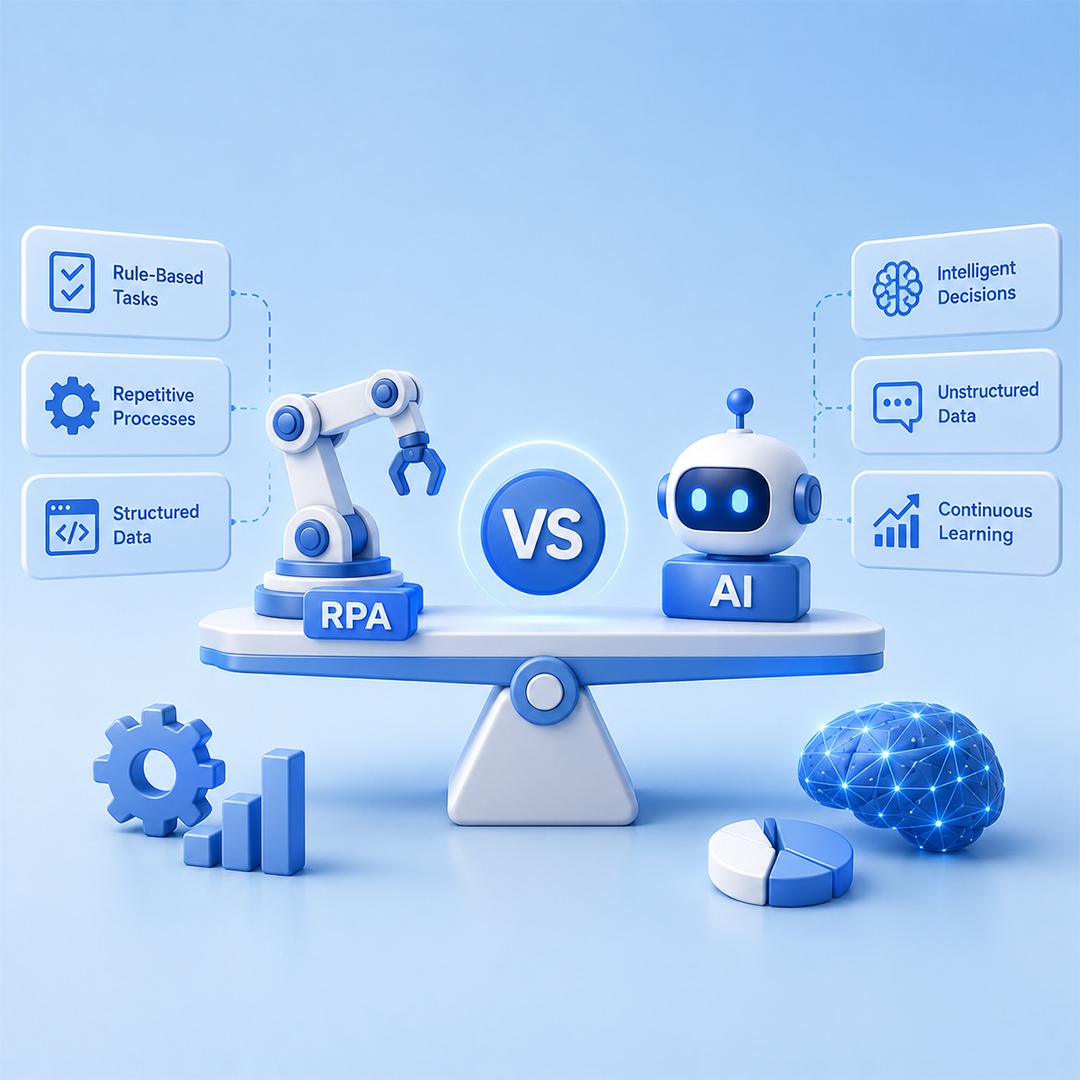
Organizations across industries are investing heavily in automation to improve efficiency, reduce costs, increase productivity, and accelerate digital transformation.
However, one of the most common questions technology leaders ask is whether they should invest in Robotic Process Automation (RPA) or AI Automation. Although both technologies aim to improve business processes, they solve different problems and offer different capabilities.
RPA
RPA focuses on automating repetitive, rule-based tasks.
AI Automation
AI Automation introduces intelligence, adaptability, decision-making, and learning capabilities into business workflows.
Understanding the differences between RPA vs AI Automation is critical when evaluating automation strategies, process optimization initiatives, and enterprise transformation programs. This guide provides a structured comparison of RPA vs AI Automation, explores RPA vs Intelligent Automation, and explains how organizations can choose the right automation approach based on business objectives.
RPA vs AI Automation At a Glance
Choose RPA if you need:
- Data entry automation
- Invoice processing
- Rules-based workflows
- Legacy system automation
- Quick automation wins
Choose AI Automation if you need:
- Intelligent document processing
- Customer service automation
- Decision support
- Predictive analytics
- Enterprise process optimization
For many organizations, the best approach combines RPA and AI Automation. RPA handles repetitive execution while AI adds intelligence, adaptability, and decision-making.
What Is RPA?
Robotic Process Automation (RPA) is a technology that automates repetitive, rule-based business tasks by mimicking human interactions with software systems. RPA bots follow predefined instructions and execute tasks consistently and accurately. The technology is particularly effective when processes are highly structured and predictable.
How RPA Works
- Read information
- Apply predefined rules
- Execute actions
- Move data between systems
- Complete repetitive tasks
The automation follows programmed logic and does not make independent decisions.
Business Benefits of RPA
Reduced manual effort, improved process speed, lower operational costs, higher accuracy, better compliance, scalable execution. RPA is often one of the fastest ways for organizations to begin their automation journey.
Common RPA Use Cases
Invoice processing, Data entry, Form submissions, Report generation, Employee onboarding, System synchronization, Claims processing, Account updates.
What Is AI Automation?
AI Automation combines artificial intelligence technologies with process automation to create systems capable of understanding, learning, reasoning, and adapting. Unlike traditional automation approaches, AI Automation can process information, interpret context, make decisions, and continuously improve performance.
How AI Automation Works
- Interpret data
- Understand language
- Recognize patterns
- Generate responses
- Make recommendations
- Execute workflows
- Adapt to changing conditions
Unlike RPA, AI Automation is not limited to predefined rules.
Business Benefits
Operational optimization, improved decision-making, enhanced customer experiences, greater scalability, reduced manual intervention, continuous improvement, enterprise transformation. AI Automation enables organizations to automate not only tasks but also business processes that require intelligence.
Components of AI Automation
Artificial Intelligence, Machine Learning, Generative AI, Natural Language Processing, Document Intelligence, Predictive Analytics, Workflow Automation, Decision Intelligence.
RPA vs AI Automation: Quick Comparison
| Category | RPA | AI Automation |
|---|---|---|
| Primary Purpose | Task automation | Intelligent process automation |
| Decision Making | Rule-based | AI-driven |
| Data Handling | Structured data | Structured and unstructured data |
| Structured Data Support | Excellent | Excellent |
| Unstructured Data Support | Limited | Excellent |
| Learning Capability | None | Continuous learning and adaptation |
| Adaptability | Low | High |
| Workflow Complexity | Simple to moderate | Moderate to complex |
| Scalability | High | Very high |
| Maintenance | Requires updates when processes change | Can adapt to changing inputs |
| Business Impact | Operational efficiency | Business transformation |
| Implementation Effort | Lower | Moderate to higher |
| Best Use Cases | Repetitive tasks | Intelligent workflows |
Key Takeaway:
RPA automates tasks. AI Automation automates decisions, workflows, and business outcomes.
Deep Dive: Key Differences
The differences between RPA vs AI Automation become clearer when comparing how each technology operates.
Decision Making
Follows predefined rules. Cannot make decisions beyond programmed instructions.
Can evaluate information and make decisions based on context.
Data Processing
Works best with structured data.
Handles structured and unstructured data (Documents, Emails, Images, Voice, Reports).
Workflow Complexity
Works best with repetitive processes.
Supports complex workflows involving multiple variables and decision points.
Adaptability
Requires reconfiguration when processes change.
Can adapt to changing inputs and business conditions.
Learning Capability
Does not learn.
Can improve through machine learning and feedback loops.
Maintenance Requirements
Frequent updates may be needed when systems change.
Often requires model monitoring and optimization rather than rule updates.
Business Value
Improves efficiency.
Transforms operations and decision-making.
Scalability
Scales repetitive processes.
Scales knowledge work, decisions, and business processes.
RPA vs Intelligent Automation: Enterprise Implications
How They Operate
Intelligent Automation combines RPA, AI, ML, Document Intelligence, Workflow Automation, and Decision Intelligence. Its primary objective is process optimization and business outcomes, while traditional RPA focuses on efficiency.
Enterprise Implications & Scalability
Traditional RPA improves operational efficiency. Intelligent Automation transforms business operations. RPA scales repetitive activities; Intelligent Automation scales decisions and workflows.
Automation & Future
Intelligent Automation offers significantly broader automation opportunities. Many organizations begin with RPA and gradually evolve toward AI-powered automation ecosystems.
Business Use Cases
As workflows become more complex and decision-driven, AI Automation becomes increasingly valuable.
| Use Case | RPA | AI Automation | Best Choice |
|---|---|---|---|
| Invoice Processing | Excellent | Excellent | RPA |
| Claims Processing | Good | Excellent | AI Automation |
| Customer Service | Limited | Excellent | AI Automation |
| Document Processing | Limited | Excellent | AI Automation |
| Data Entry | Excellent | Good | RPA |
| Compliance Monitoring | Good | Excellent | AI Automation |
| HR Operations | Good | Excellent | AI Automation |
| Finance Operations | Excellent | Excellent | AI Automation |
| IT Support | Limited | Excellent | AI Automation |
| Supply Chain Operations | Good | Excellent | AI Automation |
Cost & Implementation Comparison
| Area | RPA | AI Automation |
|---|---|---|
| Development Effort | Lower | Higher |
| Infrastructure | Lower | Moderate |
| Maintenance | Moderate | Moderate |
| Scalability | High | Very High |
| Integration Effort | Moderate | Higher |
| ROI Potential | High | Very High |
| Automation Scope | Limited | Broad |
Common Misconceptions
AI Automation Is Not Simply Advanced RPA
While both automate processes, AI Automation introduces intelligence, learning, and decision-making.
RPA Does Not Learn
Traditional RPA follows predefined rules and cannot improve autonomously.
AI Automation Is Not Always Required
Simple processes often benefit from RPA without requiring AI capabilities.
Business Objectives Should Drive Technology Selection
Organizations should focus on outcomes rather than technology labels.
Automation Maturity Matters
Businesses often achieve success by gradually evolving from RPA toward Intelligent Automation.
Which Option Is Right for Your Business?
| Business Goal | Recommended Solution |
|---|---|
| Data Entry | RPA |
| Invoice Processing | RPA |
| Document Intelligence | AI Automation |
| Customer Service Automation | AI Automation |
| Decision Support | AI Automation |
| Compliance Monitoring | AI Automation |
| Enterprise Process Optimization | AI Automation |
| Legacy System Automation | RPA |
| Workflow Intelligence | AI Automation |
| Predictive Operations | AI Automation |
Practical Guidance:
If your process is repetitive and predictable, RPA is often the best starting point.
If your process requires intelligence, interpretation, reasoning, or adaptability, AI Automation is generally the stronger choice.
How Kambaa Helps Organizations Implement Automation
Kambaa helps organizations evaluate, design, implement, and optimize automation solutions aligned with business objectives.
Automation Strategy
Identify automation opportunities and prioritize initiatives.
Process Assessment
Analyze workflows, bottlenecks, and automation potential.
RPA Implementation
Design and deploy rule-based automation solutions.
AI Automation Solutions
Implement intelligent workflows powered by AI technologies.
Intelligent Document Processing
Automate extraction, classification, and processing of business documents.
Workflow Automation
Optimize cross-functional business processes.
Enterprise Integration
Connect automation platforms with existing systems and applications.
Ongoing Optimization
Continuously improve automation performance and business outcomes.
Frequently Asked Questions
Conclusion: Which One Should You Choose?
There is no universal answer in the RPA vs AI Automation discussion. The right choice depends on your business objectives, process complexity, automation maturity, and long-term transformation goals.
Many organizations achieve the strongest results by combining both technologies as part of a broader Intelligent Automation strategy. Rather than viewing RPA vs Intelligent Automation as competing approaches, successful organizations often use them together to maximize automation value across the enterprise.
Evaluate Your Automation Needs
Begin with an automation assessment to identify high-value opportunities and define an implementation roadmap aligned with your business goals.