
RPA vs AI Automation: Complete Comparison for Decision Makers
Understand what each technology does best, where they excel, and how to build the right automation strategy.
Introduction
Organizations across industries are under constant pressure to improve efficiency, reduce costs, and automate repetitive work. As automation initiatives expand, decision-makers frequently encounter two major approaches: Robotic Process Automation (RPA) and AI Automation.
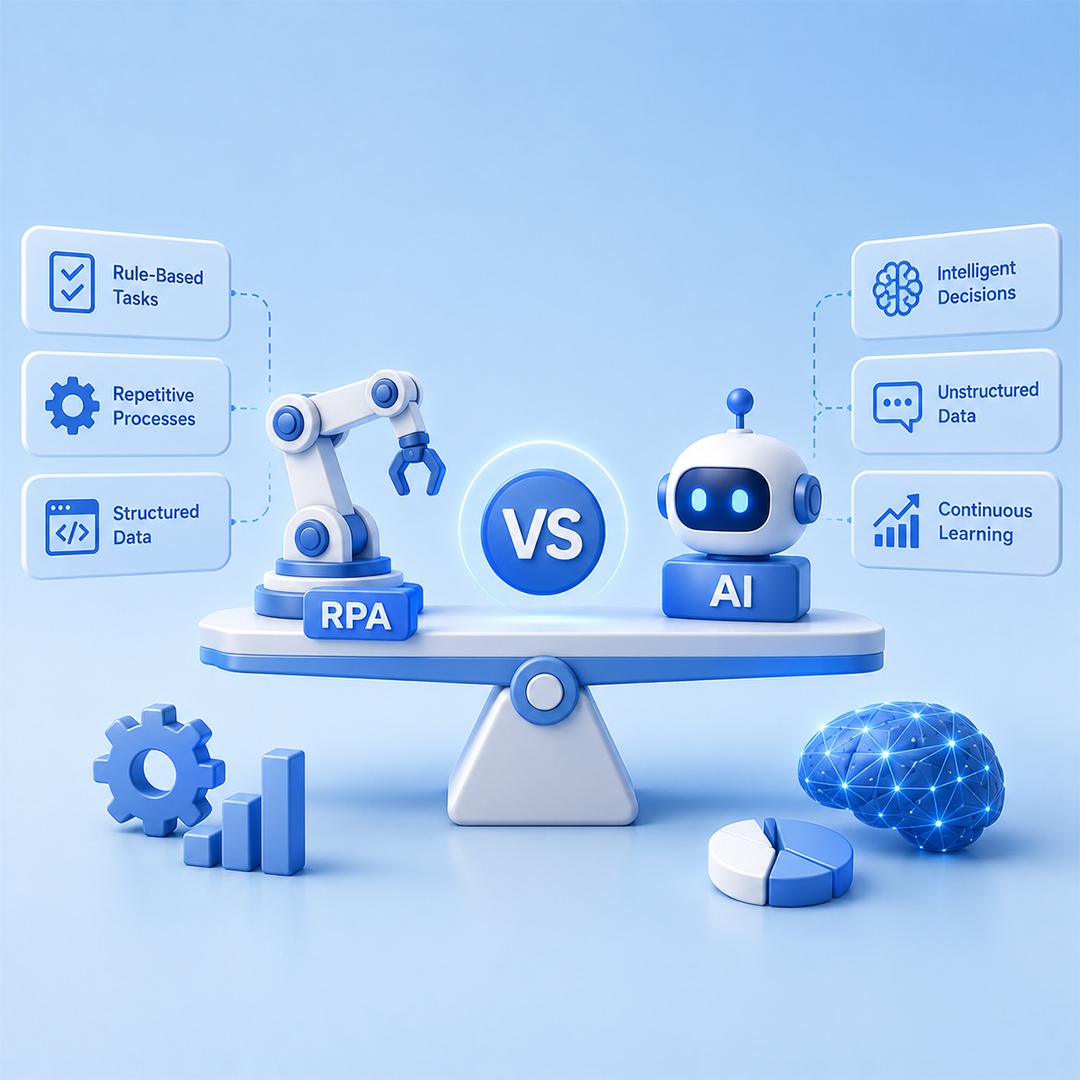
Although these terms are often used interchangeably, they solve fundamentally different business problems. RPA is designed to automate structured, rule-based tasks, while AI automation can interpret information, make decisions, and adapt to changing situations.
Understanding the differences between RPA vs AI automation is essential for building an effective automation strategy, selecting the right technology, and maximizing business value.
RPA vs AI Automation: Quick Answer
RPA
RPA (Robotic Process Automation) automates structured, repetitive, rule-based tasks by following predefined instructions. It is highly effective for predictable workflows where inputs and outputs are clearly defined.
AI Automation
AI Automation uses artificial intelligence technologies such as machine learning, natural language processing, generative AI, and AI agents to understand information, make decisions, and handle more dynamic business processes.
In simple terms:
RPA follows rules.
AI Automation interprets, reasons, and adapts.
Rather than choosing one over the other, many organizations combine RPA and AI automation to create intelligent workflows that automate both routine tasks and decision-driven processes.
What Is RPA?
Software bots following predefined rules
Robotic Process Automation (RPA) is a technology that uses software bots to perform repetitive digital tasks by following predefined rules and workflows.
RPA systems mimic human interactions with applications, databases, spreadsheets, and enterprise systems. They excel at handling structured processes that rarely change.
Typical RPA applications include:
- Data entry
- Invoice processing
- Form handling
- Report generation
- Compliance workflows
- System-to-system data transfers
For example, an RPA bot can copy invoice data from emails, enter it into an ERP system, and update accounting records without human involvement.
What Is AI Automation?
Interpretation, judgment, and decision-making
AI Automation combines artificial intelligence with workflow automation to automate tasks that require interpretation, judgment, learning, or decision-making.
Unlike RPA, AI automation can process unstructured information such as documents, emails, conversations, images, and business knowledge.
Common AI automation technologies include:
- Machine learning
- Natural language processing
- Generative AI
- Computer vision
- AI agents
Examples include customer support assistants, document understanding systems, intelligent knowledge management tools, and autonomous workflow agents. Rather than simply following rules, AI automation can evaluate context and adapt responses based on the situation.
RPA vs AI Automation: Key Differences
A side-by-side capability comparison
| Capability | RPA | AI Automation |
|---|---|---|
| Primary Purpose | Automate repetitive tasks | Automate decisions and workflows |
| Type of Tasks | Structured and predictable | Structured and unstructured |
| Data Requirements | Standardized data | Can process diverse data types |
| Decision Making | Rule-based | Context-aware |
| Adaptability | Limited | High |
| Learning Capability | None | Learns from data and feedback |
| Complexity | Lower | Higher |
| Scalability | Process-specific | Enterprise-wide opportunities |
| Human Involvement | Process setup and monitoring | Oversight and optimization |
| Typical Use Cases | Data entry, invoicing, reporting | Customer service, document analysis, AI agents |
| Implementation Effort | Usually faster | Often requires more planning |
| Long-Term Value | Efficiency gains | Efficiency plus decision support and innovation |
How RPA Works
RPA follows a simple process:
1. Process Is Defined
Business rules and workflow steps are documented.
2. Rules Are Configured
Automation logic is programmed into software bots.
3. Bot Executes Steps
The bot performs the assigned workflow exactly as configured.
4. Output Is Generated
Results are delivered to users or connected systems.
Example: An invoice-processing bot extracts invoice information, enters data into accounting software, and generates confirmation records.
How AI Automation Works
AI automation follows a more dynamic process:
1. Goal Is Defined
The desired business outcome is identified.
2. Data Is Analyzed
The AI system reviews relevant information.
3. AI Interprets Information
Context, intent, and patterns are evaluated.
4. Decisions Are Made
The system determines appropriate actions.
5. Actions Are Executed
Workflows, responses, or recommendations are generated.
6. Outcomes Are Monitored
Performance data is used to improve future results.
Example: An AI customer service agent understands customer intent, retrieves relevant information, resolves issues, and escalates only complex cases.
Where Each Technology Excels
Where RPA Excels & Where AI Automation Excels
Where RPA Excels
Data Entry
RPA is highly effective for transferring information between systems without manual effort.
Invoice Processing
Rule-based invoice handling remains one of the most common RPA use cases.
Form Handling
Standardized forms with predictable formats can be processed efficiently.
System-to-System Workflows
RPA helps connect legacy systems without extensive redevelopment.
Compliance Processes
Routine compliance reporting and documentation workflows are ideal candidates for automation.
Where AI Automation Excels
Customer Service
AI can understand questions, retrieve information, and provide personalized responses.
Document Understanding
Contracts, invoices, emails, and reports can be analyzed without predefined templates.
Knowledge Management
AI systems can search, summarize, and retrieve information from large knowledge repositories.
Sales & Marketing Automation
AI helps with lead qualification, content generation, forecasting, and campaign optimization.
AI Agents & Workflow Automation
AI agents can coordinate multi-step processes across multiple systems and departments.
RPA and AI Automation: Better Together
Many organizations achieve the greatest value by combining both technologies.
For example:
This approach is often called intelligent automation or hyperautomation.
Instead of replacing RPA, AI extends automation capabilities by enabling systems to handle more complex and variable business processes.
Which Technology Should You Choose?
Match the technology to your process characteristics
Choose RPA If:
- Processes are highly structured.
- Rules rarely change.
- Data formats are predictable.
- Quick automation wins are needed.
- The goal is efficiency improvement.
Choose AI Automation If:
- Decisions require context.
- Unstructured data is involved.
- Customer interactions are important.
- Processes change frequently.
- Knowledge work needs automation.
Combine Both If:
- End-to-end automation is required.
- Multiple systems must be connected.
- Documents require interpretation.
- Human decision-making limits scalability.
- Enterprise transformation is a priority.
Cost Considerations
RPA projects often require lower initial investment because workflows are predictable and implementation is relatively straightforward.
AI automation projects may require larger investments due to data preparation, model deployment, governance, and ongoing optimization.
Maintenance also differs. RPA bots can break when applications change, while AI systems require monitoring, retraining, and governance.
Organizations should evaluate costs based on long-term business value rather than initial implementation expenses alone.
Common Automation Mistakes
Many automation initiatives struggle because of avoidable mistakes
Successful programs start with business objectives and then select the appropriate automation approach.
The Future of Enterprise Automation
Enterprise automation is moving toward intelligent, connected systems that combine multiple technologies.
Key trends include:
Organizations are increasingly building automation ecosystems where RPA, AI, analytics, and enterprise applications work together.
Frequently Asked Questions
Common questions about RPA and AI automation
What is the difference between RPA and AI automation?
RPA automates predefined, rule-based tasks, while AI automation uses artificial intelligence to interpret information, make decisions, and adapt to changing situations.
Is AI automation replacing RPA?
No. AI automation is expanding automation capabilities, but RPA remains highly effective for structured, repetitive workflows.
Can RPA use AI?
Yes. Many organizations combine RPA with machine learning, document understanding, generative AI, and AI agents to create intelligent automation solutions.
Which is better for customer service?
AI automation is generally better suited for customer service because it can understand language, interpret intent, and provide dynamic responses.
Which is more expensive?
AI automation often requires greater investment due to data, governance, and model management requirements, while RPA implementations are typically simpler and faster to deploy.
What industries benefit most?
Financial services, healthcare, manufacturing, retail, logistics, telecommunications, and professional services all benefit from both RPA and AI automation.
Can small businesses use these technologies?
Yes. Cloud-based automation platforms have made both RPA and AI automation accessible to organizations of all sizes.
Should organizations use both?
In many cases, yes. Combining RPA and AI enables businesses to automate both routine tasks and more complex decision-driven workflows.
Conclusion
RPA and AI automation are complementary technologies rather than competing solutions.
RPA delivers exceptional value for structured, rule-based processes, while AI automation excels in areas that require interpretation, reasoning, adaptability, and decision-making. The most successful organizations evaluate automation opportunities based on business objectives, process characteristics, and long-term value creation. In many cases, combining both approaches creates the strongest foundation for scalable enterprise automation.
As organizations evaluate automation opportunities, understanding the strengths of RPA and AI automation is critical for long-term success.
Kambaa helps businesses identify automation opportunities, implement intelligent workflows, deploy AI agents, integrate RPA solutions, and build scalable automation programs aligned with business goals.