
AI in Retail: The Complete Personalization Playbook
Modern consumers expect personalized experiences across every channel. They want relevant product recommendations, timely offers, consistent interactions, and frictionless shopping journeys whether they shop online, in-store, or through mobile apps.
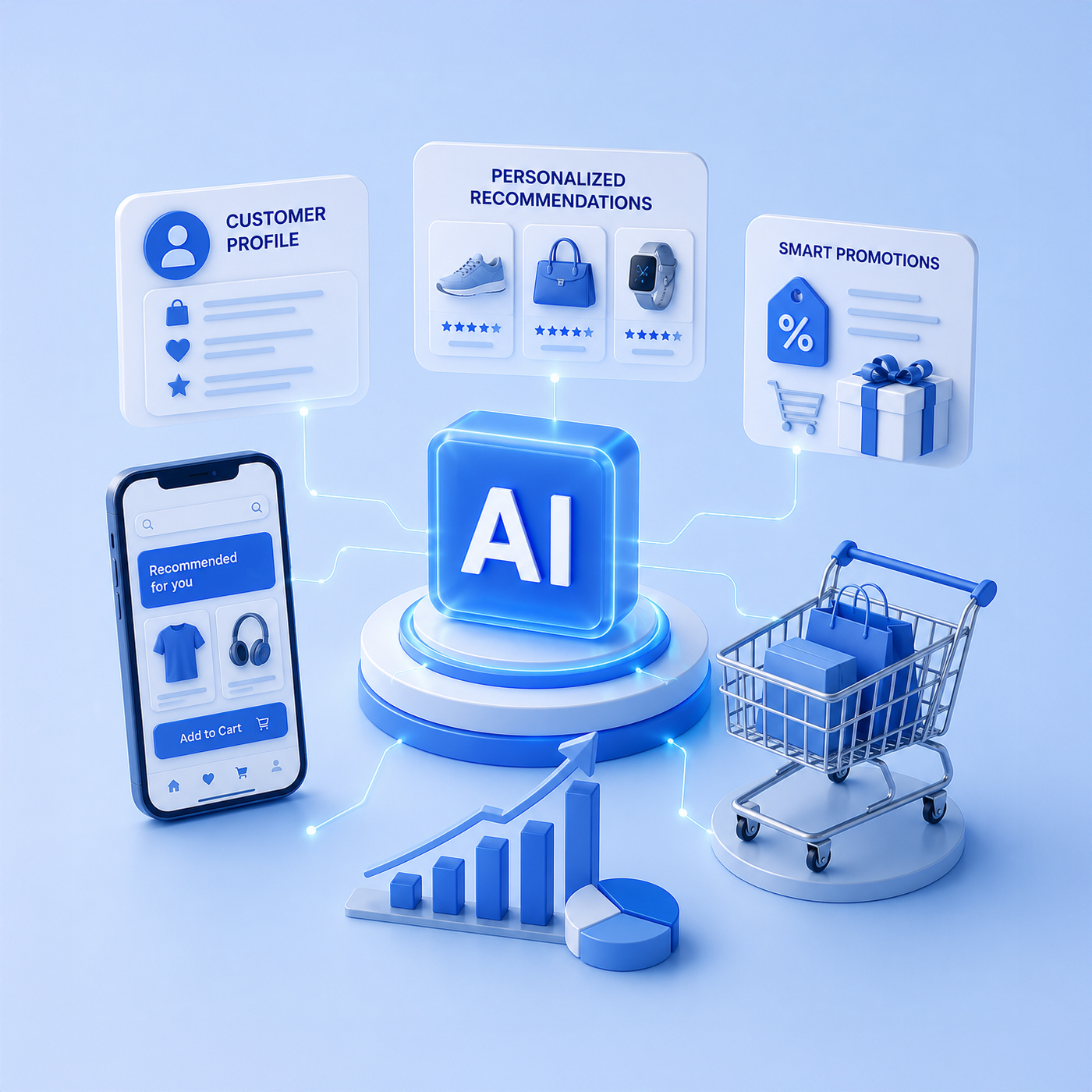
As customer expectations continue to rise, AI in retail is helping organizations deliver personalization at a scale that would be impossible through manual processes alone. Rather than replacing retail teams, AI enables smarter decisions, better customer understanding, and more efficient operations.
What Is AI in Retail?
AI in retail refers to the use of artificial intelligence technologies such as machine learning, predictive analytics, recommendation engines, computer vision, natural language processing, and generative AI to improve customer experiences, optimize operations, personalize shopping journeys, and support retail decision-making.
AI helps retailers analyze customer behavior, predict demand, automate repetitive processes, improve merchandising decisions, optimize inventory, and deliver relevant interactions across digital and physical channels. By transforming large volumes of customer and operational data into actionable insights, AI enables retailers to improve customer satisfaction, increase revenue opportunities, and operate more efficiently while maintaining human oversight and strategic control.
Why Personalization Is a Priority
Several trends are driving AI adoption:
Personalization is increasingly becoming a business necessity rather than a marketing advantage.
The 15 Most Important AI Use Cases in Retail
1. Product Recommendation Engines
Suggest relevant products based on customer behavior, improving discovery and conversion rates.
2. Personalized Search Results
Ranks products based on customer preferences and intent, creating more relevant shopping experiences.
3. Customer Segmentation
Groups customers using behavioral and purchase data to improve targeting.
4. Dynamic Pricing Support
Helps retailers optimize pricing strategies based on market conditions and demand signals.
5. Personalized Promotions
Delivers targeted offers to increase engagement and purchase likelihood.
6. Demand Forecasting
Predicts future demand to support inventory planning and replenishment.
7. Inventory Optimization
Balances stock levels across channels while reducing shortages and excess inventory.
8. Customer Churn Prediction
Identifies customers at risk of leaving, enabling proactive retention efforts.
9. Customer Service Virtual Assistants
Provides automated support for routine inquiries while escalating complex issues.
10. Visual Search
Allows shoppers to find products using images instead of keywords.
11. Personalized Email Marketing
Creates more relevant campaigns based on customer interests and behaviors.
12. Store Operations Optimization
Improves staffing, scheduling, and resource allocation decisions.
13. Customer Sentiment Analysis
Analyzes reviews and feedback to identify customer concerns and opportunities.
14. Merchandising Optimization
Supports product assortment and placement decisions using data insights.
15. Loyalty Program Personalization
Tailors rewards and incentives to individual customer preferences.
Traditional vs AI-Powered Personalization
| Area | Traditional Retail Approach | AI-Powered Retail Approach |
|---|---|---|
| Product Recommendations | Generic suggestions | Personalized recommendations |
| Promotions | Broad campaigns | Individualized offers |
| Search Experiences | Keyword-based | Intent-driven results |
| Customer Segmentation | Static segments | Dynamic behavioral segments |
| Demand Forecasting | Historical trends | Predictive forecasting |
| Inventory Planning | Manual planning | Real-time optimization |
| Customer Service | Reactive support | Intelligent assistance |
Building an AI Strategy
Phase 1: Understand Customer Data
Assess available customer, transaction, and engagement data.
Phase 2: Identify High-Impact Use Cases
Focus on opportunities with measurable customer and business value.
Phase 3: Launch Personalization Pilots
Test targeted use cases before large-scale deployment.
Phase 4: Measure Customer Outcomes
Track customer engagement, satisfaction, and conversion improvements.
Phase 5: Scale Across Channels
Expand successful initiatives across web, mobile, stores, and marketing channels.
Which Retailers Benefit Most?
E-commerce Retailers
Recommendations, search optimization, and personalization.
Omnichannel Retailers
Unified customer experiences across physical and digital channels.
Grocery & Consumer Goods Retailers
Demand forecasting and inventory optimization.
Fashion Retailers
Personalized recommendations and merchandising optimization.
Marketplace Businesses
Product discovery, search, and customer engagement improvements.
Real-World Scenarios
Example 1: Personalized Product Recommendations
Challenge: Low product discovery rates.
AI Solution: Recommendation engine.
Expected Outcome: Improved conversion and basket size.
Example 2: Inventory Optimization Across Stores
Challenge: Stock imbalances.
AI Solution: Predictive demand forecasting.
Expected Outcome: Better product availability.
Example 3: Customer Retention Improvement
Challenge: Increasing customer churn.
AI Solution: Churn prediction models.
Expected Outcome: Higher customer loyalty.
Example 4: Personalized Promotions Program
Challenge: Poor campaign performance.
AI Solution: AI-driven offer personalization.
Expected Outcome: Improved engagement and conversions.
Benefits
Improved Customer Experiences
More relevant and personalized interactions.
Higher Conversion Rates
Better recommendations lead to increased purchases.
Better Customer Retention
Personalized engagement strengthens loyalty.
Increased Average Order Value
Relevant cross-selling and upselling opportunities.
Improved Inventory Efficiency
Better demand forecasting reduces waste.
Faster Decision-Making
Data-driven insights support faster actions.
Better Marketing Performance
Improved targeting increases campaign effectiveness.
Operational Efficiency
Automation reduces repetitive manual work.
Risks and Challenges
1. Data Quality Issues
Poor data leads to inaccurate recommendations.
2. Privacy Concerns
Customer data must be handled responsibly.
3. Customer Trust Challenges
Personalization should remain transparent and relevant.
4. Integration Complexity
Legacy systems may complicate implementation.
5. Change Management
Employees need support during adoption.
6. Bias in Recommendations
Algorithms require monitoring and adjustment.
7. Governance Requirements
Clear accountability and controls are essential.
8. Measurement Difficulties
Success metrics must be defined early.
AI Governance
Customer Privacy
Protect customer information and preferences.
Transparency
Clearly communicate AI-driven experiences.
Responsible Personalization
Avoid intrusive or inappropriate targeting.
Security Controls
Safeguard customer and operational data.
Performance Monitoring
Continuously evaluate AI outcomes.
Human Oversight
Retail teams remain responsible for key decisions.
Measuring Success
1. Conversion Metrics
Track purchases and conversion rates.
2. Revenue Metrics
Measure revenue growth and order value.
3. Customer Retention Metrics
Monitor repeat purchase behavior.
4. Engagement Metrics
Evaluate customer interactions and activity.
5. Inventory Metrics
Assess stock availability and turnover.
6. Marketing Metrics
Track campaign effectiveness.
7. Customer Satisfaction Metrics
Measure customer feedback and loyalty.
8. Operational Efficiency Metrics
Monitor productivity and cost improvements.
Assessment Worksheet
Customer Data Readiness
Do you have reliable customer data sources?
Personalization Opportunities
Which customer journeys need improvement?
Technology Assessment
Can current systems support AI initiatives?
Governance Considerations
Are privacy and compliance requirements addressed?
Pilot Use Cases
Which opportunities offer quick wins?
Success Metrics
How will value be measured?
Scaling Priorities
How will successful pilots expand across channels?
The Future of AI in Retail
Emerging trends include:
Retailers that combine AI capabilities with strong customer trust and governance will be best positioned for long-term success.
Frequently Asked Questions
Conclusion
Personalization is becoming a competitive necessity in modern retail. AI enables retailers to understand customers more effectively, deliver relevant experiences, optimize operations, and improve business performance at scale.
Success depends on combining quality data, responsible governance, customer trust, and continuous optimization. Organizations that take a strategic approach to AI adoption will be better positioned to create differentiated customer experiences and sustainable growth.
Scale Personalization Responsibly
As retailers work to create more personalized customer experiences, selecting the right AI use cases and implementation strategy becomes increasingly important.
Kambaa helps retailers design, implement, govern, and scale AI solutions across personalization, customer engagement, merchandising, forecasting, intelligent automation, and digital commerce transformation initiatives.