Multi-Tenant SaaS Architecture: Patterns and Trade-offs
As SaaS products scale, one architectural decision becomes increasingly important: how should customer data, workloads, and infrastructure be isolated while maintaining performance, security, and cost efficiency?
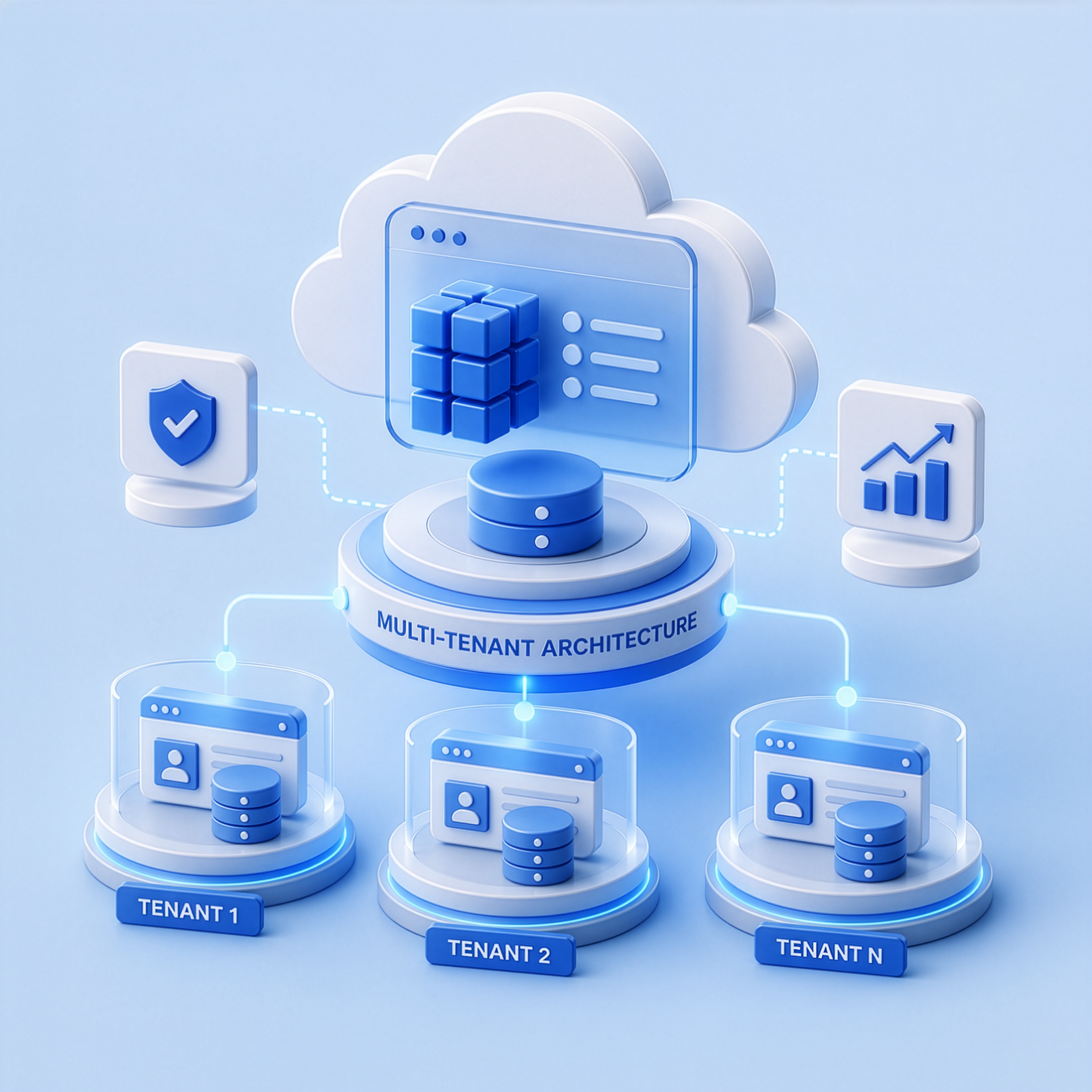
This challenge sits at the center of multi tenant saas architecture design. The right approach can improve scalability, simplify operations, and reduce infrastructure costs. The wrong approach can create security risks, operational complexity, and expensive migrations later.
Understanding the available tenancy models and their trade-offs is essential for building SaaS platforms that can grow sustainably.
What Is Multi-Tenant SaaS Architecture?
Multi-tenant SaaS architecture is a software design model where a single application instance serves multiple customers, known as tenants, while maintaining logical separation of data, permissions, configurations, and workloads. Each tenant experiences the application as though it were dedicated to them, even though underlying infrastructure may be shared.
Multi-tenancy enables SaaS providers to serve many customers efficiently while reducing infrastructure duplication. Effective multi-tenant architectures balance cost efficiency, scalability, security, and operational simplicity through carefully designed isolation mechanisms at the application, database, and infrastructure layers.
Why Multi-Tenancy Matters
Multi-tenancy remains the dominant SaaS architecture approach because it delivers:
For most SaaS companies, multi-tenancy provides the foundation required for sustainable growth.
Single-Tenant vs Multi-Tenant Architecture
| Area | Single-Tenant | Multi-Tenant |
|---|---|---|
| Infrastructure Cost | Higher | Lower |
| Operational Complexity | Higher per customer | Centralized management |
| Resource Utilization | Less efficient | More efficient |
| Scalability | Slower expansion | Easier scaling |
| Customer Isolation | Strong physical isolation | Logical isolation |
| Customization | Easier tenant-specific customization | Requires controlled customization |
| Maintenance | Multiple deployments | Centralized updates |
| Deployment Model | Dedicated environments | Shared environment |
| Upgrade Management | Customer-by-customer | Platform-wide |
| Security Considerations | Strong separation | Requires careful tenant controls |
The 4 Multi-Tenant Architecture Patterns
Pattern 1: Shared Database, Shared Schema
All tenants share the same database tables.
Advantages
- Lowest infrastructure cost
- Simplified operations
- Efficient resource utilization
Disadvantages
- Highest isolation risk
- More complex tenant filtering
Ideal Use Cases
- Early-stage SaaS products
- High-volume applications
Operational Considerations
Strict tenant filtering is mandatory.
Pattern 2: Shared Database, Separate Schemas
Each tenant receives a dedicated schema within the same database.
Advantages
- Better tenant separation
- Easier tenant-level maintenance
Disadvantages
- Increased schema management
- More operational overhead
Ideal Use Cases
- Growing SaaS platforms
- Moderate compliance requirements
Operational Considerations
Schema management automation becomes important.
Pattern 3: Separate Databases per Tenant
Every tenant has an independent database.
Advantages
- Strong isolation
- Easier compliance support
- Simplified backup strategies
Disadvantages
- Higher costs
- Greater operational complexity
Ideal Use Cases
- Enterprise SaaS
- Regulated industries
Operational Considerations
Provisioning and monitoring automation are essential.
Pattern 4: Hybrid Multi-Tenant Architecture
Combines multiple tenancy models.
Advantages
- Maximum flexibility
- Supports enterprise requirements
- Optimizes cost and isolation
Disadvantages
- Increased complexity
- More governance requirements
Ideal Use Cases
- Mature SaaS products
- Enterprise-focused platforms
Operational Considerations
Requires clear migration and tenant-placement policies.
Choosing the Right Multi-Tenant Pattern
Choose Shared Schema If:
- Cost efficiency is critical
- Customer requirements are similar
- Tenant count is high
- Compliance requirements are minimal
- Operational simplicity is important
Choose Separate Schemas If:
- Moderate isolation is required
- Tenant customization is increasing
- Growth is accelerating
- Operational teams are expanding
- Compliance requirements are moderate
Choose Separate Databases If:
- Strong isolation is mandatory
- Enterprise customers dominate
- Regulatory requirements are strict
- Customer-specific configurations are common
- Data residency matters
Choose Hybrid Architecture If:
- Customer requirements vary significantly
- Enterprise and SMB tenants coexist
- Growth is rapid
- Compliance needs differ by customer
- Long-term flexibility is important
Tenant Isolation Strategies
Data Isolation
Separates tenant records through schema, database, or partitioning strategies.
Application Isolation
Ensures tenant-specific logic and configurations remain separated.
Infrastructure Isolation
Uses dedicated resources for selected tenants when necessary.
Access Control Isolation
Enforces permissions through tenant-aware authentication and authorization.
Each approach increases isolation but may also increase operational cost.
Database Design Best Practices
Successful implementations typically include:
Code Example: Tenant-Aware Data Access
This example demonstrates a critical principle: every query is filtered using the authenticated tenant identifier.
const express = require("express");
const app = express();

app.get("/projects", async (req, res) => {
  const tenantId = req.user.tenantId;

  const projects = await db.query(
    "SELECT * FROM projects WHERE tenant_id = $1",
    [tenantId]
  );

  res.json(projects.rows);
});
Security Considerations
Strong Tenant Authentication
Verify user identity before access.
Tenant-Aware Authorization
Restrict access to tenant-owned resources.
Encryption at Rest
Protect stored data.
Encryption in Transit
Secure network communication.
Audit Logging
Track tenant activity.
Data Segregation Validation
Regularly verify tenant isolation.
Secure API Design
Prevent unauthorized access paths.
Backup Protection
Secure backup storage and restoration.
Monitoring & Alerting
Detect suspicious activity early.
Compliance Controls
Support regulatory requirements and audits.
Common Mistakes
Common architecture failures include:
- Weak tenant isolation
- Missing tenant filters
- Poor database indexing
- Excessive customization
- Premature scaling decisions
- Lack of observability
Scalability Strategies
As platforms grow, teams typically adopt:
Scalability should evolve gradually alongside product growth.
How Architecture Evolves
Early-Stage SaaS
Shared schema models maximize efficiency.
Growth-Stage SaaS
Separate schemas improve isolation and flexibility.
Enterprise SaaS
Hybrid models often emerge to balance scalability and compliance.
Architectures rarely remain static as customer requirements evolve.
Architecture Decision Worksheet
Isolation Requirements
What level of tenant separation is required?
Compliance Requirements
Are there regulatory obligations?
Scalability Expectations
How many tenants are expected?
Customization Needs
Will tenants require unique configurations?
Budget Considerations
How much operational complexity is acceptable?
Operational Complexity Tolerance
What level of infrastructure management is feasible?
Recommended Architecture Criteria
Balance security, scalability, flexibility, and cost.
What to Expect in 2026 and Beyond
Future multi-tenant platforms will increasingly support:
- AI-native SaaS systems
- Multi-tenant AI services
- Tenant-aware AI copilots
- Platform engineering practices
- Cloud-native operational models
The core challenge will remain unchanged: balancing isolation with efficiency.
Frequently Asked Questions
Conclusion
Multi-tenancy is one of the most important architectural decisions in SaaS development. Different tenancy patterns provide different balances between cost, scalability, operational complexity, and security.
The best approach depends on business requirements, customer expectations, and growth plans. Successful SaaS platforms treat tenant isolation, security, and scalability as foundational design principles rather than afterthoughts.
Design Your Multi-Tenant SaaS Platform
As SaaS platforms grow, architectural decisions around multi-tenancy can significantly influence scalability, security, cost efficiency, and long-term maintainability.
Kambaa helps startups and enterprises design, build, modernize, and scale multi-tenant SaaS platforms through cloud-native architecture, product engineering, AI integration, and long-term platform evolution.