
In-House vs Outsourced Software Development: 2026 Cost & Quality Analysis
Compare in-house and outsourced software development costs, quality, risks, and scalability considerations.
Introduction
Every organization investing in software eventually faces a critical decision: should the product be built by an internal engineering team or by an external development partner?
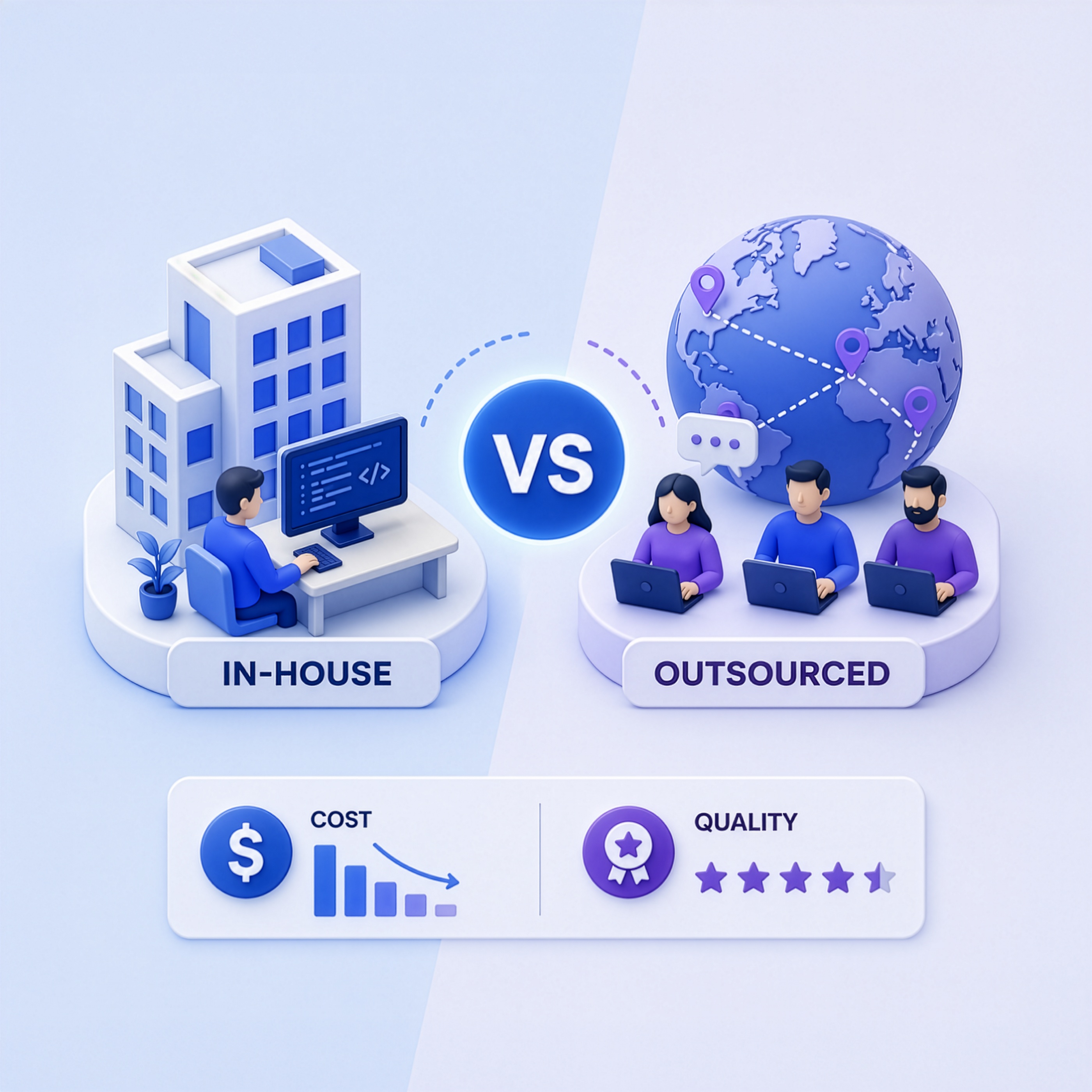
Whether launching a new digital product, modernizing legacy systems, or building internal platforms, the choice between in house vs outsourced software development can significantly impact costs, delivery speed, software quality, scalability, and long-term business outcomes.
The right answer is rarely universal. It depends on organizational goals, internal capabilities, hiring capacity, budget constraints, and strategic priorities.
This guide provides an objective framework to help decision-makers evaluate both approaches and select the model that best fits their business.
In-House vs Outsourced Software Development: Quick Answer
In-house software development involves hiring and managing employees who design, build, maintain, and improve software within the organization. Outsourced software development involves partnering with an external company or dedicated development team to deliver part or all of a software initiative.
In simple terms:
- In-house development provides greater control, stronger institutional knowledge, and deeper alignment with company culture.
- Outsourced development provides faster access to specialized expertise, flexible scaling, and potentially lower operational overhead.
Neither approach is inherently superior. Organizations should evaluate business objectives, hiring capabilities, project complexity, timeline requirements, and long-term technology strategy before selecting a delivery model.
What Is In-House Software Development?
In-house software development refers to building software using employees hired directly by the organization.
Typical teams include:
- Product Managers
- Software Engineers
- UX Designers
- QA Specialists
- Engineering Managers
Advantages
- Strong business alignment
- Better knowledge retention
- Greater control over priorities
- Long-term product ownership
Common Use Cases
- Core business platforms
- Proprietary products
- Strategic technology initiatives
- Long-term innovation programs
What Is Outsourced Software Development?
Outsourced software development involves engaging an external partner to provide development expertise and delivery services.
Common delivery models include:
- Project-based engagements
- Dedicated development teams
- Staff augmentation
- Managed delivery services
Advantages
- Faster team formation
- Access to specialized expertise
- Flexible scaling
- Reduced recruitment burden
Common Use Cases
- MVP development
- Modernization projects
- Capacity expansion
- Specialized technology initiatives
In-House vs Outsourced Software Development: Key Differences
Side-by-Side Comparison
| Evaluation Area | In-House Development | Outsourced Development |
|---|---|---|
| Upfront Cost | Higher hiring investment | Lower startup investment |
| Hiring Effort | Significant | Minimal |
| Access to Talent | Limited by hiring market | Global talent access |
| Time to Start | Often months | Often weeks |
| Scalability | Slower scaling | Faster scaling |
| Project Control | Maximum control | Shared control |
| Knowledge Retention | Strong internal retention | Depends on documentation |
| Technology Expertise | Limited to internal team | Broad specialized expertise |
| Operational Overhead | Higher management burden | Lower operational burden |
| Long-Term Cost | Predictable workforce costs | Variable engagement costs |
| Flexibility | Lower workforce flexibility | High flexibility |
| Risk Profile | Hiring and retention risk | Vendor dependency risk |
Cost Analysis: In-House vs Outsourced Development
Understanding the Full Cost Picture
In-House Cost Components
Organizations often underestimate the full cost of internal teams.
Typical expenses include:
- Recruitment fees
- Salaries
- Employee benefits
- Equipment and software
- Engineering management
- Training and certifications
- Employee retention programs
The true cost extends far beyond salary alone.
Outsourced Cost Components
External delivery costs typically include:
- Project fees
- Dedicated team agreements
- Staff augmentation costs
- Vendor management
- Transition and onboarding efforts
The key consideration is total business value rather than hourly rates alone.
Quality Analysis: Which Model Produces Better Results?
Evaluating Quality by Context
When In-House Teams Excel
Internal teams often perform best when:
- Deep domain knowledge is required
- Product strategy changes frequently
- Long-term ownership matters
- Business complexity is high
When Outsourced Teams Excel
External teams often perform best when:
- Specialized expertise is needed
- Delivery speed is critical
- Internal capacity is limited
- Proven implementation experience matters
Factors That Matter More Than Delivery Model
Quality depends more on:
Strong teams outperform weak teams regardless of sourcing model.
When In-House Development Is the Better Choice
8 Key Scenarios
Software Is a Core Competitive Advantage
Technology directly drives business success.
Deep Domain Knowledge Is Required
Business processes are highly specialized.
Long-Term Product Ownership Is Critical
The platform will evolve continuously.
Frequent Strategic Changes Occur
Roadmaps change rapidly.
Internal Innovation Is a Priority
Technology experimentation drives growth.
Security Requirements Are Extremely Sensitive
Data governance is a major concern.
Strong Hiring Capacity Exists
The company can attract and retain talent.
Engineering Is a Core Business Function
Software development is central to operations.
When Outsourced Development Is the Better Choice
8 Key Scenarios
Speed Is a Priority
The business must move quickly.
Specialized Skills Are Required
Rare expertise is needed immediately.
Internal Hiring Is Difficult
Recruitment challenges slow growth.
Budget Flexibility Is Needed
Fixed staffing costs are undesirable.
Project Workloads Fluctuate
Demand changes over time.
MVP Development Is Required
Rapid validation is important.
Modernization Expertise Is Needed
Legacy transformation experience is required.
Internal Teams Are Already Overloaded
Existing staff lack available capacity.
The Hybrid Model: Why Many Companies Choose Both
Many organizations combine internal and external teams.
Common hybrid structures include:
For example, a company may retain product management internally while using external teams to accelerate development or provide niche technical expertise.
This approach balances control with scalability.
The 5-Step Development Sourcing Framework
Step-by-step decision process
Step 1: Define Strategic Importance
Determine how critical the software is to business success.
Step 2: Assess Internal Capabilities
Evaluate available talent, leadership, and technical expertise.
Step 3: Evaluate Time-to-Market Requirements
Identify delivery urgency and business deadlines.
Step 4: Compare Total Cost of Ownership
Review long-term costs, not just initial expenses.
Step 5: Select the Right Delivery Model
Choose the model that best aligns with strategic objectives.
Real-World Decision Examples
Four Practical Scenarios
Example 1: SaaS Startup Building an MVP
- Recommendation: Outsourced development
- Reason: Speed and flexibility outweigh long-term ownership concerns.
Example 2: Enterprise Internal Operations Platform
- Recommendation: In-house development
- Reason: Deep process knowledge and long-term ownership matter.
Example 3: Legacy System Modernization Project
- Recommendation: Outsourced development
- Reason: Specialized modernization expertise accelerates delivery.
Example 4: AI-Powered Customer Portal
- Recommendation: Hybrid model
- Reason: Internal business ownership combined with external AI expertise.
Common Decision-Making Mistakes
Organizations frequently struggle because they:
The best decisions focus on business outcomes rather than resource acquisition alone.
DEVELOPMENT SOURCING WORKSHEET
In-House vs Outsourced Development Decision Worksheet
Strategic Importance Assessment
- Is software a competitive differentiator?
- Is long-term ownership critical?
Talent Availability Assessment
- Can required talent be hired internally?
- How difficult is recruitment?
Timeline Requirements
- How quickly must the solution be delivered?
Budget Considerations
- Can fixed staffing costs be supported?
- Is flexibility important?
Internal Capability Review
- Do internal leaders have delivery experience?
- Is architecture expertise available?
Risk Analysis
- Hiring risk
- Retention risk
- Vendor dependency risk
- Delivery risk
Recommended Decision Criteria
What to Expect in 2026 and Beyond
Software delivery models continue to evolve.
Key trends include:
Organizations increasingly focus on combining internal leadership with external execution capabilities.
Frequently Asked Questions
Common questions about in-house vs outsourced software development
What is the difference between in-house and outsourced software development?
In-house development uses internal employees to build and maintain software. Outsourced development relies on external teams or partners. The primary difference is ownership of talent and delivery responsibility.
Which is more cost effective?
The answer depends on project scope, duration, hiring costs, and expertise requirements. Shorter projects often benefit from outsourcing, while long-term strategic platforms may justify internal investment.
Which produces higher quality software?
Quality depends on leadership, engineering processes, communication, and expertise rather than whether the team is internal or external.
When should companies build internal teams?
Organizations should prioritize internal teams when software is strategically important, requires deep business knowledge, or demands continuous innovation.
When should companies outsource?
Outsourcing works well when speed, specialized expertise, scalability, or resource flexibility are primary concerns.
What is a hybrid development model?
A hybrid model combines internal leadership and product ownership with external engineering resources, consultants, or specialists.
How do companies evaluate outsourcing partners?
Assess technical expertise, delivery methodology, communication practices, security standards, references, and long-term support capabilities.
What are the biggest decision mistakes?
Common mistakes include focusing only on cost, ignoring management overhead, underestimating scaling needs, and selecting partners without clearly defined requirements.
Conclusion
Neither in-house nor outsourced software development is universally superior.
The best choice depends on business objectives, organizational maturity, delivery timelines, expertise requirements, and long-term technology strategy.
Successful organizations balance cost, quality, speed, and scalability while selecting a delivery model that aligns with their broader business goals. Increasingly, hybrid approaches provide the flexibility needed to compete in rapidly evolving digital markets.
As organizations build digital products, modernize systems, and scale technology capabilities, choosing the right development model becomes a critical business decision.
Kambaa helps businesses evaluate delivery strategies, extend engineering capacity, build custom software, modernize applications, and deliver scalable technology solutions through flexible development engagement models.