How to Build an AI Agent: A Complete Technical Walkthrough
Modern AI agents are not simply chat interfaces connected to large language models. Production-ready agents combine multiple components, including language models, planning systems, memory layers, knowledge retrieval, tool integrations, workflow automation, and decision-making logic.
Introduction
Many organizations understand what AI agents are, but far fewer understand what it actually takes to build one.
Modern AI agents are not simply chat interfaces connected to large language models. Production-ready agents combine multiple components, including language models, planning systems, memory layers, knowledge retrieval, tool integrations, workflow automation, and decision-making logic.
The challenge is not generating responses. The challenge is creating systems that can reliably understand goals, access information, interact with software, execute actions, and complete business tasks.
This guide explains how to build an AI agent from a technical perspective, covering architecture, technology choices, implementation steps, deployment considerations, and production readiness requirements.
What is an AI agent?
A system built to complete work, not just answer questions
An AI agent is a software system that can interpret goals, reason about tasks, create plans, use tools, interact with external systems, and execute actions to achieve desired outcomes with varying levels of autonomy.
Unlike traditional software that follows predefined rules, AI agents can adapt to changing inputs, evaluate available options, and perform multi-step workflows. Most modern agents combine large language models (LLMs), memory systems, retrieval mechanisms, planning logic, and integrations with business applications.
The objective is not simply answering questions. The objective is completing work.
The anatomy of a modern AI agent
Six components that make up a production-ready agent
Large Language Model (LLM)
The reasoning engine. It interprets instructions, understands context, generates responses, and helps determine next actions. Examples include GPT models, Claude models, Gemini models, and open-source alternatives.
Memory Layer
Enables the agent to retain information across interactions. Short-term memory supports ongoing tasks, while long-term memory stores historical context, preferences, and business knowledge.
Planning Engine
Breaks complex objectives into smaller tasks. For example, a sales agent might convert "schedule a customer demo" into multiple actions including lead validation, calendar checks, email creation, and CRM updates.
Tool Layer
Allows agents to interact with external systems. Examples include CRM platforms, databases, email systems, ticketing tools, APIs, and document repositories.
Knowledge Layer
Provides access to organizational information through search systems, vector databases, documentation repositories, and Retrieval-Augmented Generation (RAG).
Execution Layer
Performs actions and monitors outcomes. This component converts decisions into business operations.
AI agent architecture: how everything fits together
A modern AI agent typically follows this workflow
The reasoning layer interprets objectives. The planning layer determines how to achieve them. Tool selection identifies required systems and data sources. The execution layer performs actions, while the feedback loop validates results and determines whether additional actions are needed.
This architecture allows agents to move beyond conversation and into workflow automation.
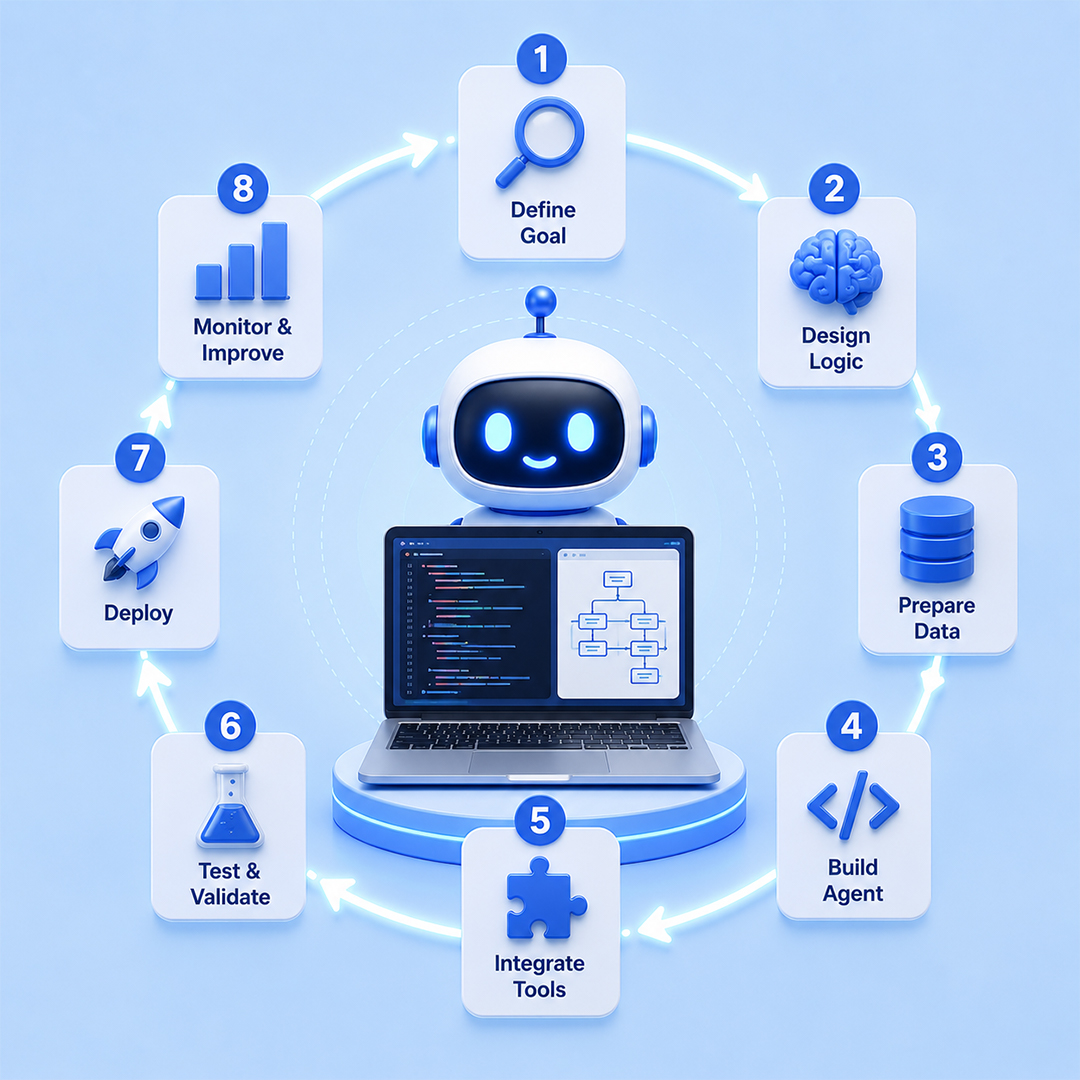
Step-by-step: how to build an AI agent
Ten steps from business goal to production deployment
Step 1: Define the Business Goal
Objective: Identify the business problem.
Technical Considerations: Define measurable outcomes and success metrics.
Common Mistake: Building technology before validating business value.
Expected Output: A clearly defined use case.
Step 2: Identify the Agent's Responsibilities
Objective: Define what the agent should and should not do.
Technical Considerations: Map workflows, permissions, and boundaries.
Common Mistake: Giving agents overly broad responsibilities.
Expected Output: Detailed capability requirements.
Step 3: Select the Foundation Model
Objective: Choose the LLM powering the agent.
Technical Considerations: Accuracy, latency, context windows, cost, and deployment options.
Common Mistake: Selecting models solely based on benchmark scores.
Expected Output: Model selection strategy.
Step 4: Design Memory Architecture
Objective: Determine how information is stored and retrieved.
Technical Considerations: Session memory, long-term memory, and persistence requirements.
Common Mistake: Treating every interaction as isolated.
Expected Output: Memory framework design.
Step 5: Connect Data Sources
Objective: Give the agent access to required information.
Technical Considerations: APIs, databases, documentation systems, and permissions.
Common Mistake: Using incomplete or low-quality data.
Expected Output: Connected knowledge ecosystem.
Step 6: Build Tool Integrations
Objective: Enable the agent to take actions.
Technical Considerations: CRM systems, ticketing platforms, email services, and business applications.
Common Mistake: Excessive tool access without governance.
Expected Output: Operational capabilities.
Step 7: Implement Planning Logic
Objective: Enable multi-step decision-making.
Technical Considerations: Task decomposition, workflow orchestration, and action sequencing.
Common Mistake: Relying entirely on LLM reasoning without structured planning.
Expected Output: Reliable workflow execution.
Step 8: Create Guardrails & Security Controls
Objective: Protect systems and data.
Technical Considerations: Access controls, audit logs, approval workflows, and policy enforcement.
Common Mistake: Treating security as an afterthought.
Expected Output: Secure operational environment.
Step 9: Test Agent Behavior
Objective: Validate reliability and performance.
Technical Considerations: Functional testing, failure scenarios, and edge cases.
Common Mistake: Testing only ideal workflows.
Expected Output: Production confidence.
Step 10: Deploy and Monitor
Objective: Launch and continuously improve.
Technical Considerations: Monitoring, observability, cost management, and governance.
Common Mistake: Assuming deployment is the final step.
Expected Output: Production-ready AI agent.
Recommended AI agent technology stack
Foundation models, frameworks, databases, and deployment
Foundation Models
Organizations typically choose between commercial and open-source models. Commercial options such as GPT, Claude, and Gemini provide strong performance and faster implementation. Open-source models offer greater customization and deployment flexibility but often require additional infrastructure and expertise.
Agent Frameworks
Popular frameworks include LangGraph, LangChain, CrewAI, and AutoGen. LangGraph is increasingly used for structured workflows, while CrewAI and AutoGen support multi-agent collaboration scenarios.
Databases
Traditional databases such as PostgreSQL remain essential for structured business data. Vector databases support semantic retrieval and RAG implementations by enabling similarity-based search across documents.
Deployment Options
Cloud deployments offer speed and scalability. Hybrid and enterprise deployments provide additional control for organizations with strict security or compliance requirements.
The right stack depends on business objectives, governance requirements, and internal capabilities.
Example: building a customer support AI agent
Consider a customer support agent for a SaaS company
Goal
Resolve customer issues and reduce ticket volume.
Inputs
Customer messages, account data, product documentation, and support history.
Knowledge Sources
Help center articles, troubleshooting guides, and internal documentation.
Tools
CRM system, ticketing platform, billing system, and knowledge base.
Workflow
The agent receives a request, retrieves relevant information, checks account status, suggests solutions, updates tickets, and escalates when necessary.
Expected Output
Faster resolution times and reduced support workload.
This example demonstrates how multiple agent components work together to solve a real business problem.
Memory, retrieval, and RAG
Critical to agent performance
Short-Term Memory
Stores information during active workflows and conversations.
Long-Term Memory
Preserves user preferences, historical interactions, and business context.
Retrieval-Augmented Generation (RAG)
Allows agents to access external knowledge rather than relying solely on model training data.
Knowledge Retrieval
Ensures responses are grounded in current business information, improving accuracy and reducing hallucinations.
For most enterprise use cases, RAG is a foundational capability.
Common challenges when building AI agents
Six recurring obstacles and how to address them
Hallucinations
Mitigate through RAG, validation systems, and constrained outputs.
Tool Failures
Implement fallback workflows and monitoring.
Data Quality Issues
Poor data produces poor decisions. Data governance is essential.
Context Limitations
Use memory systems and retrieval mechanisms to maintain context.
Security Concerns
Apply access controls, approvals, and audit trails.
Scaling Challenges
Design infrastructure for growth from the beginning.
AI agent security considerations
Enterprise deployments require strong governance
Key areas include:
- Access control and authentication
- Data privacy protection
- Prompt injection defenses
- Human approval workflows
- Audit logging
- Compliance monitoring
- Operational governance
Security should be integrated throughout the development lifecycle rather than added after deployment.
Build vs buy: should you develop your own AI agent?
Weighing custom development against existing platforms
Build Custom Agents
Benefits
- Complete control
- Tailored workflows
- Competitive differentiation
Challenges
- Higher complexity
- Longer timelines
- Increased maintenance responsibility
Use Existing Agent Platforms
Benefits
- Faster implementation
- Lower upfront costs
- Proven infrastructure
Challenges
- Limited customization
- Vendor dependency
- Platform constraints
Organizations with unique workflows often benefit from custom development, while standard use cases may be served effectively by existing platforms.
Production readiness checklist
Before deployment, verify that:
- Business goals are clearly defined
- Memory architecture is validated
- Data sources are connected
- Tool permissions are configured
- Security controls are implemented
- Guardrails are tested
- Monitoring is enabled
- Audit logging is active
- Human escalation paths exist
- Performance testing is completed
- Disaster recovery plans are documented
- Governance reviews are completed
What to expect in 2026 and beyond
AI agent development is rapidly evolving
Organizations are increasingly adopting agentic AI architectures, multi-agent systems, autonomous workflows, and enterprise orchestration platforms.
Future systems will focus less on isolated agents and more on coordinated networks of agents collaborating across departments and business processes.
The organizations building strong governance, architecture, and operational foundations today will be better positioned to scale AI initiatives tomorrow.
Frequently asked questions
Common questions about building AI agents
How do you build an AI agent?
Building an AI agent involves defining a business goal, selecting a foundation model, designing memory systems, integrating data sources, connecting tools, implementing planning logic, and deploying governance and monitoring capabilities.
What technologies are needed?
Most production agents require LLMs, databases, vector search, APIs, orchestration frameworks, monitoring tools, and security controls.
What is RAG?
Retrieval-Augmented Generation allows an AI agent to retrieve relevant information from external sources before generating responses, improving accuracy and reducing hallucinations.
What is the best framework for AI agents?
There is no universal best framework. LangGraph, LangChain, CrewAI, and AutoGen each serve different architectural requirements and workflow patterns.
How long does development take?
Simple agents may take several weeks, while enterprise-grade implementations often require several months.
How much does it cost?
Costs vary significantly based on complexity, integrations, security requirements, and deployment scope.
Can AI agents operate autonomously?
Yes, but autonomy should be constrained through governance, monitoring, and human oversight mechanisms.
What are the biggest implementation challenges?
Data quality, security, workflow design, scalability, and operational governance are among the most common challenges.
Conclusion
Building a production-ready AI agent requires much more than connecting an LLM to a user interface.
Successful implementations combine reasoning, memory, planning, retrieval, integrations, security, and governance into a cohesive architecture.
Organizations that begin with clearly defined business goals, invest in strong technical foundations, and prioritize production readiness are far more likely to achieve measurable business outcomes from AI agents.
Ready to build a production-ready AI agent?
As organizations move from AI experimentation to operational automation, building production-ready AI agents requires the right architecture, governance, and implementation strategy. Kambaa helps businesses design, develop, deploy, and scale AI agents tailored to customer service, operations, knowledge management, and enterprise workflows.