How Much Does It Cost to Build an AI Agent? (2026 Pricing Guide)
AI agent pricing is becoming more predictable. While costs vary based on complexity, integrations, autonomy, security, and deployment requirements, there are clear pricing benchmarks businesses can use for planning.
Introduction
One of the most common questions executives ask when evaluating AI initiatives is: “How much does it actually cost to build an AI agent?”
The good news is that AI agent pricing is becoming more predictable. While costs vary based on complexity, integrations, autonomy, security, and deployment requirements, there are clear pricing benchmarks businesses can use for planning.
Some organizations launch focused AI agents for a few thousand dollars, while others invest heavily in enterprise-wide automation systems. The key is understanding what drives costs and aligning investment with business outcomes.
This guide provides realistic pricing ranges, cost drivers, budgeting advice, and ROI considerations to help organizations estimate how much does it cost to build an AI agent in 2026.
Quick answer: AI agent development cost in 2026
Costs generally fall into four categories
Simple AI agents
$10,000–$30,000
Department-level AI agents
$30,000–$100,000
Cross-functional AI agents
$100,000–$250,000
Enterprise agentic systems
$250,000–$500,000+
These ranges typically include planning, development, integrations, testing, deployment, and initial setup. The final investment depends on workflow complexity, number of integrations, security requirements, customization needs, user volume, and ongoing maintenance.
Organizations that start with a focused use case often achieve faster ROI and lower implementation risk than those attempting large-scale automation immediately.
What is included in AI agent development costs?
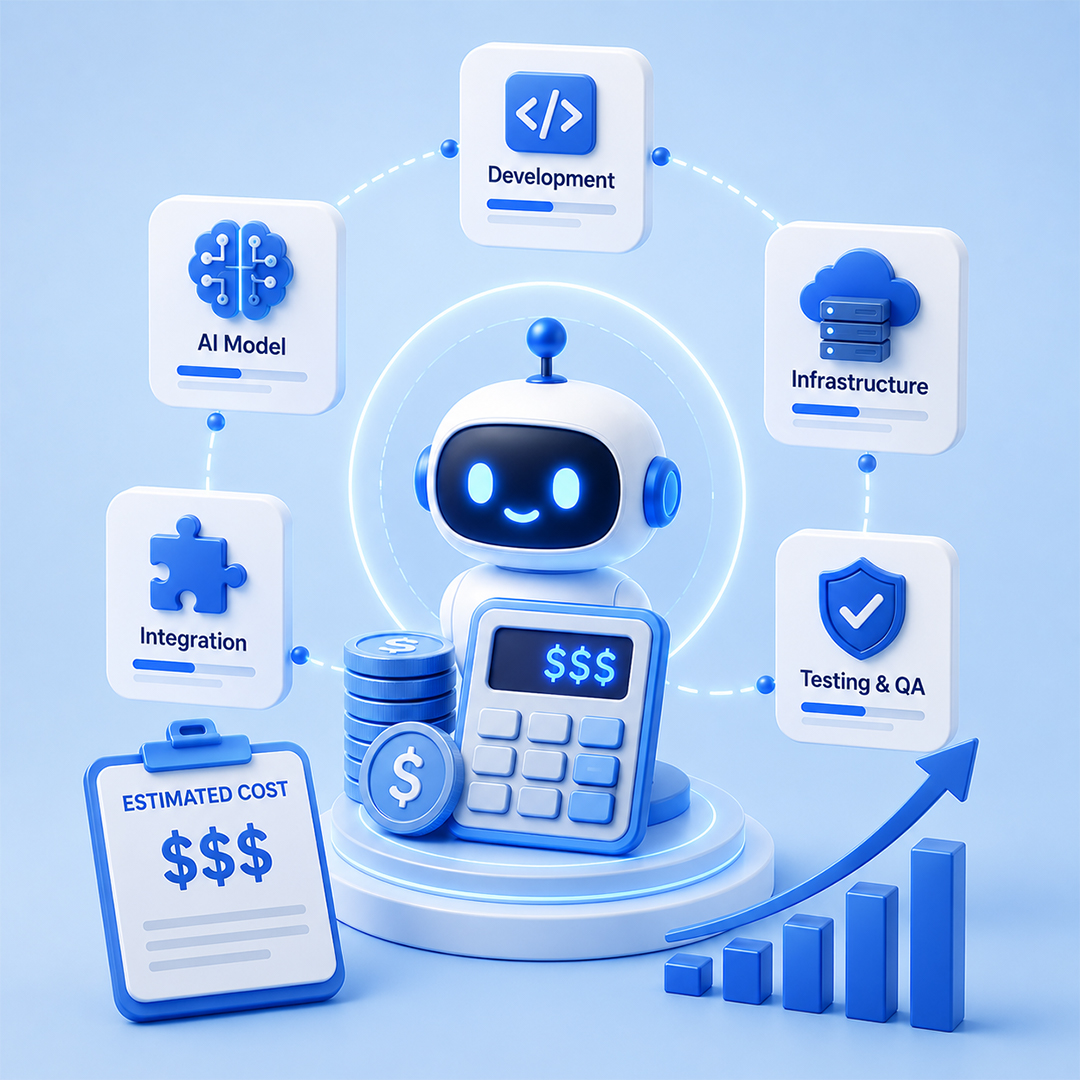
Budgets are typically distributed across seven areas
Discovery & Planning
Business goals, workflows, and requirements.
Design
User experience, workflows, and governance.
Development
Agent logic, automation, and orchestration.
Integrations
CRM, ERP, databases, APIs, and business tools.
Testing
Accuracy, reliability, security, and performance validation.
Deployment
Production rollout and configuration.
Maintenance
Monitoring, updates, optimization, and governance.
Understanding these categories helps explain why project costs vary significantly.
The 4 types of AI agents and typical costs
From simple task automation to enterprise agentic systems
1. Simple Task-Based AI Agents
$10,000–$30,000
Features
- Single workflow automation
- Limited integrations
- Basic decision-making
Best Use Cases
FAQ assistants, appointment scheduling, and simple support automation.
2. Department-Level AI Agents
$30,000–$100,000
Features
- Multiple workflows
- Several integrations
- Context-aware interactions
Best Use Cases
Customer support, HR onboarding, sales assistance, and marketing operations.
3. Cross-Functional AI Agents
$100,000–$250,000
Features
- Multi-department workflows
- Advanced orchestration
- Cross-system decision-making
Best Use Cases
Revenue operations, service management, and customer journey automation.
4. Enterprise Agentic Systems
$250,000–$500,000+
Features
- Enterprise governance
- Extensive integrations
- Advanced security and scalability
Best Use Cases
Enterprise automation, finance operations, supply chain management, and digital transformation initiatives.
What drives AI agent development costs?
Eight factors that determine your final investment
1. Scope of Functionality
More capabilities require additional development and testing. A simple assistant costs far less than a multi-purpose business agent.
2. Workflow Complexity
Multi-step workflows increase orchestration, governance, and implementation effort.
3. Number of Integrations
Each integration adds development, testing, and maintenance requirements.
4. Data Sources
Working with fragmented documents, emails, and legacy systems often increases project costs.
5. Security Requirements
Compliance, audits, access controls, and governance frameworks add complexity and cost.
6. User Volume
Supporting large user bases requires additional infrastructure and scalability planning.
7. Customization Needs
Highly tailored solutions generally cost more than implementations built on existing frameworks.
8. Ongoing Maintenance
Monitoring, optimization, updates, and governance create recurring expenses that should be budgeted from the start.
Real-world cost examples
Four sample projects and their typical price ranges
Customer Support Agent
$20,000–$60,000
Scope: Ticket routing, knowledge retrieval, CRM integration, and customer interactions.
Business Value: Reduced support workload and faster response times.
Sales Operations Agent
$40,000–$120,000
Scope: Lead qualification, CRM updates, scheduling, and follow-up automation.
Business Value: Higher sales productivity and improved pipeline management.
Internal Knowledge Agent
$30,000–$80,000
Scope: Document search, knowledge retrieval, and employee assistance.
Business Value: Faster access to information and improved employee efficiency.
Enterprise Process Automation Agent
$150,000–$500,000+
Scope: Cross-department workflows, system orchestration, and governance.
Business Value: Significant operational efficiency gains across the organization.
Build vs buy: which is more cost effective?
Weighing the tradeoffs of each approach
Building Custom AI Agents
Advantages
- Tailored to business processes
- Greater flexibility
- Competitive differentiation
Challenges
- Higher upfront investment
- Longer implementation timelines
- Ongoing maintenance responsibility
Typical Investment: $30,000–$500,000+
Custom development is often best when workflows provide strategic value.
Buying Existing Platforms
Advantages
- Faster deployment
- Lower initial costs
- Proven infrastructure
Challenges
- Limited customization
- Vendor dependency
- Potential scalability constraints
Typical Investment: $5,000–$100,000 annually
For many organizations, buying first and customizing later is a practical strategy.
Hidden costs companies often miss
Many budgets overlook these line items
- Model usage fees
- Infrastructure and hosting costs
- Ongoing maintenance
- Monitoring and governance
- Security reviews
- Data preparation
- Employee training and change management
Including these costs early helps avoid budget surprises.
How to estimate ROI from an AI agent
A practical five-step ROI framework
1. Identify Manual Effort
Measure time spent on the target workflow.
2. Estimate Time Savings
Determine how much work can realistically be automated.
3. Calculate Labor Impact
Convert saved hours into financial value.
4. Measure Productivity Gains
Consider faster execution, improved accuracy, and increased capacity.
5. Track Business Outcomes
Measure revenue growth, cost reduction, customer satisfaction, and operational improvements.
Example: If a support team spends 500 hours monthly on repetitive requests and an AI agent automates 40% of that work, approximately 200 hours become available for higher-value activities.
Common budgeting mistakes
- Underestimating integration effort
- Ignoring maintenance costs
- Building too much too early
- Failing to define clear use cases
- Focusing only on development costs instead of total ownership costs
Organizations that avoid these mistakes typically achieve better outcomes.
How businesses can reduce AI agent costs
- Start with one workflow.
- Prioritize high-impact use cases.
- Reuse existing systems.
- Pilot before scaling.
- Use phased implementation.
- Focus on measurable outcomes.
- Avoid unnecessary customization.
- Establish governance early.
What to expect in 2026 and beyond
Several trends shaping AI agent pricing
Falling model costs
AI model pricing continues to trend downward, lowering the baseline cost of building agents.
Increased AI adoption
More organizations across industries are investing in agentic automation.
Growth of agent marketplaces
Pre-built agent components are becoming more widely available.
Expansion of enterprise agent platforms
Vendors are offering more mature, enterprise-ready agent infrastructure.
More accessible development tools
Development tooling is lowering the barrier to entry for building agents.
While enterprise implementations will remain significant investments, entry-level AI agent adoption is becoming increasingly affordable.
Frequently asked questions
Common questions about AI agent development costs
How much does it cost to build an AI agent?
Most AI agent projects range from $10,000 to $500,000+, depending on complexity, integrations, security requirements, and deployment scope.
What affects AI agent pricing?
Key factors include functionality, workflow complexity, integrations, data sources, security, user volume, customization, and maintenance.
Is it cheaper to build or buy?
Buying is usually less expensive upfront, while custom development offers greater flexibility and long-term differentiation.
How long does development take?
Simple agents may take a few weeks, while enterprise systems often require several months.
What industries see the highest ROI?
Customer service, healthcare, finance, logistics, manufacturing, and sales operations frequently achieve strong returns.
Can small businesses afford AI agents?
Yes. Focused AI agents with limited scope can be implemented at relatively affordable price points.
What ongoing costs should be expected?
Organizations should budget for model usage, infrastructure, maintenance, monitoring, security, and optimization.
How do companies estimate budgets?
Start with a defined use case, identify integrations, estimate automation opportunities, and calculate expected business impact.
Conclusion
AI agent development costs typically range from $10,000 for simple implementations to more than $500,000 for enterprise-grade systems.
The biggest cost drivers are workflow complexity, integrations, customization, security requirements, and ongoing maintenance.
Organizations that focus on business outcomes, start with targeted use cases, and scale through phased implementation generally achieve stronger ROI and lower risk than those pursuing large-scale automation from the outset.
Ready to plan your AI agent investment?
As organizations move from AI experimentation to operational deployment, understanding costs is an important first step. Kambaa helps businesses design, develop, and deploy AI agents tailored to customer service, operations, sales, knowledge management, and enterprise workflows with clear implementation roadmaps and measurable business outcomes.