How Much Does AI Implementation Cost? Complete 2026 Breakdown
A simple AI chatbot may cost tens of thousands of dollars, while a company-wide transformation initiative can require investments well into seven figures. Here's a transparent breakdown of what to expect.
Introduction
"How much does AI implementation actually cost?"
It's one of the most common questions executives ask when evaluating AI initiatives. The challenge is that AI projects vary significantly in scope, complexity, business objectives, and technical requirements.
A simple AI chatbot may cost tens of thousands of dollars, while a company-wide transformation initiative can require investments well into seven figures.
The good news is that clear pricing patterns exist. Understanding the major cost categories, implementation models, and business requirements can help organizations build realistic budgets and avoid costly surprises.
This guide provides a transparent breakdown of AI implementation cost expectations for 2026.
Quick Answer
AI Implementation Cost in 2026
AI implementation costs vary based on business goals, integrations, data readiness, security requirements, and organizational scale.
Organizations should budget not only for development and deployment but also for data preparation, integrations, governance, training, maintenance, and ongoing optimization.
The most successful projects focus on business outcomes first and technology second.
As a general benchmark:
Small AI initiatives typically range from $10,000–$50,000
Department-level AI implementations often range from $50,000–$250,000
Enterprise AI projects commonly range from $250,000–$1 million+
Large-scale AI transformation programs can exceed several million dollars
What Is Included in AI Implementation Costs?
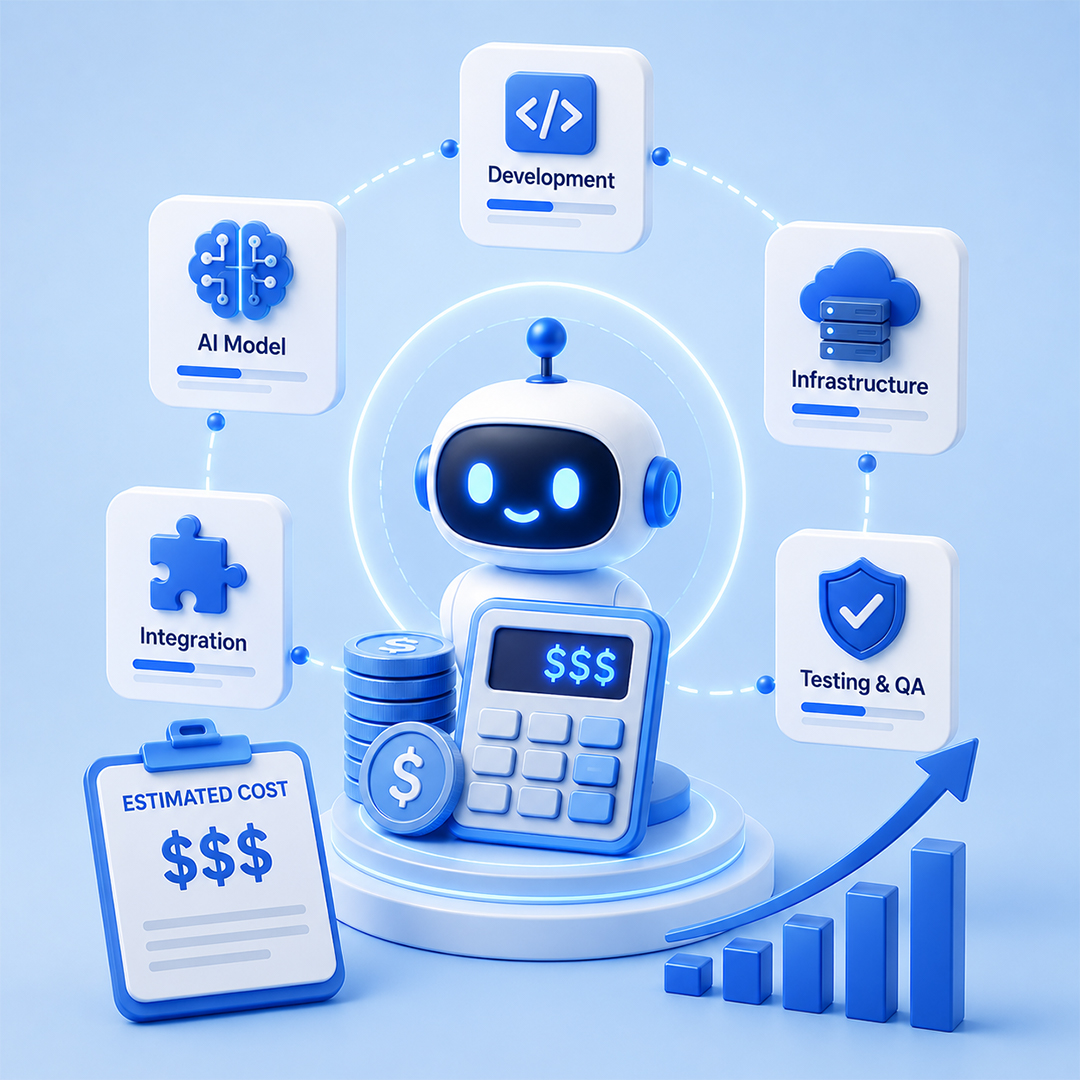
AI budgets typically include multiple cost categories.
Strategy & Discovery
Business assessment, use-case prioritization, feasibility analysis, and roadmap creation.
Data Preparation
Cleaning, organizing, labeling, and validating data sources.
Solution Design
Architecture planning, workflow design, and technical specifications.
Development
Building models, workflows, automations, interfaces, and integrations.
Integrations
Connecting AI systems with CRMs, ERPs, databases, and business applications.
Testing
Performance validation, security reviews, and user acceptance testing.
Deployment
Infrastructure setup and production rollout.
Training & Change Management
User education, process updates, and adoption support.
Ongoing Optimization
Monitoring, maintenance, model updates, and performance improvements.
The 5 Types of AI Implementations and Their Typical Costs
From chatbots to enterprise transformation
1. AI Chatbots & Virtual Assistants
Typical Budget: $10,000–$50,000
Common Use Cases: Customer support, FAQs, employee assistance, website engagement.
Implementation Complexity: Low to moderate.
These projects often provide the fastest path to AI adoption.
2. AI Process Automation
Typical Budget: $25,000–$150,000
Common Use Cases: Invoice processing, workflow automation, document handling, approval routing.
Implementation Complexity: Moderate.
Costs increase as business processes become more complex.
3. AI Analytics & Decision Support
Typical Budget: $50,000–$250,000
Common Use Cases: Forecasting, reporting, operational insights, business intelligence.
Implementation Complexity: Moderate to high.
Data quality significantly affects project costs.
4. AI Agents & Agentic Systems
Typical Budget: $50,000–$500,000+
Common Use Cases: Customer service agents, sales agents, knowledge management, workflow orchestration.
Implementation Complexity: High.
These systems often require integrations, memory layers, governance controls, and workflow automation.
5. Enterprise AI Transformation Programs
Typical Budget: $250,000–$2 million+
Common Use Cases: Organization-wide AI adoption, multiple business units, enterprise automation initiatives.
Implementation Complexity: Very high.
These programs typically involve significant process transformation.
The 10 Biggest Cost Drivers
What pushes AI budgets up or down
1. Data Quality & Readiness
Poor data increases implementation effort and delays project timelines.
2. Project Scope
Broader objectives require more development, testing, and governance.
3. Number of Integrations
Connecting multiple business systems significantly increases complexity.
4. Security & Compliance Requirements
Regulated industries often require additional controls and reviews.
5. Custom Development Requirements
Highly customized solutions generally cost more than standard implementations.
6. Model Selection
Commercial and open-source models have different cost structures and operational requirements.
7. Infrastructure Requirements
Cloud environments, private deployments, and hybrid architectures influence costs.
8. User Scale
Supporting thousands of users requires additional infrastructure and monitoring.
9. Change Management
Employee training and adoption programs are frequently underestimated.
10. Ongoing Maintenance
Monitoring, updates, optimization, and governance create recurring expenses.
Real-World AI Implementation Budget Examples
Four scopes, four budget ranges
Customer Service Automation
$20,000–$100,000Scope: AI chatbot, knowledge base integration, ticket management workflows.
Expected Outcomes: Faster response times, reduced support costs, improved customer satisfaction.
AI-Powered Sales Operations
$50,000–$200,000Scope: Lead qualification, CRM automation, sales workflow support.
Expected Outcomes: Increased sales productivity and improved pipeline management.
Internal Knowledge Management
$40,000–$150,000Scope: Document retrieval, employee assistance, enterprise search.
Expected Outcomes: Reduced time spent searching for information and improved productivity.
Enterprise AI Agent Deployment
$150,000–$750,000+Scope: Multi-system integrations, workflow automation, governance controls, enterprise deployment.
Expected Outcomes: Operational efficiency, process automation, and scalable decision support.
Build vs Buy: Cost Comparison
Two paths to AI adoption
Building Custom AI Solutions
Advantages
- Tailored to business processes
- Greater flexibility
- Competitive differentiation
Challenges
- Higher upfront investment
- Longer implementation timelines
- Greater maintenance responsibility
Typical Investment
$50,000–$1 million+ depending on complexity.
Buying Existing AI Platforms
Advantages
- Faster deployment
- Lower initial costs
- Proven functionality
Challenges
- Limited customization
- Vendor dependency
- Subscription-based costs
Typical Investment
$5,000–$250,000 annually depending on platform and scale.
The right choice depends on strategic goals, available resources, and operational requirements.
Hidden Costs Organizations Often Miss
Many budgets focus only on implementation while overlooking operational realities.
Common hidden costs include:
Including these items early improves budgeting accuracy and reduces surprises after deployment.
How to Estimate ROI From AI Investments
A practical ROI framework
Example: If a support team spends 2,000 hours annually handling repetitive requests and AI reduces that workload by 50%, the savings can often justify implementation costs within a relatively short period.
Step 1: Identify Manual Work
Measure the time employees currently spend on target processes.
Step 2: Calculate Time Savings
Estimate how much work AI can automate or accelerate.
Step 3: Estimate Productivity Gains
Translate time savings into business value.
Step 4: Measure Operational Improvements
Track faster response times, reduced errors, and process efficiency.
Step 5: Track Revenue and Cost Impact
Evaluate direct financial outcomes.
Common AI Budgeting Mistakes
Organizations frequently encounter similar budgeting challenges
Starting without clearly defined objectives
Underestimating data preparation requirements
Ignoring change management costs
Focusing only on development expenses
Attempting to automate too many processes simultaneously
Selecting technology before validating business use cases
Successful projects prioritize measurable outcomes and phased implementation.
How Businesses Can Reduce AI Implementation Costs
Eight ways to control the budget
Cost reduction should never come at the expense of business value.
What to Expect in 2026 and Beyond
Several trends are reshaping AI implementation economics
Falling model and infrastructure costs
Growth of enterprise AI platforms
Expansion of Agentic AI systems
Increased organizational adoption
More accessible implementation models
While technology costs may decline, successful deployment will continue to depend on strategy, governance, and operational readiness.
Frequently Asked Questions
Common questions about AI implementation cost
How much does AI implementation cost?
Most AI projects range from $10,000 for focused initiatives to more than $1 million for enterprise-scale transformation programs.
What factors affect AI project budgets?
Data readiness, integrations, security requirements, customization, user scale, and ongoing maintenance are among the largest cost drivers.
Is it cheaper to build or buy AI solutions?
Buying often reduces upfront costs, while custom development provides greater flexibility and competitive differentiation.
How long does implementation take?
Simple projects may take several weeks, while enterprise programs can require several months or longer.
What industries see the highest ROI?
Customer service, healthcare, financial services, manufacturing, logistics, and SaaS organizations frequently achieve strong returns.
Can small businesses afford AI?
Yes. Many small businesses start with focused implementations such as chatbots, workflow automation, or AI-powered assistance.
What hidden costs should be expected?
Organizations should budget for training, governance, monitoring, data preparation, infrastructure, and ongoing optimization.
How do organizations estimate budgets?
Begin with business objectives, define use cases, evaluate data readiness, identify integrations, and estimate operational requirements.
Conclusion
Predictable patterns make AI budgeting easier.
AI implementation costs vary widely, but predictable patterns make planning easier. Small initiatives often begin in the tens of thousands of dollars, while enterprise programs can require substantially larger investments.
The biggest cost drivers are typically data readiness, integrations, customization, security requirements, and organizational scale. Organizations that focus on clear business objectives, realistic budgeting, and phased implementation strategies are generally better positioned to achieve meaningful returns from AI investments.
The most successful AI projects are not necessarily the largest. They are the ones most closely aligned with measurable business outcomes.
Ready to plan your AI implementation budget?
As organizations move from AI experimentation to measurable business outcomes, understanding implementation costs is a critical first step. Kambaa helps businesses evaluate, design, implement, and scale AI initiatives through consulting, AI agent development, automation, and enterprise AI transformation services.