
Generative AI in Healthcare: Applications, Risks, and Real Examples
Healthcare organizations generate enormous amounts of information every day, including clinical notes, discharge summaries, patient communications, research findings, administrative records, and operational data. As this information continues to grow, healthcare leaders are exploring generative AI in healthcare as a way to help teams create, summarize, organize, and interact with information more efficiently.
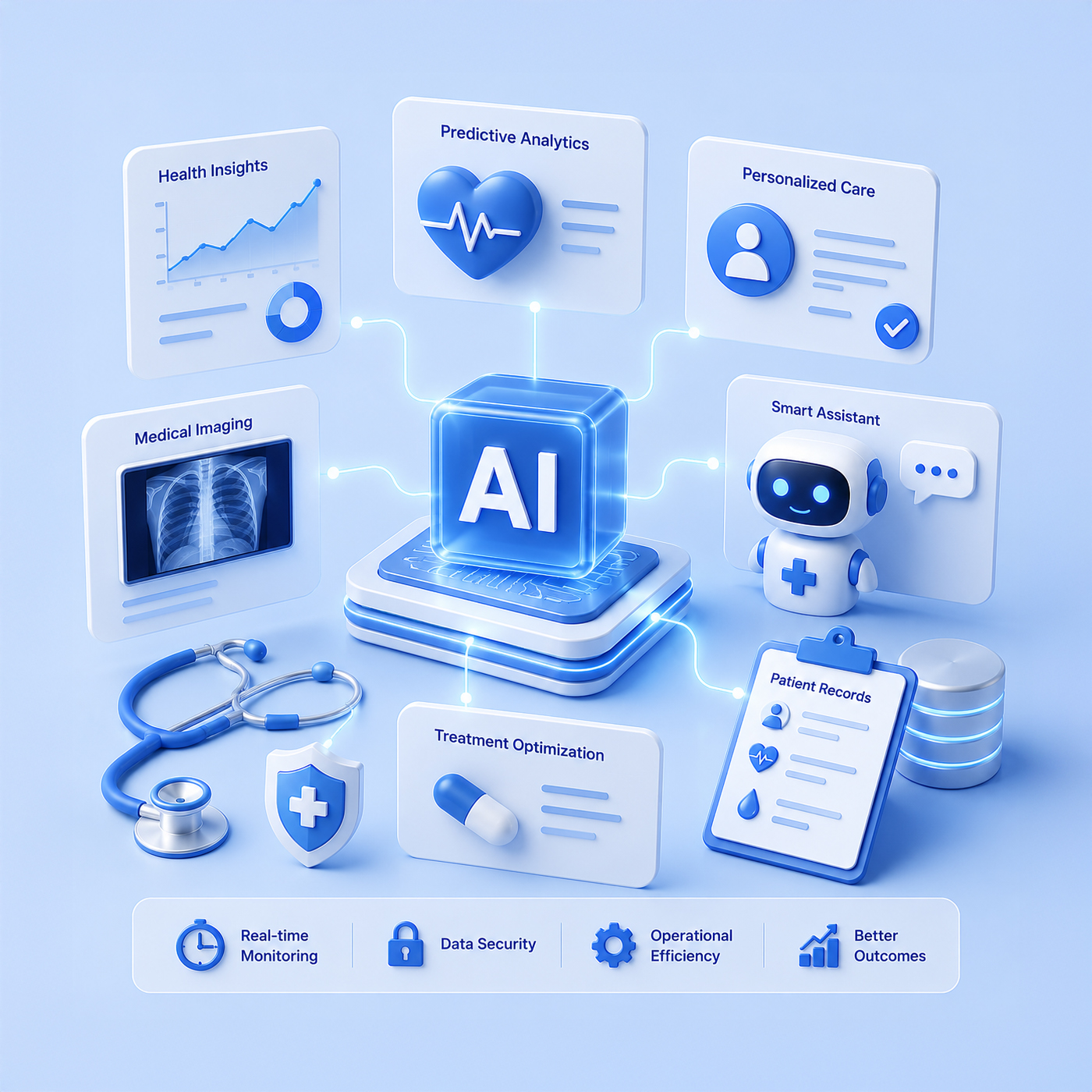
The goal is not to replace healthcare professionals but to help them spend less time on administrative tasks and more time on patient care and strategic decision-making.
What Is Generative AI in Healthcare?
Generative AI in healthcare refers to the use of artificial intelligence models that can generate, summarize, transform, or interpret healthcare-related content such as clinical documentation, patient communications, medical reports, research summaries, operational records, and knowledge resources.
These systems help healthcare professionals process information more efficiently by supporting documentation, information retrieval, communication, education, and administrative workflows. Generative AI is best viewed as an augmentation tool rather than a replacement for clinicians, nurses, administrators, or healthcare staff. Human oversight remains essential for ensuring accuracy, compliance, safety, and responsible use.
Why Organizations Are Exploring It
Key drivers include:
Generative AI helps healthcare organizations manage information-intensive workflows more effectively.
How Generative AI Differs from Traditional Healthcare AI
| Area | Traditional AI | Generative AI |
|---|---|---|
| Primary Function | Analyze and predict | Generate and summarize |
| Outputs | Scores, classifications, predictions | Text, reports, summaries, content |
| Data Interaction | Pattern recognition | Content creation and transformation |
| Typical Use Cases | Risk assessment, imaging analysis | Documentation, communication, knowledge support |
| Human Involvement | Review outputs | Review and validate generated content |
| Content Creation | Limited | Core capability |
| Clinical Support | Decision support | Information assistance |
| Operational Applications | Analytics | Workflow automation |
The 12 Most Important Generative AI Applications
1. Clinical Documentation Assistance
Generates drafts of clinical notes and visit summaries. Human review remains mandatory.
2. Discharge Summary Generation
Creates structured discharge summaries, reducing administrative workload and improving consistency.
3. Patient Communication Support
Drafts patient messages, educational content, and appointment-related communications.
4. Medical Knowledge Retrieval
Provides quick access to policies, procedures, guidelines, and organizational knowledge.
5. Clinical Research Summarization
Condenses research papers and literature reviews into digestible summaries.
6. Medical Coding Assistance
Supports coding workflows by identifying relevant documentation elements.
7. Revenue Cycle Documentation
Improves claims documentation and administrative record preparation.
8. Healthcare Contact Center Support
Assists service representatives with information retrieval and response drafting.
9. Healthcare Knowledge Management
Creates searchable knowledge repositories from large information sources.
10. Care Coordination Assistance
Summarizes patient information across departments to support coordinated care.
11. Healthcare Training & Education
Generates educational materials for clinicians, staff, and patients.
12. Administrative Workflow Automation
Automates repetitive documentation and operational communication tasks.
Real-World Examples
Example 1: Hospital Documentation Workflow
Challenge: Excessive clinician documentation time.
Generative AI Use: Drafting clinical notes and summaries.
Human Oversight: Clinicians validate and approve outputs.
Expected Outcome: Reduced documentation burden.
Example 2: Patient Communication Support
Challenge: High volume of patient inquiries.
Generative AI Use: Drafting responses and educational content.
Human Oversight: Staff review before sending.
Expected Outcome: Faster communication.
Example 3: Clinical Research Review
Challenge: Large volumes of medical literature.
Generative AI Use: Research summarization.
Human Oversight: Researchers verify findings.
Expected Outcome: Faster knowledge access.
Example 4: Healthcare Contact Center Operations
Challenge: Repetitive information requests.
Generative AI Use: Knowledge-assisted response generation.
Human Oversight: Agents review responses.
Expected Outcome: Improved service efficiency.
Benefits
Reduced Administrative Burden
Less manual documentation and repetitive work.
Faster Information Access
Teams can retrieve relevant information quickly.
Improved Documentation Quality
More consistent and structured records.
Better Knowledge Sharing
Information becomes easier to access and distribute.
Faster Research Analysis
Accelerates literature review processes.
Enhanced Patient Communication
Supports more timely and personalized interactions.
Increased Operational Efficiency
Improves workflow productivity across departments.
Improved Staff Productivity
Allows professionals to focus on higher-value activities.
Risks and Challenges
1. Hallucinated Information
Generated content may contain inaccuracies. Human review is essential.
2. Data Privacy Concerns
Patient information must be protected appropriately.
3. Regulatory Compliance Challenges
Healthcare regulations require careful governance.
4. Bias and Fairness Issues
Models may reflect biases present in training data.
5. Security Risks
AI systems require strong security controls.
6. Over-Reliance on AI Outputs
Users should never accept outputs without validation.
7. Integration Complexity
Connecting AI with existing systems can be challenging.
8. Governance Gaps
Lack of policies increases operational risk.
Governance Framework
Human Oversight
Require human review for critical outputs.
Privacy & Security
Protect patient data and access controls.
Validation Processes
Establish testing and quality assurance procedures.
Compliance Management
Align with healthcare regulations and policies.
Model Monitoring
Continuously monitor performance and accuracy.
Responsible AI Policies
Define acceptable use and accountability standards.
How to Evaluate Opportunities
Identify Information-Heavy Workflows
Target documentation and communication processes.
Assess Data Availability
Evaluate data quality and accessibility.
Evaluate Risk Levels
Identify compliance and operational risks.
Pilot Low-Risk Use Cases
Start with manageable applications.
Measure Outcomes
Track efficiency and quality improvements.
Scale Responsibly
Expand successful initiatives with governance controls.
What Leaders Should Prioritize
Quick Wins
Documentation, knowledge management, and administrative workflows.
Medium-Term Opportunities
Patient communication, coding assistance, and care coordination.
Strategic Transformation Opportunities
Enterprise knowledge assistants, AI copilots, and workflow automation.
Readiness Worksheet
Workflow Identification
Which processes are information-heavy?
Data Readiness Assessment
Is reliable data available?
Risk Assessment
What privacy, compliance, or operational risks exist?
Governance Requirements
What oversight mechanisms are needed?
Human Oversight Planning
Who validates outputs?
Pilot Opportunities
Which use cases can deliver value quickly?
Success Metrics
How will outcomes be measured?
Generative AI and the Future of Healthcare
Healthcare organizations are increasingly exploring:
- AI copilots for clinicians
- Intelligent documentation systems
- Personalized patient engagement
- Healthcare knowledge assistants
- Multimodal healthcare AI
The future will focus on helping healthcare professionals work more effectively while maintaining human oversight and accountability.
Frequently Asked Questions
Conclusion
Generative AI is emerging as a powerful augmentation technology for healthcare organizations. The most immediate value is appearing in documentation, communication, knowledge management, and administrative workflows.
Organizations that combine strong governance, human oversight, responsible implementation, and practical use-case selection will be best positioned to realize long-term value while maintaining trust, compliance, and patient-centered care.
Implement Generative AI Responsibly
As healthcare organizations evaluate Generative AI opportunities, success depends on selecting the right use cases, establishing governance, and implementing solutions responsibly.
Kambaa helps healthcare providers, payers, and health technology organizations design, implement, govern, and scale Generative AI solutions across documentation, patient engagement, knowledge management, operations, and intelligent automation initiatives.