
AI in Banking: How Financial Institutions Are Using AI in 2026
Banks face growing pressure to improve customer experiences, manage risk more effectively, detect fraud faster, reduce operational costs, and compete with digital-first financial institutions. As transaction volumes increase and regulatory requirements become more complex, AI in banking is helping financial institutions improve decision-making, automate repetitive processes, strengthen risk management, and deliver more personalized services.
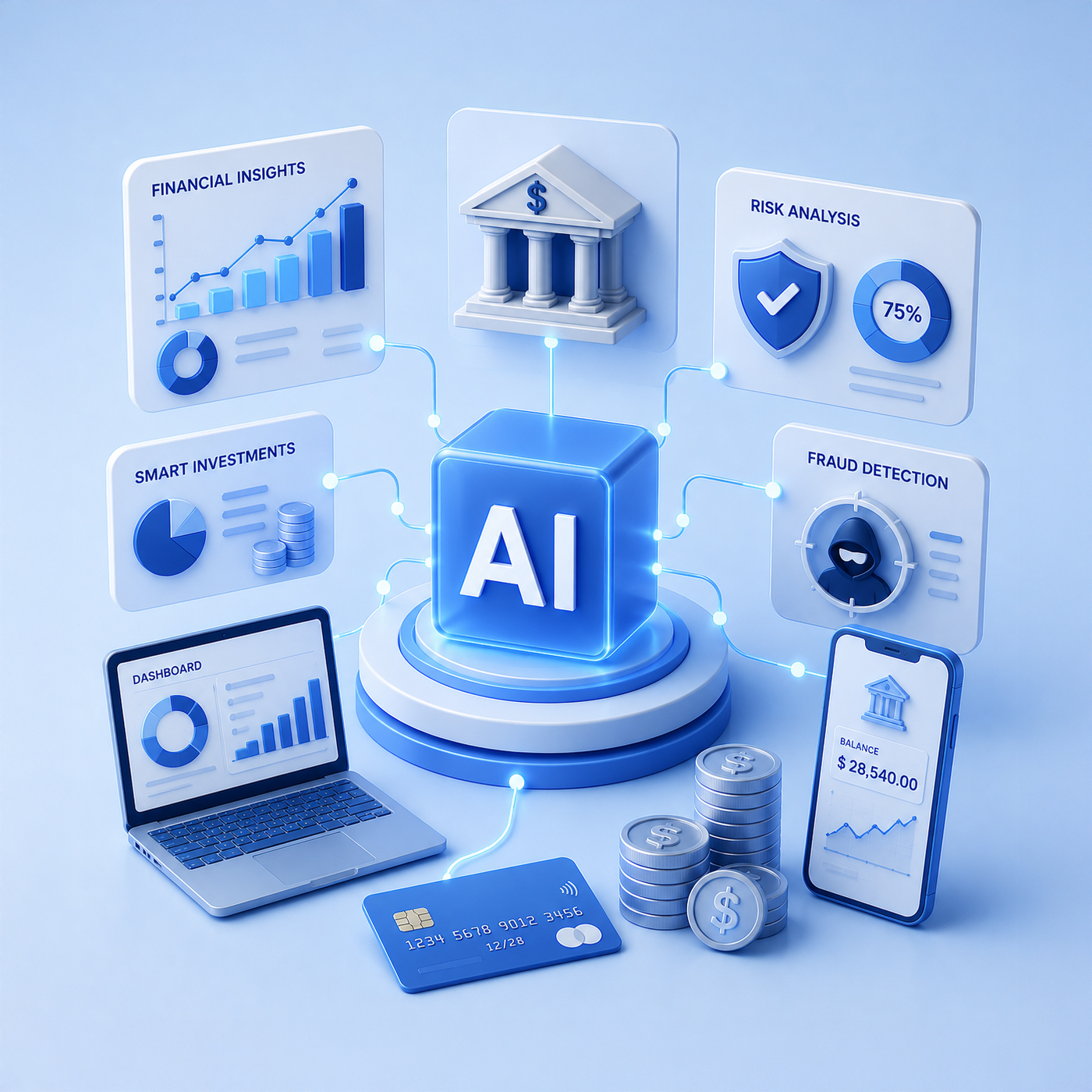
The most successful banks are using AI to augment employees—not replace them—while maintaining strong governance and human oversight.
What Is AI in Banking?
AI in banking refers to the use of artificial intelligence technologies such as machine learning, predictive analytics, natural language processing, computer vision, and generative AI to improve banking operations, customer service, fraud detection, risk management, compliance, and financial decision-making.
AI helps banks analyze large volumes of structured and unstructured data, identify patterns, automate routine workflows, enhance customer interactions, and support employees in making faster, more informed decisions. Rather than replacing bankers, risk professionals, or compliance teams, AI serves as a decision-support and operational-efficiency tool that helps financial institutions improve performance while maintaining governance and regulatory compliance.
Why AI Adoption Is Accelerating
Several factors are driving adoption:
Banks are increasingly viewing AI as a strategic capability rather than a standalone technology project.
The 15 Most Important AI Use Cases in Banking
1. Fraud Detection and Prevention
Identifies suspicious activity in real time, helping fraud teams investigate high-risk transactions faster.
2. Credit Risk Assessment
Supports lending decisions by analyzing customer behavior, credit history, and risk indicators.
3. Anti-Money Laundering (AML) Monitoring
Detects unusual transaction patterns and helps compliance teams prioritize investigations.
4. Customer Service Virtual Assistants
Provides 24/7 support for routine banking inquiries while escalating complex cases to staff.
5. Personalized Financial Recommendations
Delivers relevant product recommendations and personalized customer experiences.
6. Loan Underwriting Support
Assists underwriters by analyzing application data and identifying potential risks.
7. Know Your Customer (KYC) Automation
Speeds identity verification and customer onboarding processes.
8. Transaction Monitoring
Continuously analyzes transactions to identify anomalies and potential compliance issues.
9. Customer Churn Prediction
Identifies customers likely to leave and enables proactive retention strategies.
10. Wealth Management Assistance
Supports advisors with research, portfolio insights, and client engagement preparation.
11. Regulatory Compliance Support
Helps monitor policies, controls, and reporting requirements across banking operations.
12. Document Processing Automation
Extracts information from applications, contracts, and financial documents.
13. Collections Optimization
Prioritizes collections efforts using predictive analytics and customer behavior insights.
14. Branch Operations Optimization
Improves staffing, scheduling, and resource allocation across branch networks.
15. Banking Knowledge Management
Provides employees with quick access to policies, procedures, and regulatory guidance.
AI in Banking: Benefits and Business Impact
| Area | Traditional Approach | AI-Enhanced Approach |
|---|---|---|
| Fraud Detection | Rule-based reviews | Real-time pattern analysis |
| Customer Service | Manual interactions | Intelligent assistance |
| Risk Assessment | Static evaluations | Dynamic predictive insights |
| Compliance Monitoring | Periodic reviews | Continuous monitoring |
| Loan Processing | Manual verification | Automated support workflows |
| Transaction Monitoring | Sample-based reviews | Large-scale analysis |
| Operational Efficiency | Labor-intensive processes | Intelligent automation |
Which Institutions Benefit Most?
Retail Banks
Customer service, fraud prevention, lending, and personalization.
Commercial Banks
Risk assessment, compliance monitoring, and operational efficiency.
Investment Banks
Research analysis, risk modeling, and knowledge management.
Credit Unions
Member service automation and operational optimization.
Fintech Organizations
Customer acquisition, fraud management, and intelligent automation.
Common Challenges
Key challenges include:
- Poor data quality
- Regulatory requirements
- Privacy concerns
- Legacy technology environments
- Model governance needs
- Explainability requirements
Building an AI Strategy
Phase 1: Identify High-Value Business Problems
Focus on measurable operational or customer challenges.
Phase 2: Assess Data Readiness
Evaluate data quality, availability, and accessibility.
Phase 3: Pilot Low-Risk Use Cases
Start with controlled projects and measurable objectives.
Phase 4: Measure Outcomes
Track efficiency, accuracy, customer impact, and risk reduction.
Phase 5: Scale with Governance
Expand successful initiatives while maintaining oversight and compliance.
AI Governance in Banking
Effective governance includes:
Governance ensures AI remains trustworthy, auditable, and aligned with regulatory expectations.
Real-World Scenarios
Example 1: Fraud Detection Modernization
Challenge: Rising fraud attempts.
AI Solution: Real-time transaction monitoring.
Expected Outcome: Faster fraud detection and reduced losses.
Example 2: Loan Processing Optimization
Challenge: Slow lending decisions.
AI Solution: Automated application analysis.
Expected Outcome: Faster approvals and improved efficiency.
Example 3: AML Monitoring Enhancement
Challenge: High false-positive investigation volumes.
AI Solution: Intelligent alert prioritization.
Expected Outcome: More effective compliance operations.
Example 4: Customer Service Automation
Challenge: High inquiry volumes.
AI Solution: AI-powered virtual assistants.
Expected Outcome: Improved service availability and faster response times.
Opportunity Assessment Worksheet
Business Challenges
Which operational or customer problems need improvement?
Data Readiness
Is quality data available?
Risk Assessment
What operational, compliance, or security risks exist?
Regulatory Considerations
What governance requirements apply?
AI Use Case Prioritization
Which opportunities offer the highest value?
Pilot Opportunities
Where can low-risk pilots be launched?
Success Metrics
How will business outcomes be measured?
AI and the Future of Banking
Emerging trends include:
Future success will depend on combining AI capabilities with strong governance and human expertise.
Frequently Asked Questions
Conclusion
AI is becoming a critical capability across modern banking. From fraud detection and compliance to customer engagement and operational efficiency, AI is helping financial institutions make better decisions and improve performance.
The most successful implementations combine technology with human expertise, strong governance, and responsible deployment practices. Long-term value comes not from automation alone, but from using AI to enhance how banking professionals serve customers and manage risk.
Implement AI in Banking
As financial institutions evaluate AI opportunities, success depends on selecting the right use cases, implementing strong governance, and aligning AI initiatives with business objectives.
Kambaa helps banks, fintech companies, and financial institutions design, implement, govern, and scale AI solutions across fraud detection, compliance, customer engagement, intelligent automation, risk management, and operational transformation initiatives.