AI in Retail:Custom Software vs Off-the-Shelf Software
Compare custom-built software and packaged software solutions to determine which approach delivers the best long-term value for your business.
Organizations today have more software choices than ever before.
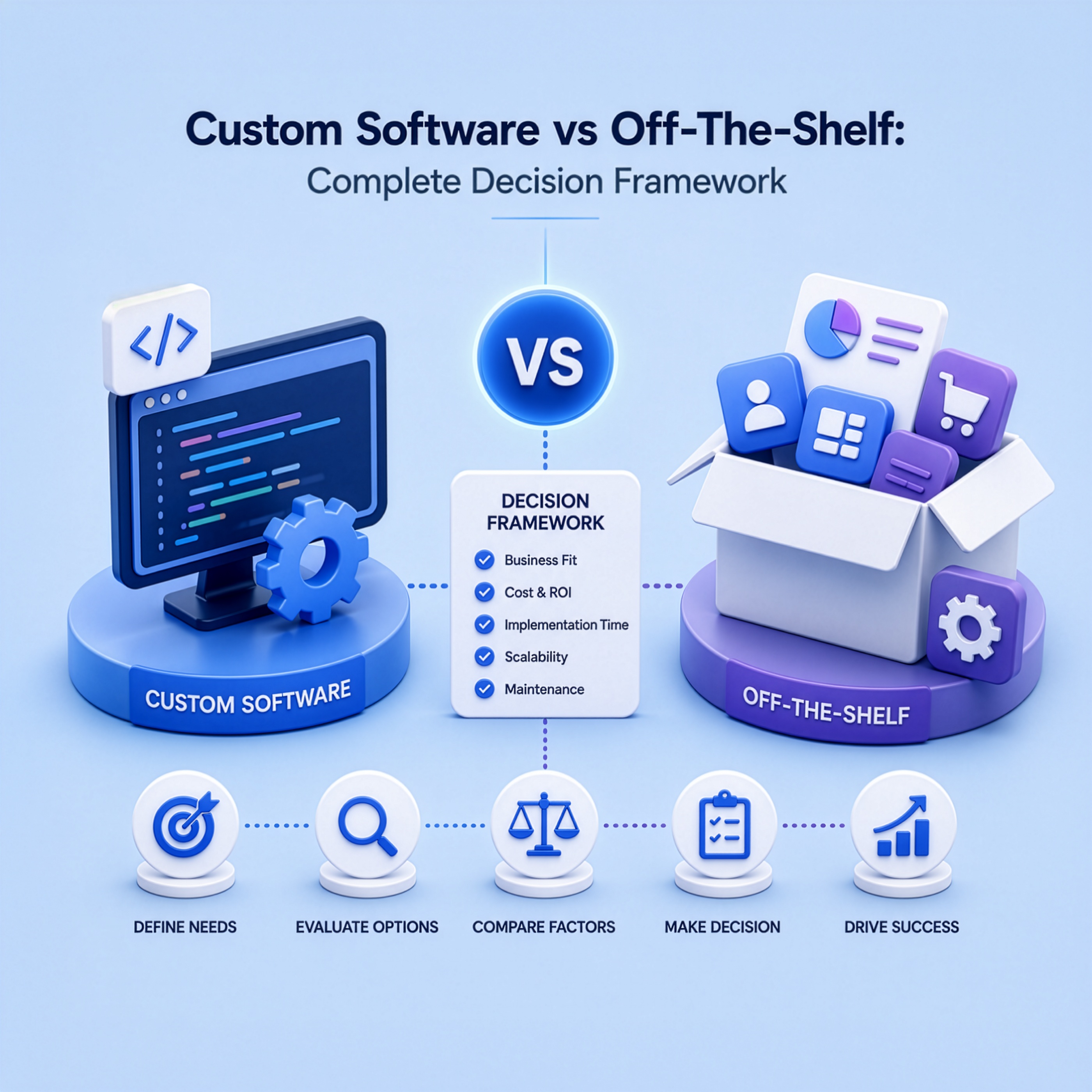
From SaaS subscriptions and enterprise platforms to fully customized applications, business leaders must decide whether to build a solution tailored to their needs or purchase an existing product. The debate around Custom Software vs Off-the-Shelf Software is not simply a technology decision. It is a business strategy decision that impacts operational efficiency, scalability, competitive advantage, customer experience, and long-term growth.
Off-the-Shelf
Provides fast access to proven functionality.
Custom Software
Provides flexibility, ownership, and alignment with unique business requirements.
The right choice depends on business goals, budget, growth plans, integration requirements, and operational complexity. This guide provides a practical framework for evaluating Build vs Buy Software decisions.
Software Choices At a Glance
Choose Off-the-Shelf if you need:
- Rapid deployment
- Lower upfront investment
- Standard business processes
- Proven functionality
Choose Custom Software if you need:
- Competitive differentiation
- Unique workflows
- Enterprise integrations
- Long-term scalability
For many organizations, the best approach is a hybrid strategy that combines packaged software for standard operations and custom software for strategic business capabilities.
What Is Custom Software?
Custom software is a purpose-built application designed specifically for the requirements of a particular organization. Unlike packaged software, custom solutions are developed around unique business processes, operational goals, customer experiences, and strategic objectives.
Key Characteristics
- Purpose-Built Functionality: Features are designed around business requirements.
- Tailored Workflows: Processes can be optimized to match how teams actually work.
- Full Ownership: Organizations own the application, architecture, and roadmap.
- Flexible Evolution: Features can evolve as business requirements change.
- Long-Term Scalability: Systems designed to support future growth.
Business Benefits
Competitive differentiation, improved operational efficiency, greater flexibility, better customer experiences, scalable growth, reduced dependency on vendors.
Custom software often becomes a strategic business asset rather than simply a tool.
What Is Off-the-Shelf Software?
Off-the-shelf software refers to commercially available products designed to serve a broad range of customers. These solutions typically offer standardized functionality and are delivered through subscription or licensing models.
Key Characteristics
- Pre-Built Functionality: Core features are already developed and tested.
- Subscription Licensing: Organizations pay recurring fees for access.
- Standardized Processes: Workflows are designed to serve broad market needs.
- Vendor-Managed Updates: The software provider maintains and updates the platform.
- Rapid Deployment: Implementation timelines are generally shorter.
Business Benefits
Faster implementation, lower initial investment, proven functionality, reduced technical responsibility, predictable subscription costs.
Off-the-shelf software often works well for common business processes.
Head-to-Head: Quick Comparison
| Category | Custom Software | Off-the-Shelf Software |
|---|---|---|
| Initial Cost | Higher | Lower |
| Implementation Speed | Slower | Faster |
| Customization | Unlimited | Limited |
| Scalability | Highly scalable | Vendor dependent |
| Integration Capability | Extensive | Variable |
| Maintenance | Managed by owner or partner | Managed by vendor |
| Security | Tailored to requirements | Standardized |
| Ownership | Full ownership | Licensed usage |
| Competitive Advantage | High | Limited |
| Flexibility | High | Moderate |
| User Experience | Business-specific | Generic |
| Long-Term Cost | Potentially lower | Ongoing subscriptions |
| Vendor Dependency | Low | High |
| Business Alignment | Excellent | Moderate |
| ROI Potential | High for strategic systems | High for standard processes |
Deep Dive: Key Differences
Understanding Custom vs Packaged Software requires evaluating more than features alone.
Flexibility
Built around business requirements.
Organizations adapt to the software.
Customization
Unlimited customization potential.
Limited customization options.
Implementation
Requires planning, design, and development.
Can often be deployed quickly.
Ownership
Full ownership and control.
Software remains owned by the vendor.
Security
Security can be tailored to organizational requirements.
Security controls are standardized.
Scalability
Designed around future business growth.
Growth may depend on vendor capabilities.
Integration
Integrates directly with business systems.
Integration capabilities vary.
Business Alignment
Designed around business strategy.
Designed around market averages.
Build vs Buy Software
When Building Makes Sense
- Processes are unique
- Competitive differentiation matters
- Customer experience is strategic
- Complex integrations are required
- Long-term scalability is important
- Organizations want complete control
When Buying Makes Sense
- Requirements are standardized
- Speed is critical
- Budget is limited
- Differentiation is not required
- Mature solutions already exist
Business Trade-Offs: Building provides flexibility but requires greater investment. Buying reduces implementation effort but may create limitations.
Risk Considerations: Custom software introduces development risk. Packaged software introduces vendor dependency risk.
Growth Considerations: Organizations expecting rapid growth often benefit from custom platforms designed for scalability. Businesses should evaluate where they expect to be in 3-5 years.
Cost Comparison
The lowest upfront cost is not always the lowest long-term cost.
| Cost Area | Custom Software | Off-the-Shelf Software |
|---|---|---|
| Initial Investment | Higher | Lower |
| Implementation Costs | Moderate to High | Low to Moderate |
| Licensing Costs | None | Ongoing |
| Customization Costs | Included in development | Often additional |
| Training Costs | Moderate | Moderate |
| Support Costs | Flexible | Subscription-based |
| Upgrade Costs | Controlled internally | Vendor-controlled |
| Integration Costs | Built into architecture | Often additional |
| Long-Term Costs | More predictable | Can increase over time |
Total Cost of Ownership (TCO) Analysis
Evaluating TCO helps organizations make informed technology decisions over a multi-year horizon.
Year 1 Costs
Custom Software
- Development investment
- Planning & Architecture
- Implementation
- Training
Off-the-Shelf
- Licensing
- Implementation & Configuration
- Training & Integration
Year 3 Costs
Custom Software
- Enhancements
- Maintenance
- Infrastructure & Support
Off-the-Shelf
- Recurring subscriptions
- Additional licenses
- Customization & Integrations
- Vendor pricing changes
Year 5 Costs
Custom Software
- Continued ownership
- Feature expansion
- Optimization
Off-the-Shelf
- Accumulated subscription fees
- Upgrade costs
- Vendor dependency costs
- Potential migration expenses
Hidden Costs
Organizations often underestimate:
- Integration effort & Process inefficiencies
- User adoption challenges & Vendor limitations
- Licensing growth & Data migration
Scaling & Technical Debt
As organizations grow, subscription-based software can become significantly more expensive.
Poorly selected software solutions can create operational and integration challenges that increase future costs.
Business Use Cases
The more unique the business process, the stronger the case for custom software.
| Scenario | Custom Software | Off-the-Shelf Software | Best Choice |
|---|---|---|---|
| Startup MVP | Good | Good | Depends on strategy |
| Enterprise ERP | Limited | Excellent | Off-the-Shelf |
| Customer Portal | Excellent | Moderate | Custom Software |
| Internal Operations Platform | Excellent | Moderate | Custom Software |
| Healthcare System | Excellent | Moderate | Custom Software |
| Financial Services Platform | Excellent | Moderate | Custom Software |
| Manufacturing Workflow Management | Excellent | Moderate | Custom Software |
| SaaS Product Development | Excellent | Not Applicable | Custom Software |
| Digital Transformation Initiative | Excellent | Moderate | Custom Software |
Common Misconceptions
Custom Software Is Always Expensive
While initial investment may be higher, long-term ownership can reduce total costs.
Off-the-Shelf Software Is Always Cheaper
Subscription costs can accumulate significantly over time.
Custom Software Takes Too Long
Modern development methodologies enable rapid delivery through phased releases.
Packaged Software Solves Every Problem
Many businesses still require customization and integration.
Customization Is Always Necessary
Some organizations can achieve excellent results with standardized solutions.
Business Requirements Should Drive Decisions
Technology choices should align with strategic objectives rather than trends.
Decision Framework
| Business Need | Recommended Approach |
|---|---|
| Unique Competitive Advantage | Custom Software |
| Standard Operations | Off-the-Shelf |
| Long-Term Scalability | Custom Software |
| Rapid Deployment | Off-the-Shelf |
| Complex Integrations | Custom Software |
| Limited Budget | Off-the-Shelf |
| Digital Transformation | Custom Software |
| Industry-Specific Workflows | Custom Software |
| Short-Term Requirements | Off-the-Shelf |
| Product Development | Custom Software |
Practical Guidance: The more strategic the system becomes, the stronger the case for custom software.
How Kambaa Helps Organizations Make the Right Choice
Technology decisions should support business goals rather than create additional complexity.
Technology Assessment
Evaluate current systems, challenges, and opportunities.
Software Strategy
Develop technology roadmaps aligned with business objectives.
Custom Software Development
Design and build scalable, business-specific applications.
Application Modernization
Transform legacy systems into modern digital platforms.
System Integration
Connect applications, workflows, and business processes.
Digital Transformation Consulting
Help organizations leverage technology as a strategic advantage.
Long-Term Support
Provide ongoing optimization, enhancement, and modernization services.
Frequently Asked Questions
Conclusion: Which Is Right for Your Business?
There is no universal answer in the Custom Software vs Off-the-Shelf Software debate. The right decision depends on business goals, growth plans, operational complexity, and strategic priorities.
Organizations that view technology as a strategic asset frequently benefit from custom development. Organizations focused on operational efficiency and speed may achieve strong results with packaged software. The most successful technology strategies begin with business objectives and evaluate software options through the lens of long-term value rather than short-term cost alone.
Evaluate Your Software Strategy
Begin with a technology assessment to evaluate business requirements and identify the most appropriate solution strategy for your long-term goals.