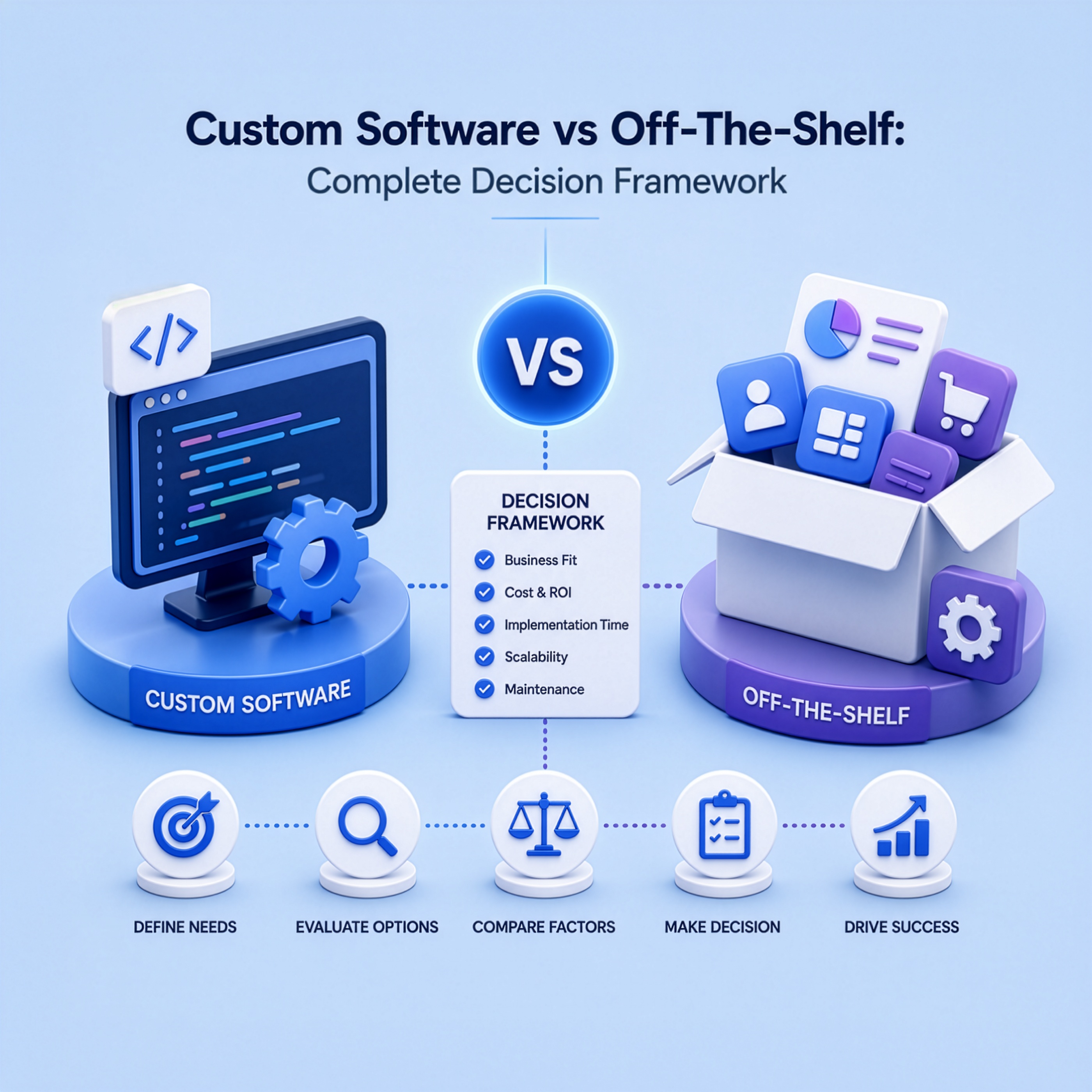
Custom Software vs Off-The-Shelf: Complete Decision Framework
Compare custom software and off-the-shelf solutions to determine the best fit for your business requirements.
Introduction
Every growing organization eventually faces a technology crossroads. Spreadsheets become difficult to manage, disconnected tools create inefficiencies, and manual processes slow growth. At that point, leadership must decide whether to purchase an existing software solution or invest in building something tailored to their needs.
The debate around custom software vs off-the-shelf software is not simply a technology decision. It is a strategic business decision that affects operational efficiency, scalability, competitive advantage, and long-term costs.
Understanding the strengths, limitations, and trade-offs of each approach helps organizations make smarter technology investments.
Custom Software vs Off-The-Shelf: Quick Answer
Custom software is built specifically for an organization's unique workflows, business requirements, and strategic goals. Off-the-shelf software is a pre-built commercial solution designed to serve a broad range of customers with similar needs.
In simple terms:
- Custom software prioritizes flexibility, control, and competitive differentiation.
- Off-the-shelf software prioritizes speed, lower upfront investment, and proven functionality.
Neither option is universally better. Organizations with highly specialized processes, complex integrations, or unique competitive requirements often benefit from custom development. Businesses with standard operational needs and limited implementation timelines often gain value from off-the-shelf platforms. The right choice depends on business complexity, growth plans, scalability needs, integration requirements, and long-term technology strategy.
What Is Custom Software?
Custom software is an application designed and developed specifically for a single organization.
Unlike commercial software products, custom solutions are built around unique workflows, business rules, and operational requirements.
Typical Examples
- Internal operations platforms
- Custom ERP systems
- Industry-specific applications
- Customer portals
- Workflow automation systems
Advantages
- Tailored functionality
- Greater flexibility
- Better integration opportunities
- Full ownership and control
Common Use Cases
Organizations with unique processes, specialized compliance requirements, or technology-driven competitive advantages.
What Is Off-The-Shelf Software?
Off-the-shelf software is a commercially available application designed for a broad customer base.
Organizations subscribe to or purchase the software and configure it to meet their needs.
Typical Examples
- CRM platforms
- Accounting software
- HR management systems
- Project management tools
- Collaboration platforms
Advantages
- Faster deployment
- Lower upfront investment
- Proven functionality
- Ongoing vendor support
Common Use Cases
Organizations with standard business requirements that want rapid implementation.
Custom Software vs Off-The-Shelf: Key Differences
Side-by-Side Comparison
| Evaluation Area | Custom Software | Off-The-Shelf Software |
|---|---|---|
| Initial Cost | Higher upfront investment | Lower upfront investment |
| Time to Deploy | Months to build | Days or weeks |
| Flexibility | Highly flexible | Limited to vendor capabilities |
| Customization | Unlimited | Usually constrained |
| Ownership | Full ownership | Vendor-owned |
| Integrations | Designed around business needs | Depends on available integrations |
| Scalability | Built for growth requirements | Limited by platform architecture |
| Security Control | Greater control | Vendor-managed |
| Competitive Advantage | Can create differentiation | Rarely creates differentiation |
| Maintenance | Organization responsibility | Vendor responsibility |
| Vendor Dependency | Minimal | Often significant |
| Long-Term Value | Potentially higher strategic value | Faster short-term value |
Advantages of Custom Software
Key Strategic Benefits
Tailored Business Processes
Software supports the business rather than forcing the business to adapt.
Competitive Differentiation
Unique capabilities can create advantages competitors cannot easily replicate.
Scalability
Systems can be designed around long-term growth objectives.
Integration Flexibility
Applications can connect directly with existing technology ecosystems.
Ownership and Control
Organizations control the roadmap, functionality, and future enhancements.
Advantages of Off-The-Shelf Software
Key Operational Benefits
Faster Deployment
Solutions can often be implemented within weeks.
Lower Upfront Costs
Organizations avoid major development investments.
Proven Functionality
Features have been tested across many customers.
Vendor Support
Updates, maintenance, and support are typically included.
Reduced Development Risk
Businesses avoid many software development challenges.
When Custom Software Is the Better Choice
8 Key Scenarios
Your Processes Are Highly Unique
Standard software cannot effectively support your workflows.
Existing Software Creates Operational Friction
Employees constantly work around platform limitations.
Competitive Advantage Depends on Technology
Technology directly supports market differentiation.
Integration Requirements Are Complex
Multiple systems must work together seamlessly.
Scalability Is a Major Priority
Long-term growth requires architectural flexibility.
Compliance Requirements Are Specialized
Industry regulations demand tailored functionality.
Data Ownership Is Critical
Organizations require greater control over information assets.
Long-Term Cost Efficiency Matters
Subscription fees may eventually exceed custom development costs.
When Off-The-Shelf Software Is the Better Choice
8 Key Scenarios
Requirements Are Standardized
Common business processes already fit existing solutions.
Speed Is the Top Priority
Immediate deployment is required.
Budget Is Limited
Large development investments are not practical.
Internal Technical Resources Are Limited
Managing custom software would be difficult.
Industry Solutions Already Exist
Strong commercial products address the problem effectively.
Processes Are Still Evolving
Requirements may change significantly.
Immediate Deployment Is Required
Business urgency outweighs customization needs.
Technology Is Not a Competitive Differentiator
Software supports operations rather than strategic advantage.
The 5-Step Software Decision Framework
Step-by-step decision process
Step 1: Define Business Objectives
Clarify desired outcomes, operational goals, and strategic priorities.
Step 2: Evaluate Process Complexity
Determine whether processes are standardized or unique.
Step 3: Assess Long-Term Scalability
Consider future growth, users, and operational requirements.
Step 4: Calculate Total Cost of Ownership
Evaluate all costs beyond initial implementation.
Step 5: Evaluate Strategic Value
Assess whether technology contributes directly to competitive advantage.
Total Cost of Ownership (TCO): What Businesses Often Miss
Many organizations focus only on purchase or development costs.
Additional factors include:
The lowest upfront cost is not always the lowest long-term cost.
Real-World Decision Examples
Four Practical Scenarios
Example 1: Startup CRM Selection
- Scenario: Early-stage startup needs customer management.
- Recommendation: Off-the-shelf CRM.
- Why: Requirements are standard and speed matters.
Example 2: Manufacturing Operations Platform
- Scenario: Complex production workflows.
- Recommendation: Custom software.
- Why: Unique operational requirements and integrations.
Example 3: Internal Employee Portal
- Scenario: HR and operations self-service portal.
- Recommendation: Hybrid evaluation.
- Why: Depends on workflow complexity and integration needs.
Example 4: Industry-Specific SaaS Product
- Scenario: Software intended as a commercial product.
- Recommendation: Custom development.
- Why: Product differentiation is essential.
Common Software Selection Mistakes
Organizations frequently make avoidable mistakes:
Successful technology investments align with business outcomes rather than feature lists.
What to Expect in 2026 and Beyond
Several trends are reshaping software decisions:
These innovations will reduce development barriers while increasing software flexibility.
Frequently Asked Questions
Common questions about custom software vs off-the-shelf software
What is the difference between custom software and off-the-shelf software?
Custom software is built specifically for one organization, while off-the-shelf software is designed for many customers with similar needs.
Which option is more cost-effective?
The answer depends on timeframe. Off-the-shelf software often costs less initially, while custom software may provide better long-term value for complex businesses.
Is custom software always more expensive?
Not necessarily. While initial development costs are higher, long-term subscription and licensing costs can make commercial software more expensive over time.
How long does custom software development take?
Simple projects may take several months, while enterprise applications often require six months to a year or more.
Can off-the-shelf software be customized?
Most commercial platforms offer configuration and limited customization, though flexibility is usually restricted compared to custom development.
Which option scales better?
Custom software generally offers greater scalability because it is designed around specific business requirements.
What are the biggest decision mistakes?
Focusing only on upfront cost, ignoring integrations, and failing to evaluate long-term strategic value.
How should businesses evaluate software investments?
Organizations should assess objectives, complexity, scalability, TCO, and strategic importance before deciding.
SOFTWARE DECISION WORKSHEET
Custom Software vs Off-The-Shelf Decision Worksheet
Business Objectives:
What outcomes are we trying to achieve?
Process Complexity Assessment:
Are workflows standard or unique?
Scalability Requirements:
How will requirements evolve over the next 3–5 years?
Integration Requirements:
Which systems must connect?
Budget Considerations:
What are acceptable upfront and ongoing costs?
Strategic Importance:
Does technology create competitive advantage?
Recommended Decision Criteria:
Conclusion
Neither custom software nor off-the-shelf software is inherently superior. The right choice depends on business goals, operational complexity, scalability requirements, and long-term strategy.
Organizations that focus only on short-term costs often miss important strategic considerations. The most successful software investments align technology decisions with business outcomes, future growth plans, and competitive positioning.
As organizations evaluate software investments, choosing between custom software and off-the-shelf solutions is ultimately a strategic business decision.
Kambaa helps businesses assess requirements, evaluate technology options, build custom applications, modernize existing systems, and develop scalable software solutions aligned with long-term business goals.