AI SEO vs Traditional SEO: What Changes in 2026
Buyers increasingly use ChatGPT, Gemini, Claude, Perplexity, and Google AI Overviews to research products before ever visiting a website. Organizations are no longer competing only for rankings — they are competing for citations and visibility inside AI-generated responses.
Introduction
Search behavior is changing faster than at any point in the past decade. For years, businesses focused primarily on ranking higher in search engine results pages. Today, that is only part of the visibility equation. Buyers increasingly use ChatGPT, Gemini, Claude, Perplexity, and Google AI Overviews to research products, compare vendors, understand solutions, and validate purchasing decisions before visiting websites.
As AI-generated answers become a common starting point for discovery, organizations are no longer competing only for rankings. They are also competing for citations, recommendations, and visibility inside AI-generated responses. This shift has led to the emergence of AI SEO — a broader approach to search optimization that extends beyond traditional rankings and focuses on how AI systems discover, understand, and reference information.
Understanding the difference between AI SEO and traditional SEO is becoming essential for organizations that want to remain visible in the evolving search landscape.
What is AI SEO?
Optimizing for both search engines and AI systems
AI SEO is the practice of optimizing content, entities, authority signals, website structure, and information architecture to improve visibility across both traditional search engines and AI-powered discovery platforms such as ChatGPT, Gemini, Claude, Perplexity, and Google AI Overviews.
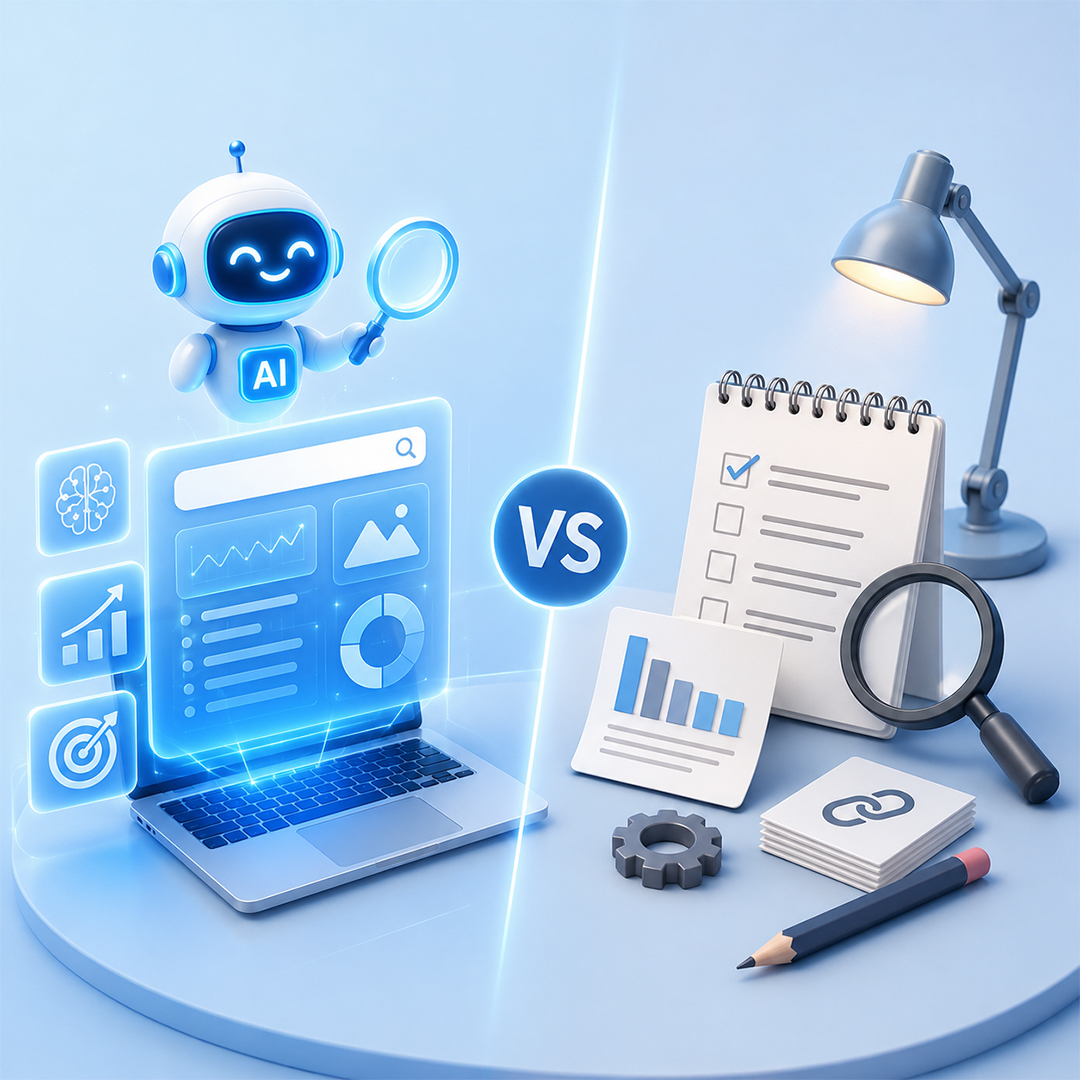
Unlike traditional SEO, which primarily focuses on rankings and organic traffic, AI SEO aims to improve how AI systems understand, retrieve, cite, recommend, and present information. It combines elements of search optimization, entity development, content strategy, authority building, and AI visibility management.
The goal is to ensure that a brand remains discoverable wherever modern buyers search for information — whether through search results or AI-generated answers.
Quick answer
Traditional SEO
Focuses on improving rankings within search engine results pages by optimizing keywords, content, backlinks, technical performance, and user experience. In short, it helps users find your website.
AI SEO
Expands this approach by optimizing for visibility inside AI-generated answers, recommendations, summaries, and citations — emphasizing entity authority, structured content, extractability, topical expertise, and third-party validation. In short, it helps AI systems understand, reference, and recommend your information.
Both disciplines remain important, but AI SEO addresses the growing role of AI-powered discovery in modern buying journeys.
Why search is changing
Five trends reshaping how people discover information
AI-Assisted Discovery
Users increasingly ask AI platforms questions instead of manually browsing search results.
Conversational Search
Search behavior is becoming more natural and dialogue-driven.
Research-First Buying Journeys
Buyers use AI systems to compare options and validate decisions before engaging vendors.
Zero-Click Experiences
Many questions are answered directly without requiring users to visit websites.
Growth of AI-Generated Answers
Platforms increasingly summarize information rather than simply linking to it.
For businesses, these changes mean visibility must extend beyond rankings alone.
AI SEO vs traditional SEO
A side-by-side comparison across 12 factors
How traditional SEO works
Built around helping search engines rank pages
Crawling
Search engines discover pages through links and sitemaps.
Indexing
Content is processed and stored within search engine databases.
Ranking
Algorithms evaluate relevance and quality to determine rankings.
Keywords
Keywords help search engines understand page topics.
Backlinks
External links act as authority and trust signals.
Technical SEO
Site performance, crawlability, mobile usability, and accessibility influence visibility.
Search Intent
Pages perform best when they satisfy the user's intent behind a query.
Traditional SEO remains highly effective because search engines continue to play a major role in digital discovery.
How AI SEO works
Focused on how AI systems interpret information
AI Citations
Visibility increasingly depends on whether AI systems reference a brand or source.
Entity Optimization
Organizations, products, services, and experts are evaluated as entities.
Content Extractability
Information must be easy for AI systems to identify and summarize.
Knowledge Graphs
AI systems use relationships between entities to understand context.
Authority Signals
Expertise, trustworthiness, and consistency influence visibility.
Structured Information
Clear formatting improves machine understanding.
AI Visibility
The objective extends beyond rankings to broader discoverability across AI ecosystems.
AI SEO is fundamentally about making information easier for machines to understand and trust.
Where AI SEO and traditional SEO overlap
Shared foundations both approaches rely on
Despite their differences, AI SEO and traditional SEO share several important foundations. For most organizations, strong traditional SEO provides the foundation upon which AI SEO is built.
High-Quality Content
Useful, accurate, and relevant content remains essential.
E-E-A-T
Experience, Expertise, Authoritativeness, and Trustworthiness continue to influence visibility.
Technical Website Quality
Fast, accessible, and well-structured websites perform better.
Topical Authority
Deep expertise within a subject area benefits both approaches.
User Experience
Content must be useful for real people, not just algorithms.
Content Relevance
Meeting user needs remains the foundation of effective optimization.
The 5 pillars of AI SEO
The core building blocks of AI visibility
1. Entity Authority
Entity authority focuses on helping AI systems understand who your organization is and why it matters.
Implementation: Maintain consistent brand information, expert profiles, and service definitions across all digital properties.
Expected outcome: Stronger entity recognition and trust.
2. Topical Depth
AI systems reward organizations that demonstrate comprehensive expertise.
Implementation: Create content clusters covering important topics from multiple perspectives.
Expected outcome: Improved authority and relevance.
3. Structured Content
Well-organized content improves machine understanding.
Implementation: Use definitions, FAQs, frameworks, summaries, and logical headings.
Expected outcome: Better content extraction and usability.
4. Third-Party Validation
External recognition strengthens credibility.
Implementation: Earn mentions, reviews, interviews, and industry references.
Expected outcome: Increased trust and authority signals.
5. AI Citation Readiness
Content should be easy for AI systems to reference.
Implementation: Provide direct answers, practical frameworks, and concise explanations.
Expected outcome: Improved citation and recommendation potential.
When traditional SEO is enough
Search often remains the dominant discovery channel for:
- Local businesses targeting geographic searches
- Ecommerce stores focused on product keywords
- Location-based service providers
- Transactional search campaigns
- Organizations primarily dependent on organic traffic
For these businesses, traditional search often remains the dominant discovery channel.
When AI SEO becomes essential
AI-generated recommendations are especially influential for:
- B2B SaaS companies
- Consulting firms
- Technology providers
- AI-focused businesses
- Enterprise service organizations
- Research-driven purchasing categories
In these industries, buyers often spend significant time gathering information before contacting vendors, making AI-generated recommendations increasingly influential.
Common misconceptions about AI SEO
What AI SEO is not
AI SEO Replaces SEO
AI SEO complements traditional SEO rather than replacing it.
Rankings No Longer Matter
Search rankings remain important and continue driving discovery.
AI SEO Is Only for Large Brands
Smaller organizations can build strong authority within niche markets.
Schema Alone Solves AI Visibility
Structured data helps, but authority and content quality remain critical.
AI Citations Happen Automatically
Visibility requires deliberate optimization and authority development.
A practical AI SEO roadmap
Four phases to evolve without abandoning proven SEO practices
Phase 1: Strengthen SEO Foundations
Improve technical SEO, content quality, user experience, and search visibility.
Phase 2: Improve Entity Authority
Clarify brand identity, expertise, services, and organizational information.
Phase 3: Optimize for AI Citations
Develop structured content, FAQs, frameworks, and highly extractable resources.
Phase 4: Monitor AI Visibility
Track mentions, citations, recommendations, and visibility across major AI platforms.
What to expect in 2026 and beyond
Organizations that adapt early will be better positioned
AI-First Discovery
More users will begin research within AI platforms.
Entity-Based Search
Brands and expertise will become increasingly important.
AI Citation Tracking
Organizations will monitor AI visibility alongside rankings and traffic.
Multi-Platform Visibility Strategies
Success will require optimization across search engines and AI ecosystems.
Integration of SEO, AEO, GEO, and LLMO
These disciplines will increasingly work together as part of a unified visibility strategy.
Frequently asked questions
Common questions about AI SEO vs traditional SEO
What is AI SEO?
AI SEO is the practice of optimizing content, authority signals, entities, and website structure to improve visibility across both search engines and AI-powered discovery platforms.
How is AI SEO different from traditional SEO?
Traditional SEO focuses on rankings and traffic, while AI SEO expands visibility efforts to include AI citations, recommendations, entity recognition, and AI-generated answers.
Is AI SEO replacing SEO?
No. Traditional SEO remains valuable. AI SEO builds upon SEO foundations to address emerging AI-powered discovery experiences.
Does AI SEO help with ChatGPT visibility?
Yes. Strong AI SEO practices can improve how AI systems understand, reference, and potentially recommend content.
How do AI systems choose sources?
AI systems evaluate authority, relevance, expertise, structure, trust signals, entity clarity, and content quality when selecting information.
Should businesses invest in both AI SEO and SEO?
For most organizations, yes. Traditional SEO supports discoverability while AI SEO strengthens visibility across emerging AI-powered platforms.
Conclusion
Search visibility is evolving beyond traditional rankings.
While SEO remains a critical component of digital growth, AI-powered discovery is creating new opportunities and challenges for organizations. Buyers increasingly rely on AI systems to research solutions, compare providers, and gather recommendations before engaging vendors.
Businesses that combine strong SEO foundations with AI-focused optimization strategies will be best positioned for the future. Authority, entity development, structured content, and AI visibility are becoming as important as rankings themselves.
The future of search is not AI SEO versus SEO. It is a balanced strategy that leverages both.
Want a balanced SEO and AI SEO strategy?
As AI-powered discovery becomes a larger part of how buyers research products and services, organizations need strategies that improve visibility across both traditional search engines and AI-generated experiences. Kambaa helps businesses strengthen digital visibility through AI SEO, GEO, AI citation optimization, content authority development, and broader search growth initiatives.