
AI in Healthcare: 15 Use Cases Transforming Patient Care in 2026
Healthcare organizations face growing pressure to improve patient outcomes, reduce administrative burdens, optimize operations, and manage increasing volumes of clinical data. At the same time, workforce shortages and rising costs are forcing leaders to find new ways to improve efficiency.
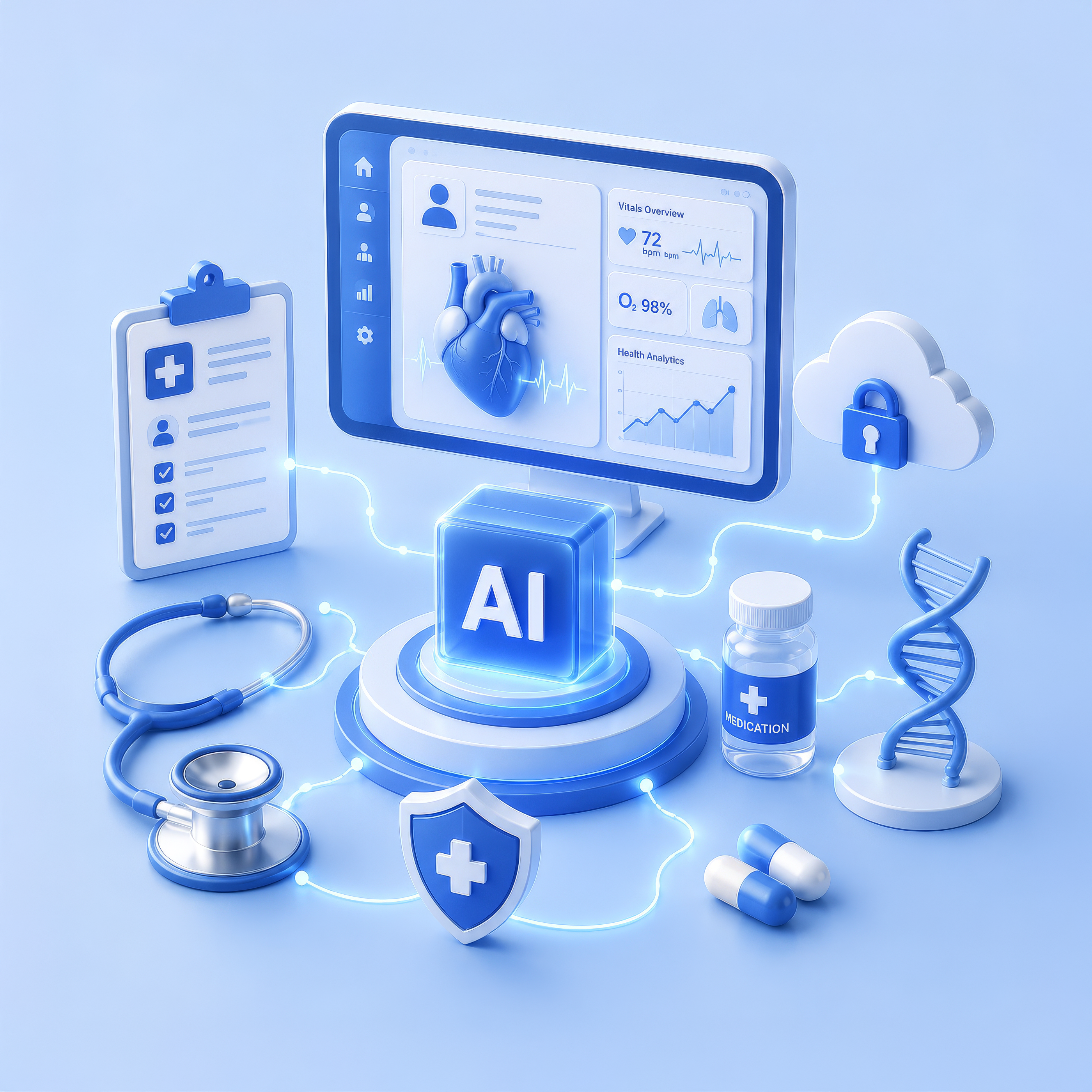
This is where AI in healthcare is creating significant value. Rather than replacing clinicians, AI helps healthcare professionals process information faster, automate repetitive work, identify patterns, and make better-informed decisions across clinical and operational workflows.
What Is AI in Healthcare?
AI in healthcare refers to the use of artificial intelligence technologies—including machine learning, natural language processing, computer vision, predictive analytics, and generative AI—to support healthcare operations, clinical decision-making, patient engagement, diagnostics, research, and administrative workflows.
Rather than replacing healthcare professionals, AI augments clinicians, administrators, and care teams by helping them analyze information, automate routine processes, identify risks, improve efficiency, and make more informed decisions. The goal is to enhance healthcare delivery, operational performance, and patient experiences while maintaining human oversight and clinical judgment.
Why AI Adoption Is Accelerating
Several factors are driving rapid adoption:
Healthcare organizations increasingly view AI as a practical tool for supporting care delivery and business operations.
The 15 Most Important AI Use Cases in Healthcare
1. Medical Imaging Analysis
AI assists radiologists by identifying patterns in medical images, improving review speed and prioritization.
2. Clinical Decision Support
AI helps clinicians analyze patient data and surface relevant insights during care decisions.
3. Predictive Patient Risk Assessment
Predictive models identify patients who may require additional attention or intervention.
4. Patient Triage Assistance
AI helps prioritize patient inquiries and directs cases to appropriate care pathways.
5. Healthcare Documentation Automation
AI reduces manual documentation by generating summaries and organizing clinical notes.
6. Medical Coding Assistance
AI supports coding accuracy and helps reduce administrative effort.
7. Revenue Cycle Optimization
AI improves claims processing, denial management, and reimbursement workflows.
8. Appointment Scheduling Optimization
Scheduling systems use AI to reduce no-shows and improve resource utilization.
9. Virtual Health Assistants
AI-powered assistants answer common questions and support patient engagement.
10. Personalized Treatment Recommendations
AI analyzes patient information to support individualized treatment planning.
11. Drug Discovery & Research
Researchers use AI to analyze large datasets and accelerate discovery processes.
12. Remote Patient Monitoring
AI helps identify meaningful patterns in data collected from connected devices.
13. Population Health Analytics
Healthcare leaders use AI to identify trends and improve community health initiatives.
14. Hospital Operations Optimization
AI supports staffing, capacity planning, resource allocation, and workflow efficiency.
15. Healthcare Knowledge Management
AI helps healthcare teams quickly access policies, procedures, research, and clinical information.
AI in Healthcare: Benefits and Business Impact
| Area | Traditional Approach | AI-Enhanced Approach |
|---|---|---|
| Documentation | Manual entry | Automated assistance |
| Scheduling | Static scheduling | Dynamic optimization |
| Data Analysis | Manual review | Pattern recognition and insights |
| Risk Identification | Reactive monitoring | Predictive identification |
| Patient Communication | Limited availability | 24/7 support assistance |
| Resource Planning | Historical planning | Predictive forecasting |
| Administrative Workloads | Labor intensive | Intelligent automation |
Which Organizations Benefit Most?
Hospitals & Health Systems
Improve clinical operations, documentation, staffing, and resource planning.
Clinics & Physician Groups
Reduce administrative burden and improve patient engagement.
Health Insurance Providers
Enhance claims processing, fraud detection, and member support.
Pharmaceutical Companies
Accelerate research, clinical trials, and drug development.
Telehealth Providers
Improve patient triage, engagement, and virtual care experiences.
Common Challenges
Key challenges include:
- Data quality issues
- Privacy and security concerns
- Regulatory requirements
- System integration complexity
- Change management challenges
- AI governance requirements
Building an AI Strategy for Healthcare
Phase 1: Identify Priority Problems
Focus on measurable operational and clinical challenges.
Phase 2: Assess Data Readiness
Evaluate data quality, availability, and governance.
Phase 3: Pilot High-Value Use Cases
Start with manageable projects that can demonstrate value quickly.
Phase 4: Measure Outcomes
Track operational, financial, and patient experience improvements.
Phase 5: Scale Responsibly
Expand successful initiatives with governance and monitoring controls.
AI Governance in Healthcare
Effective healthcare AI governance includes:
Strong governance helps organizations maintain trust while scaling AI initiatives.
Real-World Scenarios
Example 1: Hospital Documentation Automation
Challenge: Clinicians spend excessive time on documentation.
AI Solution: Automated note generation and summarization.
Expected Outcome: Reduced administrative workload and more time for patient care.
Example 2: Predictive Readmission Monitoring
Challenge: Identifying patients at risk of readmission.
AI Solution: Predictive analytics models.
Expected Outcome: Better care coordination and proactive interventions.
Example 3: Revenue Cycle Optimization
Challenge: Claims delays and reimbursement issues.
AI Solution: Automated coding and claims analysis.
Expected Outcome: Improved financial performance and reduced denials.
Example 4: Population Health Management
Challenge: Managing large patient populations.
AI Solution: Risk stratification and analytics.
Expected Outcome: Better preventive care planning and resource allocation.
Opportunity Assessment Worksheet
Operational Challenges
What inefficiencies create the greatest impact?
Data Availability
Do relevant data sources exist and are they accessible?
Clinical Workflow Impact
How will AI support existing workflows?
Compliance Considerations
What privacy and regulatory requirements apply?
Expected Outcomes
What measurable improvements are expected?
Pilot Opportunities
Which use cases can deliver value quickly?
Success Metrics
How will performance and ROI be measured?
What to Expect in 2026 and Beyond
Healthcare AI is evolving toward:
The future will focus on helping healthcare professionals work more effectively while maintaining human-centered care.
Frequently Asked Questions
Conclusion
AI is becoming an increasingly valuable tool across healthcare operations, administration, analytics, and clinical support. The greatest opportunities come from augmenting healthcare professionals rather than replacing them.
Organizations that focus on practical use cases, strong governance, measurable outcomes, and responsible implementation will be best positioned to realize long-term value from healthcare AI.
Transform Healthcare with AI
As healthcare organizations explore AI-driven transformation, identifying the right use cases and implementation strategy is critical for achieving meaningful outcomes.
Kambaa helps healthcare providers, payers, and health technology organizations design, implement, govern, and scale AI solutions across clinical support, operational efficiency, patient engagement, analytics, and intelligent automation initiatives.