AI Agents vs Chatbots: Key Differences and When to Use Each
A chatbot is primarily designed to communicate. An AI agent is designed to achieve outcomes. Here's how to tell them apart and choose the right one.
Introduction
Many organizations want to automate customer support, employee assistance, sales workflows, or operational processes. During their evaluation process, they often encounter two terms that are frequently used interchangeably: AI Chatbots and AI Agents.
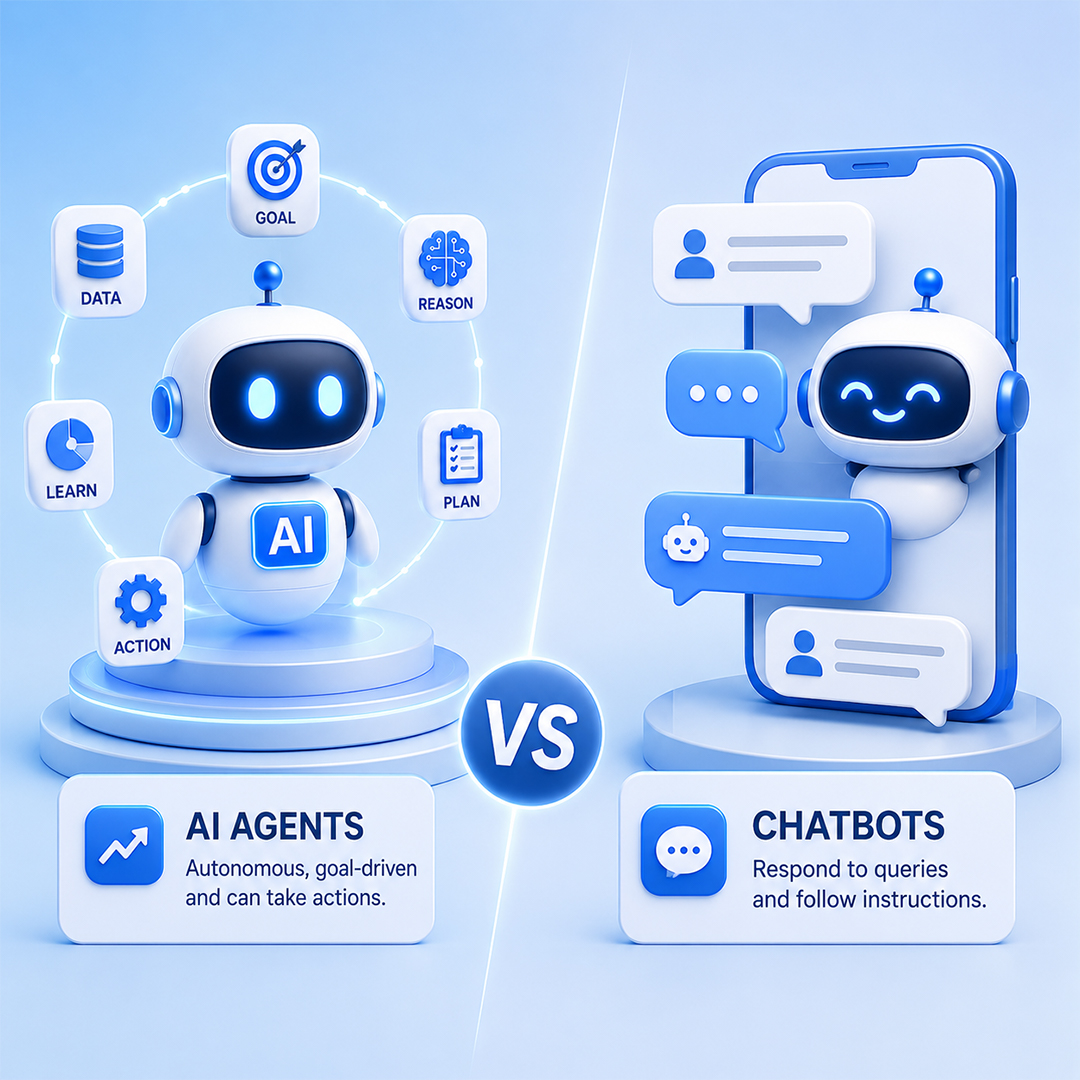
At first glance, they may appear similar. Both use artificial intelligence, both interact with users, and both can help automate business activities. However, they solve fundamentally different problems. A chatbot is primarily designed to communicate. An AI agent is designed to achieve outcomes.
Understanding the distinction is critical because choosing the wrong technology can lead to unnecessary complexity, missed opportunities, or investments that fail to deliver meaningful business value.
AI agent vs chatbot: quick answer
A chatbot is an AI-powered or rule-based system designed primarily to answer questions, provide information, and interact with users through conversation. Its primary function is communication.
An AI agent goes beyond conversation. It can understand goals, make decisions, access tools, interact with business systems, execute tasks, and complete multi-step workflows with varying levels of autonomy. While a chatbot focuses on responding to requests, an AI agent focuses on achieving outcomes.
For example, a chatbot can explain how to reset a password. An AI agent can verify the user's identity, reset the password, update the account, notify the user, and confirm completion of the task.
Chatbots communicate. AI agents act.
What Is a Chatbot?
A chatbot is software designed to interact with users through text or voice conversations. Traditional chatbots follow predefined rules and scripted responses. Modern AI chatbots use large language models to generate more natural and flexible conversations.
Common chatbot capabilities
- Answering frequently asked questions
- Providing product information
- Handling basic customer support
- Capturing leads
- Scheduling appointments
- Assisting website visitors
For example, an ecommerce chatbot may answer questions about shipping policies, return procedures, or product availability. The chatbot's primary goal is to provide information and assist users through conversation.
What Is an AI Agent?
An AI agent is an intelligent software system that can understand goals, make decisions, use tools, access information, and execute actions to complete tasks. Unlike chatbots, AI agents are goal-oriented rather than conversation-oriented.
An AI agent can
- Analyze information
- Create plans
- Use business applications
- Access databases
- Trigger workflows
- Complete multi-step processes
- Adapt to changing situations
For example, an AI sales agent could qualify leads, gather prospect information, schedule meetings, update a CRM system, and send follow-up emails without requiring constant human involvement. The primary objective of an AI agent is not conversation—it is task completion.
AI agent vs chatbot: the key differences
Twelve capabilities compared
How chatbots work
A relatively straightforward process
User Submits a Query
A customer asks a question such as: "What are your business hours?"
Chatbot Processes the Request
The chatbot interprets the question and identifies the intent.
Response Is Generated
The chatbot retrieves or generates an appropriate answer.
Conversation Continues
Additional questions can be answered as needed.
Example
A customer visits a support website and asks: “How do I update my billing information?” The chatbot provides instructions and links to the appropriate page. Its role is informational rather than operational.
How AI agents work
A more sophisticated workflow
Goal Is Assigned
Example: "Onboard a new customer."
Agent Understands Context
The agent reviews customer records, account status, and onboarding requirements.
Creates a Plan
It determines necessary actions.
Accesses Tools and Systems
The agent connects to CRM platforms, calendars, email systems, and documentation repositories.
Takes Actions
Meetings are scheduled, emails are sent, and onboarding tasks are completed.
Evaluates Results
The agent confirms completion and handles exceptions if necessary.
Unlike chatbots, agents are designed to execute workflows rather than simply explain them.
When a chatbot is the right choice
Excellent value in many situations
FAQ Automation
Answering common questions efficiently.
Customer Support
Handling routine inquiries and reducing support volume.
Appointment Booking
Helping users schedule meetings or consultations.
Website Assistance
Guiding visitors to relevant information.
Lead Capture
Collecting contact information and qualifying basic inquiries.
When workflows are straightforward and communication is the primary objective, chatbots are often sufficient.
When an AI agent is the better choice
Valuable when work extends beyond conversation
Multi-Step Customer Service
Resolving issues across multiple systems and processes.
Sales Automation
Managing lead qualification, scheduling, follow-up, and CRM updates.
Document Processing
Extracting information, validating data, and routing documents.
IT Support Automation
Diagnosing issues and executing remediation workflows.
Workflow Orchestration
Coordinating tasks across multiple business applications.
Internal Knowledge Management
Retrieving, analyzing, and delivering information from various systems.
These use cases require action, decision-making, and execution rather than simple communication.
Real-world examples
Side-by-side across four functions
Customer Support
Chatbot
Answers questions about returns, shipping, and account access.
AI Agent
Processes refunds, updates orders, generates support tickets, and resolves issues automatically.
Sales Operations
Chatbot
Provides information about products and services.
AI Agent
Qualifies leads, enriches prospect data, schedules meetings, and updates CRM records.
HR and Employee Support
Chatbot
Answers questions about policies and benefits.
AI Agent
Processes leave requests, updates employee records, and coordinates onboarding workflows.
IT Service Management
Chatbot
Provides troubleshooting guidance.
AI Agent
Diagnoses issues, resets credentials, creates tickets, and executes remediation steps.
Benefits of Chatbots
For many organizations, chatbots provide an accessible starting point for automation.
- Easier implementation
- Lower deployment costs
- Faster time to value
- Improved customer response times
- Reduced support workload
- Better website engagement
- Scalable customer interactions
- Consistent communication
Benefits of AI Agents
AI agents create value by completing work, not just answering questions.
- End-to-end process automation
- Higher workforce productivity
- Reduced manual effort
- Faster task completion
- Improved operational efficiency
- Better decision support
- Scalable business operations
- Enhanced customer experiences
- Greater workflow consistency
- Increased organizational agility
Common misconceptions
Clearing up the confusion
AI Agents and Chatbots Are the Same
They share some technologies but solve different business problems.
AI Agents Replace Employees
Most organizations use agents to augment teams rather than eliminate roles.
Chatbots Are Obsolete
Chatbots remain highly effective for many customer-facing scenarios.
AI Agents Require Enterprise Budgets
Many organizations begin with targeted use cases and modest investments.
Every Chatbot Should Become an Agent
Not every workflow requires advanced automation. Simpler solutions often provide better ROI.
How to decide between an AI agent and a chatbot
Use this framework when evaluating solutions
Choose a Chatbot If:
- Your primary goal is answering questions
- Workflows are simple
- Customer support is the main use case
- Budget is limited
- Fast deployment is important
- Minimal system integration is required
Choose an AI Agent If:
- Tasks involve decision-making
- Multiple systems must work together
- Workflow automation is the objective
- Business processes are complex
- Operational efficiency is a priority
- Outcomes matter more than conversations
A useful rule of thumb
If users primarily need information, start with a chatbot. If users need work completed, consider an AI agent.
What to expect in 2026 and beyond
Conversation versus execution remains the key factor
Agentic AI Growth
Organizations are increasingly deploying systems capable of independent task execution.
Smarter Chatbots
Chatbots will continue becoming more conversational and context-aware.
Multi-Agent Systems
Multiple AI agents will collaborate to solve complex business problems.
Enterprise AI Adoption
AI will become embedded across departments and workflows.
Increasing Automation Opportunities
More business processes will become candidates for intelligent automation.
Frequently asked questions
Common questions about AI agents and chatbots
What is the difference between an AI agent and a chatbot?
A chatbot primarily communicates and answers questions. An AI agent can communicate, make decisions, use tools, and complete tasks to achieve specific goals.
Can a chatbot become an AI agent?
Yes. Some modern solutions combine chatbot interfaces with agent capabilities, allowing conversations to trigger actions and workflows.
Are AI agents more expensive?
Generally, yes. AI agents often require additional integrations, workflow design, and business logic compared to standard chatbot implementations.
Which is better for customer service?
It depends on the use case. Chatbots are effective for answering questions, while AI agents are better for resolving issues that require actions across multiple systems.
Do AI agents replace employees?
No. Most organizations use AI agents to automate repetitive work so employees can focus on higher-value activities.
Can small businesses use AI agents?
Absolutely. AI agent platforms are becoming increasingly accessible to small and mid-sized organizations.
What industries benefit most?
Technology, healthcare, finance, retail, manufacturing, professional services, and customer support operations commonly benefit from AI-powered automation.
How do businesses get started?
Start by identifying repetitive workflows, selecting a high-impact use case, running a pilot project, and measuring business outcomes before scaling.
Conclusion
AI chatbots and AI agents are related technologies, but they serve different purposes.
Chatbots excel at communication, answering questions, and supporting customer interactions. AI agents excel at completing tasks, automating workflows, and achieving business outcomes. Neither technology is universally better — the right choice depends on the complexity of the problem, the level of automation required, and the business objectives being pursued.
Not sure whether you need a chatbot or an AI agent?
Kambaa helps businesses design, develop, and deploy AI agents, conversational AI solutions, and intelligent automation systems tailored to specific business goals.