
AI Agents Explained: The Future of Intelligent Work
Discover how AI agents think, act, and automate work across industries with real-world intelligence and autonomous execution.
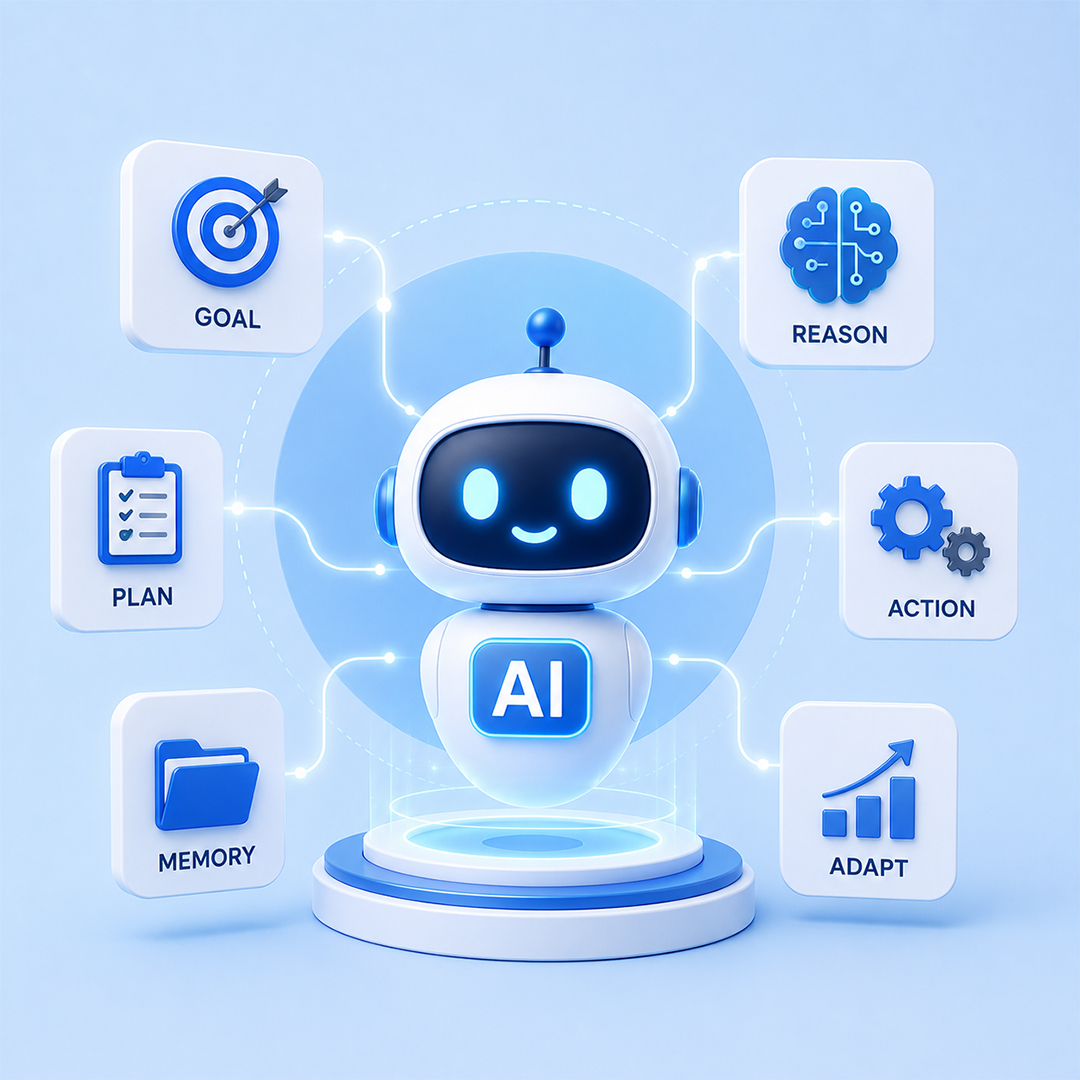
Artificial Intelligence is entering a new phase. Businesses are no longer looking for tools that simply automate repetitive actions. They now want intelligent systems capable of understanding goals, making decisions, and executing work independently. This is where AI agents are changing the game.
AI agents are rapidly becoming the digital workforce behind modern enterprises — handling customer conversations, automating operations, analyzing data, coordinating workflows, and driving business efficiency at scale. From global enterprises to fast-growing startups, organizations are deploying AI agents to create faster, smarter, and more scalable operations.
Understanding AI Agents in Simple Terms
An AI agent is an intelligent system designed to perform tasks autonomously based on objectives, context, and data. Instead of waiting for constant human instructions, AI agents can:
Think of an AI agent as a digital team member capable of performing operational, analytical, or conversational tasks with intelligence.

Why AI Agents Are Becoming So Important
Traditional software follows instructions. AI agents pursue outcomes. This difference is transforming how companies approach productivity, customer engagement, and digital transformation. Modern organizations use AI agents to:
Reduce manual effort
Automate complex clerical and repetitive operations.
Improve operational speed
Execute tasks and workflows in seconds rather than hours.
Deliver 24/7 customer experiences
Instantly resolve customer questions around the clock.
Automate business workflows
Run seamless operations across multiple software platforms.
Increase employee productivity
Empower human teams to focus on strategy and growth.
Handle large-scale decision-making
Deploy consistent, data-backed analytical decisions.
AI agents are helping businesses move beyond static automation into adaptive intelligence.
What Makes AI Agents Different From Traditional Automation?
Most automation tools depend on fixed rules and predefined workflows. AI agents operate dynamically. Instead of following a rigid script, they can:
Understand natural language
Comprehend, translate, and communicate using everyday language.
Respond based on context
Vary outputs and behavior based on user intent and history.
Learn from interactions
Continuously self-improve through machine learning feedback.
Adapt to changing conditions
Handle updated formats, visual layouts, and exceptions.
Interact with multiple systems simultaneously
Read database records, write logs, and trigger APIs at the same time.
This makes AI agents far more powerful than conventional automation platforms.

Core Components Behind an AI Agent
Every AI agent operates using a combination of intelligence layers.
Data Collection
AI agents gather information dynamically from various sources:
- Emails & notifications
- CRMs & ERP systems
- Business documents
- API integrations
- Live conversations
- Enterprise systems
Context Understanding
Using AI models and machine learning, the agent understands meaning, intent, and business relevance.
- Understand natural meaning
- Semantic intent mapping
- Business relevance checks
Intelligent Decision-Making
The system evaluates possible actions and identifies the most suitable outcome.
- Evaluate options
- Select optimal path
- Apply policy logic
Autonomous Execution
The AI agent performs actions automatically across systems such as:
- Updating system records
- Sending dynamic responses
- Triggering automation workflows
- Escalating complex issues
- Generating operational reports
Where AI Agents Are Being Used Today
AI agents are already reshaping multiple industries.
Customer Experience
AI-powered support agents can resolve tickets, guide customers, and automate service operations around the clock.
Healthcare
Hospitals and healthcare providers use AI agents for appointment coordination, patient assistance, and operational efficiency.
Retail & E-Commerce
AI agents personalize shopping journeys, recommend products, and manage customer engagement across channels.
Financial Services
Banks and fintech companies deploy AI agents for fraud monitoring, risk analysis, and customer onboarding.
Human Resources
Recruitment teams use AI agents for resume screening, interview coordination, and employee support automation.
AI Agents and the Future of Work
The future workplace will not rely only on human teams. It will combine:
Businesses are already adopting hybrid operational models in which AI agents work alongside employees to improve speed, accuracy, and scalability. This shift is expected to redefine enterprise productivity over the next decade.
Different Types of AI Agents
Not all AI agents work the same way.
Conversational AI Agents
Designed for human interaction through chat, voice, or messaging platforms.
Task Automation Agents
Focused on completing operational workflows automatically.
Decision Intelligence Agents
Analyze data and recommend actions for business optimization.
Multi-Agent Systems
Multiple AI agents collaborate to achieve larger objectives.
Autonomous Enterprise Agents
Operate across systems with minimal human supervision.
Benefits of Deploying AI Agents
Organizations investing in AI agents are seeing measurable business outcomes.
| Benefit | Business Outcome |
|---|---|
| Faster Operations | AI agents process tasks instantly without delays. |
| Lower Operational Costs | Automation reduces repetitive manual work. |
| Improved Accuracy | AI minimizes human errors in workflows and decision-making. |
| Scalability | AI agents can handle thousands of simultaneous operations. |
| Better Customer Experience | Businesses can deliver faster, personalized, and always-available support. |
Common Misconceptions About AI Agents
“AI agents are just chatbots.â€
Chatbots mainly respond to messages. AI agents can reason, decide, and execute actions across systems.
“AI agents replace humans.â€
Most organizations use AI agents to augment human teams, not eliminate them.
“AI agents are only for large enterprises.â€
Today, startups and mid-sized businesses are increasingly adopting AI agents due to the availability of AI platforms and cloud infrastructure.
The Rise of Autonomous Businesses
The next evolution of digital transformation is autonomy. Future businesses will rely heavily on:
AI agents will become the operational backbone of modern enterprises. Companies that adopt AI agent ecosystems early are expected to gain significant competitive advantages in efficiency, speed, and innovation.

Frequently Asked Questions
Final Thoughts
AI agents are not a futuristic concept anymore. They are actively transforming how businesses operate, communicate, analyze, and scale. As organizations move toward AI-first operations, AI agents will become essential for delivering intelligent automation, operational agility, and next-generation customer experiences. The businesses adopting AI agents today are building the foundation for tomorrow’s autonomous enterprise.
Ready to Build Enterprise AI Agents?
Kambaa helps businesses design and deploy scalable AI agent ecosystems for customer support, workflow automation, analytics, and intelligent enterprise operations.
Accelerate digital transformation with AI-powered enterprise solutions from Kambaa.