AI in Retail:AI Agent vs Chatbot: Key Differences Explained
Understand the key differences between AI agents and chatbots, including capabilities, use cases, automation potential, implementation complexity, and business value.
Artificial intelligence is transforming how organizations engage customers, automate operations, and improve productivity.
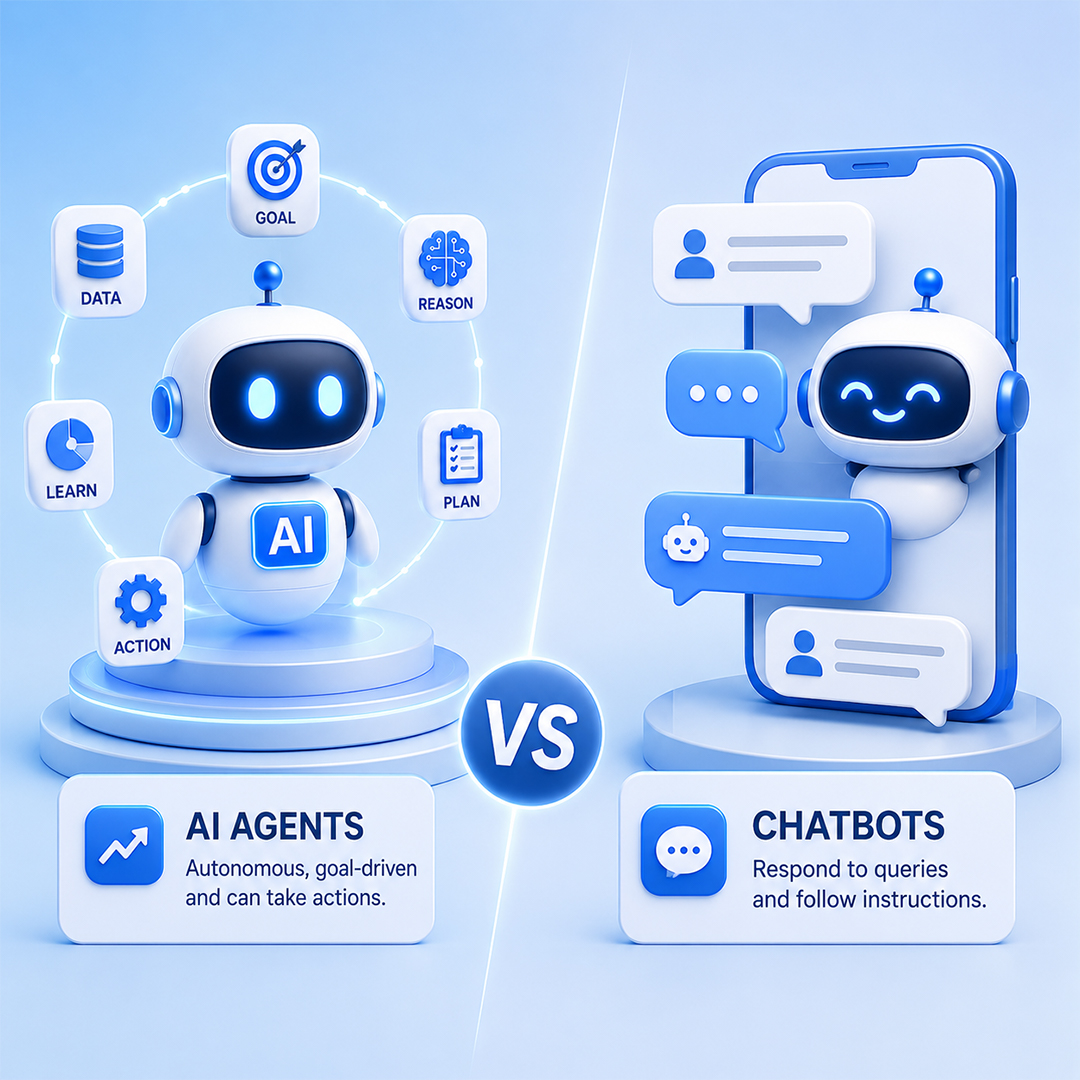
Two of the most common technologies businesses evaluate are AI agents and chatbots. While the terms are often used interchangeably, they represent very different levels of capability.
Chatbot
A chatbot is primarily designed to interact with users and answer questions.
AI Agent
An AI agent is designed to understand goals, make decisions, execute tasks, and interact with systems autonomously.
Understanding the Difference Between AI Agent and Chatbot is essential for organizations evaluating automation opportunities, customer experience initiatives, operational efficiency programs, and AI transformation strategies. This guide compares AI Agent vs Chatbot across capabilities, business value, implementation effort, and real-world use cases.
AI Agent vs Chatbot At a Glance
Choose a Chatbot if you need:
- FAQ automation
- Customer support
- Appointment scheduling
- Lead qualification
- Website assistance
Choose an AI Agent if you need:
- Workflow automation
- Multi-system execution
- Research assistance
- Decision support
- Business process automation
For many organizations, the best approach is a combination of both. A chatbot handles conversations while an AI agent executes tasks and workflows behind the scenes.
What Is a Chatbot?
A chatbot is a software application designed to interact with users through text or voice conversations. Chatbots are commonly used to answer questions, provide information, guide users through simple workflows, and support customer interactions. Modern chatbots range from rule-based systems to AI-powered conversational assistants.
Types of Chatbots
Rule-Based Chatbots:
Follow predefined conversation paths and decision trees. Examples: Customer support menus, FAQ assistants, Appointment scheduling bots, Website chat widgets.
Conversational AI Chatbots:
Use large language models to generate responses dynamically. Examples: Customer support assistants, Sales assistants, Product recommendation bots, Employee help desk assistants.
Business Benefits
24/7 availability, reduced support costs, improved response times, increased customer engagement, scalable customer interactions. Chatbots are often the first step in a business's AI adoption journey.
What Is an AI Agent?
An AI agent is a software system that can understand objectives, make decisions, execute actions, interact with tools, and work toward achieving defined goals. Unlike chatbots, AI agents are not limited to conversations. They can reason, plan, execute workflows, retrieve information, interact with applications, and automate complex business processes.
Key Characteristics of AI Agents
- Autonomous Decision-Making: Evaluate information and determine appropriate actions.
- Goal-Oriented Execution: Work toward completing objectives rather than answering questions.
- Multi-Step Workflows: Execute sequences of actions across systems.
- Tool Usage: Can interact with CRMs, ERPs, Databases, Email, Business Apps, APIs.
- Reasoning Capabilities: Evaluate options and choose actions based on goals.
Business Benefits
Operational efficiency, workflow automation, reduced manual effort, faster execution, improved productivity, scalable decision support. AI agents represent the next evolution of enterprise automation.
AI Agent vs Chatbot: Quick Comparison
| Category | Chatbot | AI Agent |
|---|---|---|
| Primary Purpose | Answer questions and assist conversations | Achieve goals and complete tasks |
| Decision Making | Limited | Advanced |
| Memory | Minimal or session-based | Persistent and contextual |
| Autonomy | Low | High |
| Workflow Execution | Limited | Multi-step execution |
| Learning Capability | Basic | Adaptive and goal-oriented |
| Context Awareness | Conversation-focused | Task and business-context aware |
| Integration Capability | Moderate | Extensive |
| Reasoning Ability | Limited | Advanced |
| Tool Usage | Minimal | Can use multiple tools and systems |
| Complexity | Lower | Higher |
| Business Impact | Customer interaction | Business process transformation |
| Best Use Cases | FAQs, support, lead capture | Automation, operations, decision support |
| Implementation Effort | Lower | Moderate to high |
Summary:
A chatbot primarily talks. An AI agent thinks, decides, and acts.
Deep Dive: Core Differences
The Difference Between AI Agent and Chatbot becomes clearer when comparing core capabilities.
Interaction Model
Conversation-first. Designed to answer user questions.
Goal-first. Designed to achieve outcomes.
Decision-Making Ability
Typically responds to prompts.
Can independently determine actions needed to complete objectives.
Task Execution
Provides information.
Performs actions (e.g., Creating tickets, sending emails, updating records, executing workflows, generating reports).
Memory
Usually limited to current conversation context.
Can maintain persistent memory and historical context.
Reasoning
Limited reasoning.
Advanced reasoning and planning capabilities.
Adaptability
Typically follows predefined workflows.
Can adapt based on changing inputs and objectives.
Autonomy
Requires user interaction.
Can operate independently.
Business Value
Improves customer interaction.
Transforms business operations.
Agentic AI vs Chatbot: Enterprise Implications
How They Operate
Agentic AI systems understand goals, plan actions, execute workflows, monitor outcomes, adjust behavior, interact with systems, and operate with varying degrees of autonomy. The objective is execution. Traditional chatbots answer questions, follow scripts, and provide info. The objective is communication.
Enterprise Implications & Scalability
Agentic AI enables business process automation, operational optimization, decision support, cross-system execution, and enterprise orchestration. Agentic AI scales operational capacity, while chatbots scale customer interactions.
Automation & Future
Agentic AI offers substantially greater automation potential. Many organizations are moving beyond conversational interfaces toward autonomous business systems powered by AI agents.
Business Use Cases
The more execution required, the more likely an AI agent becomes the preferred solution.
| Use Case | Chatbot | AI Agent | Best Choice |
|---|---|---|---|
| Customer Support | Excellent | Good | Chatbot |
| Internal Knowledge Management | Good | Excellent | AI Agent |
| Sales Assistance | Good | Excellent | AI Agent |
| Workflow Automation | Limited | Excellent | AI Agent |
| Document Processing | Limited | Excellent | AI Agent |
| Research Assistance | Good | Excellent | AI Agent |
| IT Operations | Limited | Excellent | AI Agent |
| HR Automation | Moderate | Excellent | AI Agent |
| Finance Operations | Limited | Excellent | AI Agent |
Cost & Implementation Comparison
| Area | Chatbot | AI Agent |
|---|---|---|
| Development Effort | Lower | Higher |
| Infrastructure | Lower | Moderate |
| Maintenance | Lower | Moderate |
| Scalability | High | High |
| Integration Effort | Moderate | Higher |
| ROI Potential | Moderate | High |
| Automation Capability | Limited | Extensive |
Common Misconceptions
AI Agents Are Not Simply Advanced Chatbots
Many AI agents include conversational interfaces, but their primary purpose is execution.
Not Every Chatbot Is an AI Agent
Most chatbots remain interaction-focused systems.
Autonomy Matters
The defining characteristic of an AI agent is autonomous action.
Workflow Execution Matters
Executing business processes is fundamentally different from answering questions.
Business Objectives Should Drive Technology Selection
Organizations should select technologies based on business outcomes rather than industry buzzwords.
Which Option Is Right for Your Business?
| Business Goal | Recommended Solution |
|---|---|
| Simple Customer Support | Chatbot |
| FAQ Automation | Chatbot |
| Lead Qualification | Chatbot or AI Agent |
| Knowledge Retrieval | AI Agent |
| Workflow Automation | AI Agent |
| Multi-System Execution | AI Agent |
| Research Assistance | AI Agent |
| HR Operations | AI Agent |
| Finance Operations | AI Agent |
| Enterprise Process Automation | AI Agent |
Practical Guidance:
If the primary objective is communication, choose a chatbot.
If the primary objective is execution, choose an AI agent.
If both are required, consider a hybrid approach.
How Kambaa Helps Organizations Build AI Agents & Chatbots
Kambaa helps organizations evaluate, design, implement, and optimize AI-powered solutions aligned with business objectives.
AI Strategy
Identify opportunities and prioritize use cases.
AI Consulting
Evaluate whether a chatbot, AI agent, or hybrid approach is most appropriate.
Custom AI Agents
Design and develop autonomous systems tailored to business requirements.
Conversational AI
Build intelligent customer-facing and employee-facing assistants.
Enterprise Automation
Implement AI-driven workflow automation across business functions.
Integration Services
Connect AI systems with existing applications and enterprise platforms.
Ongoing Optimization
Continuously improve performance, accuracy, and business outcomes.
Frequently Asked Questions
Conclusion: Which One Should You Choose?
There is no universal winner in the AI Agent vs Chatbot discussion. The right choice depends on your business goals.
As organizations move toward AI-powered operations, many are adopting both technologies together. Chatbots provide conversational experiences while AI agents handle execution behind the scenes. The most successful implementations start with clear business objectives and a practical understanding of where each technology delivers the greatest value.
Evaluate Your AI Needs
Kambaa helps organizations evaluate whether a chatbot, AI agent, or hybrid approach is most appropriate for their unique challenges.