AI in Retail:AI Agent Deployment: Cost, Timeline, and Success Rates (Industry Study)
Learn what impacts AI agent deployment costs, timelines, success factors, and enterprise adoption strategies.
Executive Summary
Based on Kambaa's analysis of AI agent projects, implementation patterns, enterprise deployments, executive interviews, and market observations:
- Most AI agent initiatives begin with narrow, high-value workflows.
- Internal agents generally deploy faster than customer-facing agents.
- Integration complexity drives cost more than model selection.
- Governance and human oversight remain critical success factors.
- Knowledge-based agents show the fastest enterprise adoption.
- Organizational readiness often determines deployment outcomes.
- Multi-agent systems are emerging but remain early-stage.
- Enterprises are shifting from experimentation to operational deployment.
Executive Implications
- Start with focused business problems.
- Prioritize integration and governance.
- Measure workflow outcomes, not technical outputs.
What Is AI Agent Development?
AI agent development is the process of designing, building, deploying, integrating, governing, and continuously improving AI systems capable of performing tasks, making decisions, interacting with software systems, executing workflows, and collaborating with users toward defined objectives.
Unlike traditional chatbots, AI agents can reason through tasks, retrieve information, use tools, interact with business systems, execute actions, and adapt to changing contexts. Successful AI agent development requires workflow design, integrations, data access, governance, monitoring, security controls, and human oversight.
The goal is not simply conversation but measurable business outcomes through intelligent workflow execution.
About This Research
To better understand AI agent deployment trends, Kambaa analyzed enterprise AI agent initiatives, implementation projects, technology adoption patterns, executive interviews, deployment outcomes, and market observations across industries. Findings reflect modeled benchmark observations and implementation patterns rather than independently verified market statistics.
Key Findings from the Industry Study
The 12 Most Common AI Agent Use Cases
Common value drivers include productivity, faster information access, workflow efficiency, and decision support.
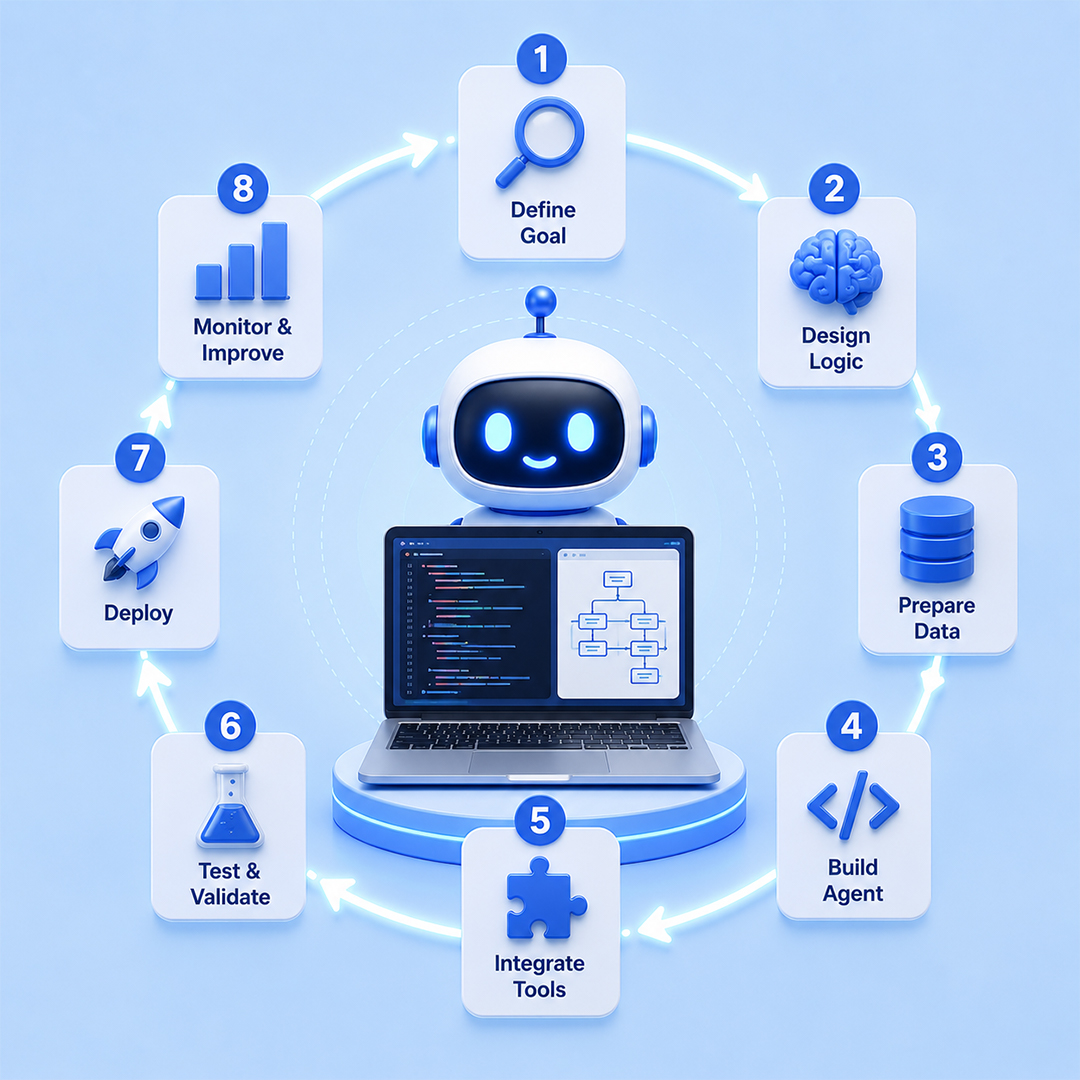
AI Agent Deployment Timeline Framework
Discovery & Design
Define objectives, workflows, and success metrics.
Prototype Development
Build and validate core capabilities.
Pilot Deployment
Test with real users and controlled workloads.
Operational Rollout
Expand adoption and production usage.
Optimization & Scaling
Improve performance and extend use cases.
AI Agent Development Cost Benchmarks
| Agent Type | Complexity Level | Typical Development Effort | Primary Cost Drivers |
|---|---|---|---|
| Knowledge Assistant | Low | Low | Data access |
| Customer Support Agent | Medium | Medium | Integrations, governance |
| Internal Operations Agent | Medium | Medium | Workflow complexity |
| Workflow Automation Agent | High | High | Process orchestration |
| Multi-Agent System | Very High | Very High | Coordination architecture |
| Enterprise Agent Platform | Very High | Very High | Security, governance, integrations |
What Separates Successful Deployments?
Clear Business Objectives
Strong Governance
Quality Data Access
Workflow-Centric Design
Human Oversight
User Adoption Programs
Continuous Monitoring
Incremental Scaling
Successful deployments focus on business workflows rather than AI capabilities alone.
Industry Analysis
Healthcare
Focus on documentation, knowledge access, and care coordination.
Financial Services
Compliance, customer support, and risk workflows lead adoption.
Manufacturing
Operational support and maintenance workflows are growing priorities.
Retail
Customer engagement and operational efficiency dominate deployments.
Technology Companies
Developer productivity and internal knowledge management lead investment.
Why AI Agent Projects Fail
Starting Too Broad
Weak Integration Planning
Poor Data Quality
Lack of Governance
Missing Human Oversight
Unrealistic Expectations
Weak Change Management
No Outcome Measurement
Most failures stem from organizational, process, and governance gaps rather than model limitations.
What Leaders Should Do Next
Focus on High-Frequency Workflows
Start with Copilot Experiences
Build Governance Early
Invest in Integrations
Measure Outcomes
Scale Proven Successes
Prepare for Multi-Agent Systems
AI Agent Readiness Assessment
Business Readiness
Clear objectives and ownership.
Data Readiness
Accessible, trusted information.
Technology Readiness
Integration and infrastructure maturity.
Governance Readiness
Policies, controls, and monitoring.
Workforce Readiness
Training, adoption, and change management.
AI Agent Deployment Readiness Scorecard
Evaluate:
Organizations scoring highly across these dimensions are generally better positioned for successful deployments.
Predictions for 2027
Frequently Asked Questions
Conclusion
AI agent adoption is accelerating across industries. Findings from this industry study suggest that deployment costs depend more on workflow complexity, integrations, and governance than on AI models themselves.
Organizations that combine strong business objectives, data readiness, governance frameworks, and change management practices are more likely to achieve sustainable outcomes.
Transform Your Operations
Organizations achieving the strongest AI agent outcomes are focusing on workflow transformation, governance, integration strategy, and measurable business outcomes rather than agent technology alone.
Kambaa helps enterprises assess AI agent readiness, identify high-value opportunities, design governance frameworks, build AI agents, and scale successful deployments across the organization.