
Agentic AI vs Generative AI: The Differences That Matter for Business
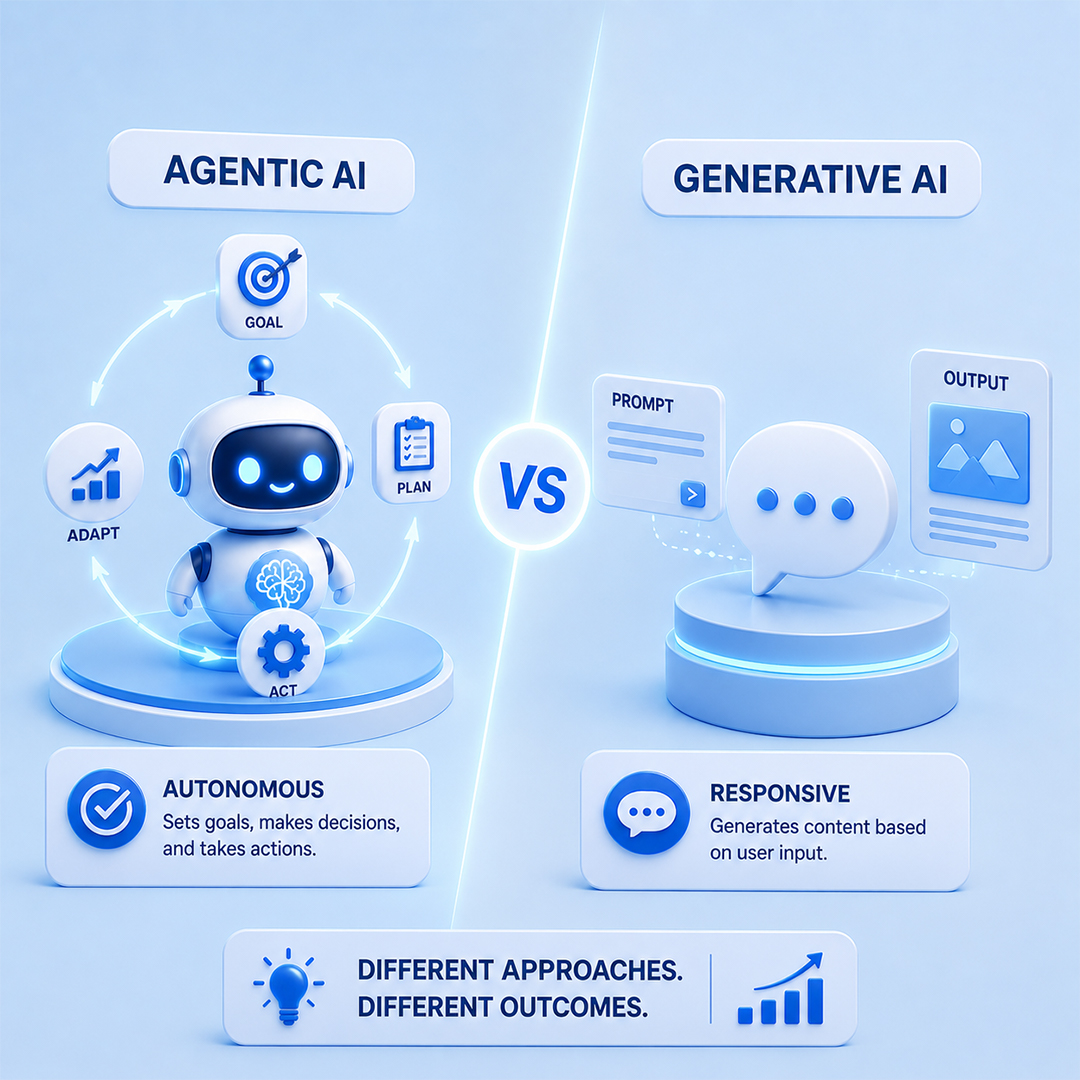
Generative AI produces information. Agentic AI uses information to complete tasks. Understanding this distinction is becoming increasingly important for automation and digital transformation initiatives.
Introduction
Artificial intelligence is evolving rapidly. The first wave of modern AI focused on generating content, answering questions, summarizing information, and assisting users with knowledge work. Tools such as ChatGPT, Gemini, and Claude introduced millions of people to Generative AI and demonstrated how AI could boost productivity across nearly every business function.
A new wave of AI is now emerging. Instead of simply generating information, AI systems are increasingly capable of planning, making decisions, using tools, and executing tasks. This new approach is commonly known as Agentic AI.
For business leaders evaluating automation, productivity, and digital transformation initiatives, understanding agentic AI vs generative AI is becoming increasingly important. While both technologies are powered by artificial intelligence, they solve different business problems and deliver different types of value.
Agentic AI vs Generative AI: Quick Answer
Generative AI
Designed to create content such as text, images, code, summaries, and recommendations in response to user prompts. Its primary purpose is generating information.
Agentic AI
Goes beyond content generation. Designed to pursue goals, make decisions, use tools, interact with software systems, execute workflows, and take actions to achieve outcomes.
In simple terms:
Generative AI produces information.
Agentic AI uses information to complete tasks.
For example, Generative AI can draft a customer follow-up email. Agentic AI can draft the email, send it, update the CRM, schedule a meeting, and track responses automatically. The key distinction is that Generative AI assists users, while Agentic AI helps execute work.
What Is Generative AI?
Systems that create new content from learned patterns
Generative AI refers to artificial intelligence systems that create new content based on patterns learned from large datasets.
These systems can generate:
- Text
- Images
- Code
- Audio
- Video
- Summaries
- Recommendations
Popular examples include:
- ChatGPT
- Gemini
- Claude
- AI image generation platforms
- AI coding assistants
Generative AI works by interpreting prompts and producing outputs that align with the user's request.
Common business applications include:
- Content creation
- Research assistance
- Customer communication
- Knowledge management
- Marketing support
- Software development assistance
The primary strength of Generative AI is helping people create and process information more efficiently.
What Is Agentic AI?
Systems that pursue goals and execute workflows
Agentic AI refers to artificial intelligence systems that can pursue goals, make decisions, plan actions, use tools, and execute workflows with limited human intervention.
Unlike Generative AI, which typically responds to prompts, Agentic AI focuses on achieving outcomes.
An agentic system can:
- Understand objectives
- Gather information
- Create plans
- Interact with applications
- Execute tasks
- Monitor progress
- Adapt to changing conditions
For example, instead of simply suggesting how to onboard a customer, an agentic system can schedule meetings, send onboarding materials, create tasks, update systems, and track completion.
The defining characteristic of Agentic AI is action.
Why This Difference Matters
A broader shift in business automation
The distinction between Generative AI and Agentic AI reflects a broader shift in business automation.
AI Maturity Evolution
Organizations are moving from experimentation toward operational deployment.
Business Automation
Companies increasingly want AI systems that perform work rather than simply provide recommendations.
Productivity Improvements
Agentic systems can reduce manual effort across multiple departments.
Operational Efficiency
Complex workflows can be streamlined through coordinated automation.
Digital Transformation
Businesses are increasingly integrating AI into core operational processes rather than treating it as a standalone tool.
Understanding this evolution helps leaders make better technology decisions and prioritize investments appropriately.
Agentic AI vs Generative AI
A side-by-side capability comparison
| Capability | Generative AI | Agentic AI |
|---|---|---|
| Primary Purpose | Generate content and information | Achieve goals and outcomes |
| User Interaction | Prompt-response model | Goal-driven model |
| Content Creation | Core capability | Often utilizes generative capabilities |
| Decision Making | Limited | Active and adaptive |
| Goal Orientation | Task focused | Outcome focused |
| Workflow Execution | Minimal | Core capability |
| Tool Integration | Optional | Essential |
| Memory Usage | Often session-based | Persistent and contextual |
| Adaptability | Response-level | Workflow-level |
| Autonomy | Low | Moderate to high |
| Business Impact | Productivity assistance | Process automation |
| Human Involvement | Continuous | Reduced but supervised |
How Generative AI Works
A relatively straightforward process
1. User Provides a Prompt
Example: "Create a product launch email."
2. Model Interprets the Request
The system analyzes the prompt and identifies user intent.
3. Content Is Generated
The AI produces a draft email.
4. User Reviews the Output
The user edits, approves, or modifies the content.
The process is highly effective for knowledge work and content generation but generally requires human involvement to complete tasks.
How Agentic AI Works
A more advanced workflow
1. Goal Is Assigned
Example: "Launch the new product campaign."
2. Context Is Analyzed
The system gathers campaign information, customer data, and previous performance metrics.
3. Plan Is Created
Tasks are organized into a workflow.
4. Tools Are Selected
The system connects to CRM, email platforms, analytics tools, and project management software.
5. Actions Are Executed
Campaign assets are deployed and workflows initiated.
6. Results Are Evaluated
Performance data is reviewed.
7. Objective Is Completed
The campaign is managed and optimized toward predefined goals.
This ability to plan and execute distinguishes Agentic AI from traditional Generative AI systems.
Real-World Business Examples
Generative AI vs Agentic AI across four business areas
Customer Service
Generative AI
Answers customer questions and drafts responses.
Agentic AI
Resolves support tickets, updates accounts, processes refunds, and closes cases.
Sales Operations
Generative AI
Creates prospecting emails and sales scripts.
Agentic AI
Qualifies leads, updates CRM records, schedules meetings, and manages follow-up workflows.
Marketing Teams
Generative AI
Generates blog content, ad copy, and campaign ideas.
Agentic AI
Coordinates campaigns, launches workflows, tracks performance, and automates reporting.
IT Operations
Generative AI
Provides troubleshooting recommendations.
Agentic AI
Diagnoses issues, resets credentials, creates tickets, and executes remediation actions.
Benefits of Generative AI
- Faster content creation
- Improved employee productivity
- Better knowledge accessibility
- Lower content production costs
- Faster research and analysis
- Enhanced creativity and idea generation
- Improved customer communication
- Easier access to organizational knowledge
Generative AI is particularly effective when the primary requirement is information creation or processing.
Benefits of Agentic AI
- End-to-end process automation
- Reduced manual work
- Faster workflow execution
- Improved operational scalability
- Better resource utilization
- Increased organizational efficiency
- Faster response times
- Enhanced decision support
- Improved consistency across processes
- Greater business agility
Agentic AI creates value by helping organizations complete work rather than simply generate information.
When Generative AI Is the Right Choice
Often sufficient for knowledge-intensive activities
- Content creation
- Research assistance
- Brainstorming and ideation
- Report generation
- Summarization
- Customer communication
- Documentation support
If employees primarily need help creating, analyzing, or understanding information, Generative AI is often the best starting point.
When Agentic AI Is the Better Choice
Valuable when organizations need automation, not just assistance
- Workflow automation
- Multi-step business processes
- Process orchestration
- Operations management
- IT automation
- Customer service resolution
- Sales process automation
If the objective is reducing manual work and increasing operational efficiency, Agentic AI typically delivers greater value.
Common Misconceptions
What Agentic AI and Generative AI are not
Agentic AI Replaces Generative AI
Agentic systems often rely on Generative AI to perform reasoning and communication tasks.
Generative AI Is Becoming Obsolete
Generative AI remains essential for content creation and knowledge work.
Agentic AI Is Fully Autonomous
Most business implementations operate with governance controls and human oversight.
Every AI Project Needs Agents
Many organizations achieve significant value using Generative AI alone.
Agentic AI Replaces Employees
The primary goal is augmentation and productivity enhancement rather than workforce replacement.
A Business Adoption Framework
Start with Generative AI, expand into Agentic AI
Start With Generative AI When:
- Teams need immediate productivity improvements
- Content creation is a major priority
- Knowledge management challenges exist
- AI adoption is still in early stages
Move Toward Agentic AI When:
- Repetitive workflows are consuming resources
- Multiple business systems need coordination
- Automation opportunities are clear
- Operational efficiency becomes a strategic objective
A practical approach is to begin with Generative AI and gradually expand into Agentic AI as organizational maturity increases.
What to Expect in 2026 and Beyond
Several trends shaping the future of enterprise AI
Agentic AI Growth
Organizations are increasingly investing in systems that can execute tasks.
Multi-Agent Systems
Multiple agents will collaborate to solve complex business problems.
AI-Powered Workflows
Automation will become embedded in daily operations.
Enterprise Automation
AI will become part of core business infrastructure.
Human-AI Collaboration
Employees will increasingly work alongside intelligent systems that support execution as well as decision-making.
The future is unlikely to be Generative AI or Agentic AI. Instead, successful organizations will combine both approaches.
Frequently Asked Questions
Common questions about Agentic AI and Generative AI
What is the difference between Agentic AI and Generative AI?
Generative AI creates content and information, while Agentic AI focuses on achieving goals by planning, making decisions, and executing actions.
Is Agentic AI better than Generative AI?
Neither is universally better. Each serves different purposes. Generative AI excels at creating information, while Agentic AI excels at automating workflows and achieving outcomes.
Can Agentic AI use Generative AI?
Yes. Many agentic systems use Generative AI models to reason, communicate, summarize information, and support decision-making.
Does Agentic AI replace ChatGPT?
No. Agentic systems often incorporate large language models similar to ChatGPT as part of their overall architecture.
What industries benefit most?
Technology, healthcare, finance, manufacturing, retail, logistics, and professional services organizations can all benefit from agentic capabilities.
Is Agentic AI autonomous?
Agentic systems can operate with varying degrees of autonomy, but most business implementations include oversight and governance controls.
When should businesses adopt Agentic AI?
Organizations should consider Agentic AI when repetitive workflows, process inefficiencies, and cross-system coordination challenges become significant obstacles.
Can small businesses use Agentic AI?
Yes. Agentic solutions are becoming increasingly accessible, allowing smaller organizations to automate high-value workflows without enterprise-scale investments.
Conclusion
Generative AI and Agentic AI represent two important stages in the evolution of artificial intelligence.
Generative AI helps organizations create, analyze, and communicate information more effectively. Agentic AI builds on those capabilities by planning actions, coordinating systems, and executing workflows to achieve business outcomes.
Rather than competing technologies, they are complementary approaches that solve different challenges. As AI adoption continues to mature, successful organizations will increasingly combine Generative AI for intelligence and Agentic AI for execution.
The businesses that understand this distinction today will be better positioned to take advantage of the next wave of AI-driven transformation.
Ready to combine Generative AI with Agentic execution?
As organizations move beyond AI experimentation toward measurable business outcomes, understanding when to use Generative AI and when to deploy Agentic AI becomes increasingly important. Kambaa helps businesses design, develop, and deploy AI agents, intelligent automation systems, and AI-powered workflows tailored to specific business goals.